

O software de gestão do desempenho de ativos liga os seus dados de OT e IT para acompanhar, analisar e prever o estado e a fiabilidade de ativos críticos. Quando lidera operações de grande escala, não pode permitir pontos cegos ou falhas inesperadas — estas ferramentas proporcionam-lhe uma visão em tempo real e baseada em dados do desempenho das suas máquinas, infraestruturas e sistemas.
Neste guia, partilho o melhor software de gestão do desempenho de ativos para 2026, explicando como cada solução apoia a fiabilidade empresarial, a manutenção preditiva e a integração à escala. Vou concentrar-me no que realmente importa para CTOs e responsáveis tecnológicos que não têm tempo a perder com períodos de inatividade.
Why Trust Our Software Recommendations
6,700+
Reviews
20
Industry experts
16+
Evaluation factors
14
Years
Our team has been testing and reviewing software since 2012. As tech leaders ourselves, we know how difficult—and important—it is to choose the right software.
For this guide, we evaluated tools using hands-on testing and independent research, scoring tools using our selection criteria.
Our reviews reflect our human editorial judgment, not a sales pitch.
Expert reviewers:
- Paulo Gardini MiguelTech Director
 Tim FisherVP of AI
 Gabriel RosasTech Lead & Software Architect
 Christhian GruhnTech Lead & Platform Architect

Tabela de comparação de software de gestão do desempenho de ativos
Esta tabela de comparação resume os detalhes de preços das minhas principais escolhas de software de gestão do desempenho de ativos:
| Tool | Best For | Trial Info | Price | ||
|---|---|---|---|---|---|
| 1 | Best for sensor-to-work-order AI diagnostics | Free demo available | Pricing upon request | Website | |
| 2 | Best for AI-driven APM at enterprise scale | Free demo available | Pricing upon request | Website | |
| 3 | Best for infrastructure-heavy RCM and RBI programs | Not available | Pricing upon request | Website | |
| 4 | Best for rotating equipment in oil and gas | Not available | Pricing upon request | Website | |
| 5 | Best for industrial-scale OT/IT data convergence | Free demo available | Pricing upon request | Website | |
| 6 | Best for SAP-native closed-loop EAM execution | Free demo available | From $295/month | Website | |
| 7 | Best for AI-driven predictive maintenance at scale | Free demo available | Pricing upon request | Website | |
| 8 | Best for asset-intensive industrial AI maintenance | Free demo available | Pricing upon request | Website | |
| 9 | Best for digital twin-driven predictive analytics | Not available | Pricing upon request | Website | |
| 10 | Best for industrial-scale predictive analytics | Free demo available | Pricing upon request | Website |


Análises do melhor software de gestão do desempenho de ativos
Seguem-se os meus resumos detalhados do melhor software de gestão do desempenho de ativos que integrou a minha lista restrita. As minhas análises oferecem uma visão detalhada das funcionalidades, dos melhores casos de utilização e das capacidades de cada plataforma, para o ajudar a encontrar a melhor solução para si.
 Best for sensor-to-work-order AI diagnostics
- Free demo available
- Pricing upon request
Visit WebsiteCustomer Rating:4.8/5
TRACTIAN tracks asset health scores and cavitation alerts in real time. TRACTIAN is an industrial asset performance management platform that pairs proprietary IoT sensors with a native CMMS and AI diagnostics engine to monitor rotating equipment health, predict failures, and manage work orders end to end.
Who Is TRACTIAN Best For?
TRACTIAN is a strong fit for maintenance and reliability teams in asset-intensive industries like manufacturing, oil & gas, and mining who need sensor-driven predictive maintenance without a lengthy deployment.
Why I Picked TRACTIAN
I picked TRACTIAN as one of the best because its sensor-to-work-order pipeline is genuinely end-to-end in a way most APM platforms aren't. The Smart Trac Ultra sensors detect failure signatures like bearing wear or rotor bar damage, and the AI automatically generates a prioritized, technician-ready work order in TracOS with a root cause explanation and repair SOP attached. I also rate its Electrical Signature Analysis highly, since it catches motor winding and insulation faults months before they show up through vibration monitoring alone.
TRACTIAN Key Features
- Electrical Signature Analysis: Monitors raw electrical waveforms per phase to detect rotor, stator, winding, and insulation faults before they appear in vibration data.
- Composable asset tree: Builds a flexible, hierarchical asset registry with AI-assisted BOM registration, criticality weighting, and linked failure history per asset.
- OEE production monitoring: Tracks availability, performance, and quality in real time, with operator-labeled downtime causes and AI detection of micro-stops without PLC connectivity.
- Native SQL connector: Provides direct, real-time SQL access to CMMS data for live connections to Excel, Tableau, Looker, and custom BI tools without API middleware.
TRACTIAN Integrations
TRACTIAN offers integrations with SAP, Oracle, IBM Maximo, Infor, ServiceNow, Power BI, Microsoft Teams, Slack, Autodesk, and Samsara. It also provides a native SQL connector and REST API for custom connections and live BI access.
Pros and Cons
Pros:
- Electrical Signature Analysis detects faults early
- AI generates work orders with root cause
- Combines sensors, CMMS, and AI diagnostics
Cons:
- Custom enterprise pricing lacks public transparency
- Hardware lock-in restricts third-party sensor use
Learn more about TRACTIAN: Best for AI-driven APM at enterprise scale
- Free demo available
- Pricing upon request

C3 AI centralizes asset alerts, costs, and diagrams in one dashboard. C3 AI Reliability is an AI-native asset performance management platform that combines real-time asset health monitoring, predictive maintenance analytics, prescriptive failure mode identification, and process optimization across large-scale industrial environments.
Who Is C3 AI Best For?
C3 AI Reliability is built for large enterprises in asset-intensive industries—oil and gas, chemicals, cement, and manufacturing—running thousands of assets across multiple sites.
Why I Picked C3 AI
I picked C3 AI Reliability as one of the best because no other tool on this list handles AI-driven predictive maintenance at enterprise scale quite like it does. The platform's CHARM time-series foundation model detects anomalies across thousands of simultaneous asset streams, and its automated failure mode identification doesn't just flag problems—it prescribes specific mitigation steps with AI-generated evidence packages. Shell runs 10,000+ assets through it; Dow runs 500+ production AI models with $45M in documented annual benefit.
C3 AI Key Features
- C3 AI Asset Connect: A centralized digital asset hub that unifies sensor data, engineering drawings, work orders, failure modes, and 3D models into a single system of record using 200+ prebuilt asset templates.
- C3 AI Energy Management: Tracks energy consumption, GHG emissions, water use, and waste at equipment, facility, and enterprise levels with real-time monitoring and benchmarking across sites.
- C3 AI Field Services: Extends the platform to frontline technicians with AI-guided mobile inspection checklists, work order summaries, and an AI assistant chat for field asset restoration.
- Multi-cloud and edge deployment: Runs on AWS, Azure, Google Cloud, private cloud, and edge environments, with support for Kubernetes, NVIDIA, Intel, and ARM hardware for OT-constrained plant networks.
C3 AI Integrations
C3 AI offers prebuilt integrations with SAP, Oracle, IBM Maximo, AVEVA, Honeywell, Bently Nevada, and SKF. It also connects to SCADA, LIMS, and OPC UA data sources across cloud, private-cloud, hybrid, and edge deployments.
Pros and Cons
Pros:
- Supports multi-cloud and edge deployments
- Provides AI-driven failure mode identification
- Handles thousands of assets at enterprise scale
Cons:
- No first-party digital twin simulation available
- Requires substantial data preparation and alignment
Learn more about C3 AI: Best for infrastructure-heavy RCM and RBI programs
- Not available
- Pricing upon request
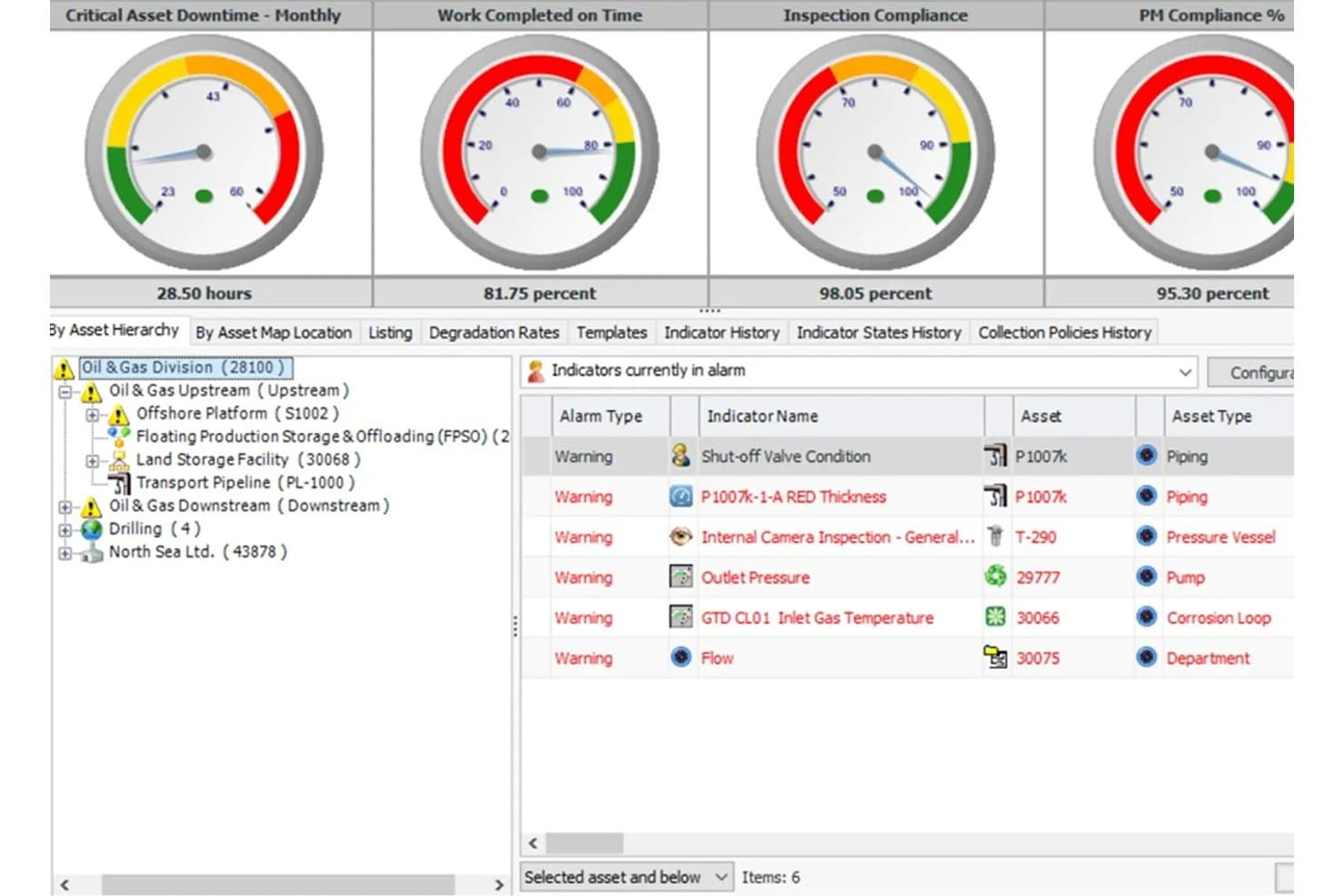
AssetWise centralizes asset health alerts and KPI gauges in one dashboard. AssetWise is Bentley Systems' modular asset performance management suite built on a digital twin platform, combining RCM, RBI, condition monitoring, predictive analytics, and asset lifecycle information management for infrastructure-intensive industries.
Who Is AssetWise Best For?
AssetWise is built for asset-intensive industries like oil & gas, utilities, and rail, where formal RCM and RBI programs are a regulatory and operational necessity.
Why I Picked AssetWise
AssetWise earns its spot on my shortlist because no other platform in this category matches its depth for formal RCM and RBI programs in infrastructure-heavy environments. I'm particularly impressed by its RBI tooling for static equipment like pressure vessels and piping, which runs probabilistic failure assessments against ISA 84 and IEC 61511 standards. On top of that, its iTwin digital twin platform carries engineering models from the capital project phase directly into operations, so your reliability team isn't working from degraded or disconnected asset data.
AssetWise Key Features
- Root cause analysis (RCA) tools: Build fault trees and fishbone diagrams to trace equipment failures back to their fundamental causes.
- Atmospheric storage tank (AST) analysis: Runs probability and consequence assessments on storage tanks to calculate remaining life and schedule surveys.
- APM Inspections mobile app: Lets field technicians capture gauge readings, photos, and barcode scans offline, then sync work requests when reconnected.
- Management of Change (MOC) workflows: Tracks and controls engineering change requests across the asset lifecycle within the centralized ALIM registry.
AssetWise Integrations
AssetWise has certified integrations with SAP, IBM Maximo, and Oracle eAM, plus integrations with Ellipse and Power BI. It connects to Sensemetrics and offers a REST API with TLS 1.2 for custom integrations.
Pros and Cons
Pros:
- Proven performance in infrastructure industries
- Deep RCM and RBI compliance support
- Digital twin integration for engineering continuity
Cons:
- Implementation complexity slows initial deployment
- End-to-end work orders require external EAM
Learn more about AssetWise:

Cordant visualizes asset risk across categories in a unified dashboard. Cordant is Baker Hughes' industrial APM platform built on the Bently Nevada System 1 condition monitoring engine, combining asset health monitoring, reliability strategy development, defect elimination, and mechanical integrity management for heavy industrial equipment.
Who Is Cordant Best For?
Cordant is built for reliability engineers and maintenance teams in oil and gas, LNG, petrochemical, and heavy process industries managing large fleets of rotating equipment.
Why I Picked Cordant
I picked Cordant as one of the best because no other APM platform pairs 60+ years of Bently Nevada condition monitoring heritage with a library of 247+ pre-built failure modes built specifically for rotating equipment like compressors, turbines, and pumps. I love how System 1's continuous autonomous monitoring captures vibration and process data at up to one sample per second, with sub-second alarm capture during startups, giving reliability engineers in oil and gas the signal fidelity they actually need. The hybrid AI and physics-based analytics layer then translates raw readings into prescriptive advisories, so my team isn't just seeing anomalies but getting ranked, actionable guidance on what to fix first.
Cordant Key Features
- Defect elimination workflows: Identifies cause-and-effect relationships across problems, events, and incidents, then tracks corrective actions through to resolution with multiple RCA methodologies.
- Production loss accounting: Sets production targets by plant, product, and period, then automatically quantifies and classifies losses to surface performance gap drivers.
- Asset strategy scenario modeling: Builds financially optimized reliability strategies with performance, cost, and risk scenario comparisons to support maintenance investment decisions.
- Energy and sustainability management: Tracks energy consumption and emissions at the individual asset and plant level to support ESG reporting and identify underperforming equipment.
Cordant Integrations
Cordant integrates with SAP PM, IBM Maximo, OSIsoft PI, Honeywell Uniformance, and OPC UA/DA data sources. It’s also available through Microsoft Azure Marketplace and connects with Bently Nevada System 1 hardware.
Pros and Cons
Pros:
- Unified platform for health, strategy, integrity
- Prescriptive maintenance powered by hybrid analytics
- Deepest rotating equipment monitoring expertise
Cons:
- Requires external CMMS for work order management
- No native mobile field execution capability
Learn more about Cordant: Best for industrial-scale OT/IT data convergence
- Free demo available
- Pricing upon request
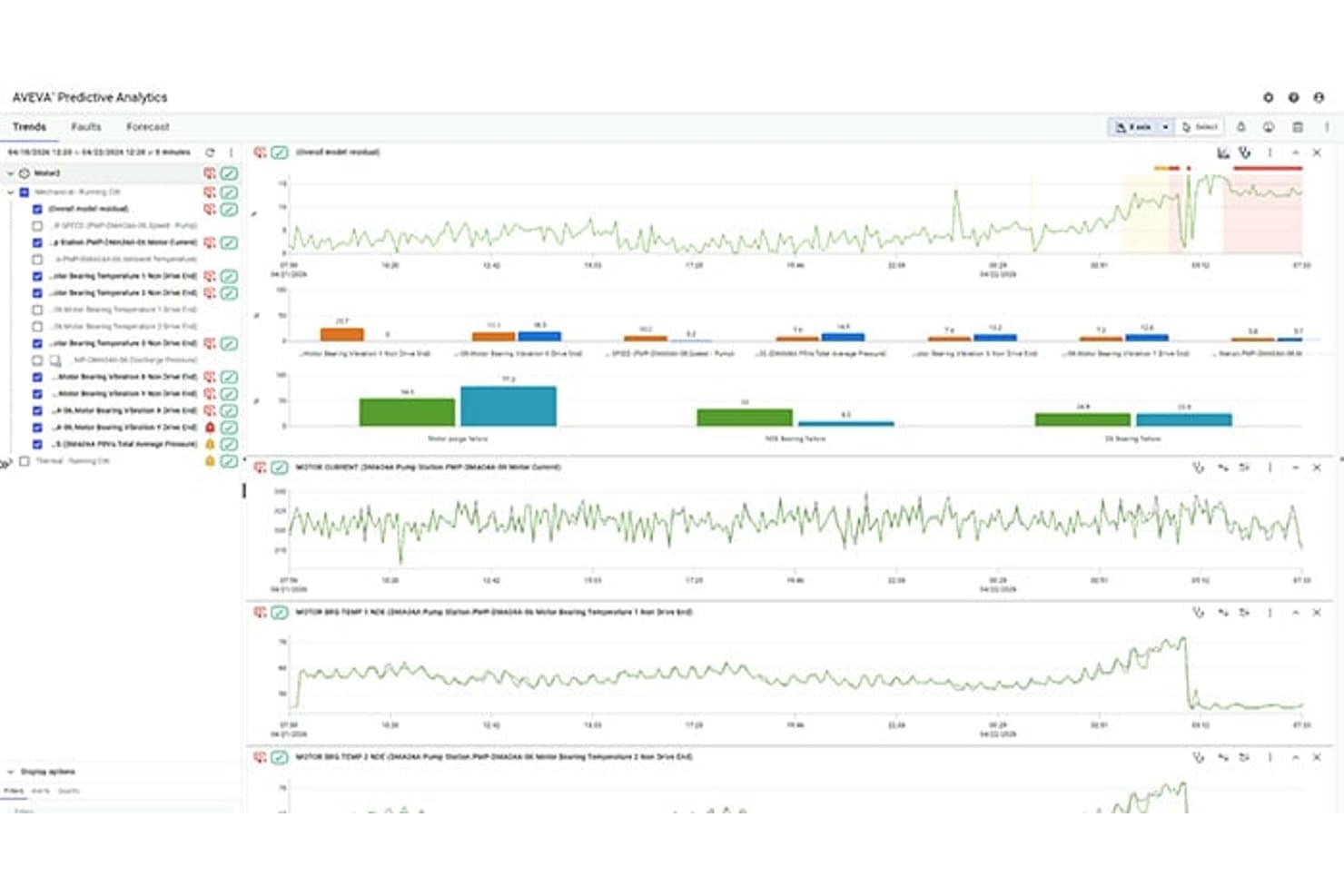
AVEVA APM tracks equipment trends and fault predictions over time. AVEVA APM is an industrial asset performance management platform built around the PI System data infrastructure, combining real-time condition monitoring, AI-driven predictive analytics, OT/IT data integration, and enterprise-scale asset contextualization across edge, on-premises, and cloud environments.
Who Is AVEVA APM Best For?
AVEVA APM is a strong fit for large industrial operators in oil and gas, power, pharma, and mining who need to unify OT and IT data at enterprise scale.
Why I Picked AVEVA APM
I've included AVEVA APM in my top picks because no other platform comes close to its depth of OT/IT data convergence at industrial scale. The PI Server Asset Framework contextualizes raw sensor data from up to 20 million tags into structured asset hierarchies, giving operations and IT teams a shared data layer across sites. Paired with AVEVA Predictive Analytics, that same infrastructure feeds ML-based early warning models, like the ones TotalEnergies used to save €1.5M and avoid 64 days of unplanned downtime in a single year.
AVEVA APM Key Features
- PI Server Asset Framework: Models raw sensor data into structured, multi-level asset hierarchies with metadata templates, criticality attributes, and relational context across enterprise sites.
- Event Frames: Captures and analyzes repeatable operational events—batches, shifts, downtime periods—and links them directly to process data for root-cause analysis and OEE reporting.
- AVEVA Edge Data Store: Collects and buffers industrial data at the edge in remote or harsh environments, maintaining data continuity during network disruptions before syncing to central or cloud archives.
- PI Integrator for Business Analytics: Pushes time-series asset data from PI Server into enterprise BI tools like Power BI and Tableau, as well as cloud data lakes on Azure and AWS.
AVEVA APM Integrations
AVEVA APM integrates with SAP, Microsoft Power BI, Tableau, Azure, AWS, and Databricks through connectors, PI Integrator, APIs, and SDKs. It also connects to industrial sources through OPC UA, MQTT, and Modbus, with CMMS/EAM connections available via APIs and PI notifications.
Pros and Cons
Pros:
- Tiered dashboards show real-time and historical KPIs
- Enables prescriptive analytics with AI models
- Scales to 20 million data tags
Cons:
- Complex setup effort for large environments
- No native work order management module
Learn more about AVEVA APM: Best for SAP-native closed-loop EAM execution
- Free demo available
- From $295/month

SAP Supply Chain tracks asset inspection recommendations with risk and status views. SAP Asset Performance Management is an enterprise-grade APM solution that combines embedded IoT connectivity, AI-driven predictive analytics, RCM and FMEA methodologies, and closed-loop work order execution within the SAP ecosystem.
Who Is SAP Supply Chain Best For?
SAP Asset Performance Management is built for large enterprises in asset-intensive industries—energy, oil & gas, utilities, and manufacturing—that are already running SAP EAM and need a predictive maintenance layer that feeds directly back into their existing work order environment.
Why I Picked SAP Supply Chain
SAP Asset Performance Management earns its spot on my shortlist because it's the only APM tool I've found that closes the loop directly inside SAP EAM, turning a failure prediction into a live work order without any middleware in between. I particularly like how Weibull-based failure curve analytics and RUL estimation feed directly into automated maintenance notifications, so reliability engineers aren't just seeing predictions but acting on them within the same system. The embedded Cumulocity IoT layer adds native OPC UA connectivity, letting you pull sensor streams from PLCs and SCADA systems straight into the APM application.
SAP Supply Chain Key Features
- Risk and criticality assessment: Standardized templates calculate risk and criticality scores across impact categories to classify assets and derive appropriate maintenance strategies.
- AI-assisted visual inspection: Computer vision analyzes images collected from cameras and drones to detect wear indicators and automatically generate maintenance alerts.
- Failure curve analytics: Weibull-based statistical models visualize asset degradation trends and failure probabilities to support maintenance planning decisions.
- Joule AI assistant: A natural language interface lets reliability engineers query asset data and surface maintenance insights without navigating complex dashboards.
SAP Supply Chain Integrations
SAP Asset Performance Management offers native integrations with SAP S/4HANA Cloud, SAP ERP, and embedded Cumulocity IoT. It connects to industrial systems through OPC UA, data historians, data lakes, and SCADA or DCS environments.
Pros and Cons
Pros:
- Built-in RCM and FMEA methodologies
- Native AI-driven visual and sensor analytics
- Direct work order execution inside SAP EAM
Cons:
- Implementation can take several months
- Requires existing SAP EAM environment
Learn more about SAP Supply Chain: Best for AI-driven predictive maintenance at scale
- Free demo available
- Pricing upon request

IBM Maximo Application Suite tracks asset health, risk, and failure metrics in real time. IBM Maximo Application Suite is an enterprise asset performance management platform that combines EAM, IoT condition monitoring, AI-driven predictive maintenance, mobile field execution, and RCM strategy management in a single suite.
Who Is IBM Maximo Application Suite Best For?
IBM Maximo Application Suite is built for large enterprises in asset-intensive industries—utilities, oil and gas, transportation, and nuclear—that need AI-driven predictive maintenance and IoT condition monitoring across thousands of assets and multiple sites.
Why I Picked IBM Maximo Application Suite
IBM Maximo Application Suite earns its spot on my shortlist because of how far its AI-driven predictive maintenance goes beyond basic alerting. Maximo Predict runs five distinct ML models simultaneously, including one that forecasts the specific date an asset is likely to fail, so maintenance teams can schedule interventions before breakdown rather than reacting to it. I'm also impressed by Condition Insight, which maps that failure forecast directly to FMEA-based prescribed actions and surfaces the recommendation in plain language, no data science background required.
IBM Maximo Application Suite Key Features
- Maximo Monitor IoT ingestion: Pulls near-real-time data from SCADA systems, data historians, BMS, and MES sources via an Edge Data Collector, with AI anomaly detection built in.
- RCM Strategy Builder: An AI agent that helps you build FMEA frameworks and maintenance strategy workflows, backed by a library of 800 asset types and 58,000 failure modes.
- Maximo Assist AR troubleshooting: Gives field technicians AI-powered guidance and augmented reality collaboration with remote experts, with support for 22 languages.
- Multi-org asset registry: Maintains a hierarchical, multi-site asset registry with industry-specific data models for verticals like Nuclear, Oil & Gas, Aviation, and Utilities.
IBM Maximo Application Suite Integrations
IBM Maximo Application Suite offers documented integrations with SAP S/4HANA, Oracle Applications, AVEVA PI, Ignition SCADA, ESRI ArcGIS, IBM Envizi, and IBM TRIRIGA. Open APIs and IBM App Connect support custom connectivity across OT, ERP, GIS, and ESG systems.
Pros and Cons
Pros:
- Deep library for regulated industry failure modes
- Prescriptive maintenance using five ML models
- Real-time anomaly detection with AI explanation
Cons:
- User interface remains cluttered despite redesign
- System setup and rollout are highly complex
Learn more about IBM Maximo Application Suite: Best for asset-intensive industrial AI maintenance
- Free demo available
- Pricing upon request

IFS Cloud EAM tracks supplier invoice spend and analysis over time. IFS Cloud EAM is an enterprise asset management platform that combines real-time asset health monitoring, AI-driven predictive maintenance, work order management, and IoT integration for asset-intensive industrial environments.
Who Is IFS Cloud EAM Best For?
IFS Cloud EAM is a strong fit for asset-intensive industries like energy, mining, aerospace, and manufacturing that need enterprise-grade AI-driven maintenance at scale.
Why I Picked IFS Cloud EAM
IFS Cloud EAM earns its spot on my shortlist because no other platform embeds Industrial AI this deeply into asset-intensive maintenance workflows. I particularly like the Copilot-assisted FMECA, which walks reliability engineers through failure mode analysis and auto-generates maintenance strategies from historical asset data. Pair that with condition-based maintenance triggers and explainable AI recommendations, and you get a system built specifically for environments where an unplanned failure means a downed wind farm or a grounded aircraft fleet.
IFS Cloud EAM Key Features
- Asset investment planning: Copperleaf-powered capital planning tools let you rank assets by risk, model investment scenarios, and prioritize maintenance spend across your portfolio.
- Integrated 3D visualization: Navigate interactive 3D models of physical assets to validate conditions and trigger work orders directly from the visual interface.
- Sustainability management module: Track, collect, and report ESG data against a CSRD-aligned KPI catalog, with tools for goal-setting and disclosure reporting.
- Mobile field execution: Field technicians can update asset status, log work, and capture images from a mobile interface that syncs in real time with the core platform.
IFS Cloud EAM Integrations
IFS Cloud EAM has native integrations across IFS Cloud, including IFS ERP, IFS Field Service Management, IFS Supply Chain Management, and Copperleaf. It also connects with Crosser, OPC-UA, and SCADA systems, with APIs for custom integrations.
Pros and Cons
Pros:
- 3D asset visualization for work order validation
- Asset-based pricing aligns with operational needs
- Predictive maintenance uses embedded industrial AI
Cons:
- Advanced analytics require additional licensed modules
- Implementation projects are often lengthy and complex
Learn more about IFS Cloud EAM: Best for digital twin-driven predictive analytics
- Not available
- Pricing upon request

ABB Genix APM tracks asset health metrics like availability and MTBF. ABB Genix APM is an industrial asset performance management platform that combines predictive analytics, digital twin modeling, AI-driven diagnostics, and performance KPI reporting across rotating, electrical, and static equipment.
Who Is ABB Genix APM Best For?
ABB Genix APM is a strong fit for large industrial operators in oil & gas, power generation, utilities, and mining who need AI-driven predictive analytics across complex, multi-site asset portfolios.
Why I Picked ABB Genix APM
ABB Genix APM earns its spot on my shortlist because of how far its digital twin capability goes beyond basic condition monitoring. The Predict 360 module builds genuine digital twins by combining physics-based and AI/ML models, so I can simulate failure scenarios for a compressor or heat exchanger before anything breaks in the real world. Layered on top, the Genix APM Copilot uses LLMs to answer natural-language questions like "what failure mode caused this pressure drop" and automatically generates work requests in connected CMMS systems.
ABB Genix APM Key Features
- Assess 360 asset integrity tracking: Monitors asset risk categories, failure mechanisms, and lifecycle status across 120+ pre-built asset models with OPEX/CAPEX financial analytics built in.
- Opportunity Loss Manager: Quantifies production losses in measurable terms, giving operations teams a direct view of performance gaps tied to specific assets.
- System Anomaly Detection: Identifies abnormal asset behavior across OT data sources using configurable thresholds and NAMUR NE107 health scoring for early warning.
- Flexible deployment architecture: Supports on-premise, ABB-managed cloud, and customer-managed cloud configurations, including air-gapped environments for OT security compliance.
ABB Genix APM Integrations
ABB Genix APM integrates with ABB System 800xA, Symphony Plus, OPC UA, Modbus TCP, OSIsoft PI, and AVEVA PI. It also connects with Azure, IoT devices, and external CMMS/EAM systems through its industrial data architecture.
Pros and Cons
Pros:
- Copilot uses LLMs for root-cause analysis
- Over 120 pre-built industrial asset models
- Digital twin simulation for failure prediction
Cons:
- Most work orders depend on CMMS integration
- Lack of pricing transparency before sales contact
Learn more about ABB Genix APM: Best for industrial-scale predictive analytics
- Free demo available
- Pricing upon request
GE Vernova visualizes asset risk levels using a color-coded risk matrix. GE Vernova APM is an industrial asset performance management platform that combines AI-powered anomaly detection, predictive analytics, mechanical integrity management, and reliability engineering tools across a modular, cloud-native architecture.
Who Is GE Vernova Best For?
GE Vernova APM is a strong fit for large industrial enterprises in oil & gas, power generation, and heavy manufacturing that run multi-site operations and need mature AI-driven failure prediction at scale.
Why I Picked GE Vernova
GE Vernova APM earns its spot on my shortlist because SmartSignal's similarity-based ML models have been trained over 20+ years of industrial failure data, giving it failure detection lead times measured in weeks or months rather than hours. I'm particularly impressed by the digital twin blueprints, which map tag configurations to known failure modes across rotating equipment and turbines without custom scripting. The Monte Carlo simulations in the APM Reliability module add another layer, letting reliability engineers model maintenance strategy tradeoffs before committing to a schedule.
GE Vernova Key Features
- Autonomous Inspection: Uses computer vision and AI to automate visual inspection tasks like gauge reading and corrosion detection directly from image captures.
- APM Integrity module: Manages mechanical integrity and risk-based inspection workflows, including mobile documentation via the Integrity Mobile app.
- CERius emissions tracking: Monitors Scope 1, 2, and 3 emissions data and ties asset-level performance to ESG reporting requirements.
- Bi-directional EAM integration: Syncs with SAP, IBM Maximo, and Oracle to automatically trigger and schedule work orders when analytics detect an issue.
GE Vernova Integrations
GE Vernova APM offers native integrations with SAP, IBM Maximo, Oracle, and Proficy Historian, plus connections to OSIsoft PI/AVEVA PI. It supports custom connectivity through REST APIs, OPC UA, MQTT, Kafka, and APM Connect.
Pros and Cons
Pros:
- Supports large-scale, multi-site deployments
- Digital twin blueprints require no custom scripting
- Delivers weeks-to-months advance failure prediction
Cons:
- Some users report integration challenges with legacy systems
- Implementation often requires significant technical resources
Learn more about GE Vernova:
Outro software de gestão do desempenho de ativos
Eis algumas opções adicionais de software de gestão do desempenho de ativos que não integraram a minha lista restrita, mas que ainda vale a pena conhecer:
- 11Attune APMBest for pre-built asset twin model libraries
- 12Cognite Data FusionBest for IT/OT data convergence at industrial scale
- 13FiixBest for CMMS-rooted APM with Rockwell OT sync
- 14eMaintBest for CMMS-rooted condition-based maintenance
- 15MaintainXBest for mobile-first maintenance across multiple sites
- 16AspenTechBest for process-industry failure prediction
- 17Oracle Fusion Cloud MaintenanceBest for Oracle ERP-native asset lifecycle management
- 18Siemens AdvantaBest for edge-to-cloud APM in Siemens OT environments
How I Evaluate Asset Performance Management Software
I split my evaluation into baseline capabilities every serious APM platform must cover and the differentiators that separate tools built for real industrial complexity from those that just check boxes.
Core Functionality (Table Stakes For This List)
When I'm selecting tools for my list, I rank each one on a scale from 0 (does not offer the functionality) to 5 (excels in this area) for each core functionality listed below. I then calculate the tool's total score into a percentage, using 65% as a benchmark to help assess its overall fit for the list.
- Asset health monitoring: I evaluate how each tool ingests real-time sensor and IoT data to track operating parameters like vibration, temperature, and pressure across connected assets.
- Predictive maintenance analytics: ML-driven failure prediction and remaining useful life estimates are what I look for, not just threshold-based alerts or static scheduling rules.
- Centralized asset registry: I check whether the platform maintains a structured, hierarchical asset database with criticality rankings, lifecycle status, and support for taxonomies like ISO 14224.
- Work order management: The link between detected asset conditions and automated work order generation matters here, including mobile execution and parts integration in the field.
- Performance and reliability reporting: Dashboards covering KPIs like OEE, MTBF, MTTR, and availability across multiple sites tell me how well a platform supports data-driven reliability decisions.
- IoT and enterprise integration: I look for native connectors to SCADA, historians, ERP, and EAM/CMMS systems, plus open APIs and edge support for bi-directional data sync.
Once I have a list of tools that meet the criteria, I consider what sets each platform apart.
Differentiating Factors (What Sets Vendors Apart)
Here's how I compare and contrast different vendors:
Standout Features
I look for digital twin simulation that lets reliability teams model failure scenarios and test maintenance strategies on virtual asset replicas before committing resources in production. Edge computing support matters just as much—platforms like GE Vernova and ABB Genix APM process anomaly detection at the asset level, which is essential for remote sites with limited bandwidth or strict OT network segmentation. I also evaluate prescriptive RUL analytics, where the platform doesn't just flag a pending failure but tells a technician what to replace, when, and which parts to stage. Finally, I check for mobile field execution with offline capability and AR overlays, since work orders are useless if frontline crews can't act on them at the asset.
Beyond Features
I evaluate each vendor's deployment model against real plant network constraints—cloud-only platforms won't fly in air-gapped OT zones, so I check for hybrid and on-premise options aligned with Purdue Model segmentation. Industry-specific reference deployments matter just as much; a vendor with pre-built failure mode libraries for rotating equipment in oil and gas, like Cordant, saves months compared to building taxonomies from scratch. I also model total cost of ownership across licensing structures, since per-asset and per-tag pricing can diverge dramatically as sensor counts scale across sites.
Como escolher um software de gestão do desempenho de ativos
Ao comparar software de gestão do desempenho de ativos, a escolha certa depende do grau de alinhamento da plataforma com a complexidade dos seus ativos, as suas necessidades de conectividade e os seus objetivos de fiabilidade:
| Se a sua prioridade for… | Procure… |
|---|---|
| Se a sua prioridade for…Integração rápida com dados de OT/IT existentes | Procure…Conectores nativos para o seu SCADA, historiador e ERP |
| Se a sua prioridade for…Previsão antecipada e precisa de falhas | Procure…Aprendizagem automática integrada para calcular a vida útil remanescente (RUL) |
| Se a sua prioridade for…Análise de fiabilidade específica do setor | Procure…Bibliotecas de modelos ou taxonomias para os seus tipos de ativos |
| Se a sua prioridade for…Execução de trabalhos em áreas com largura de banda limitada | Procure…Funcionalidade móvel e de ordens de trabalho sem ligação |
| Se a sua prioridade for…Operações seguras em redes isoladas | Procure…Opções de implementação no local ou híbrida |
Como avaliar a sua lista restrita
- Teste as alegações de integração nativa: Peça uma demonstração em direto de 1 hora que mostre a ingestão de dados do seu sistema de OT/IT real ou de amostra.
- Verifique o desempenho da aprendizagem automática: Peça um caso documentado que compare a precisão da RUL com registos de manutenção reais.
- Verifique a cobertura de ativos do setor: Peça uma lista completa dos modelos de ativos pré-configurados ou dos modelos de taxonomia para as suas classes de ativos.
- Demonstre o suporte móvel sem ligação: Faça um teste que consista em gerar e concluir uma ordem de trabalho com a rede desativada num dispositivo móvel.
- Pondere a flexibilidade de implementação face à facilidade de atualização: Decida se precisa de uma implementação no local/híbrida para locais seguros ou da nuvem para obter atualizações mais rápidas do fornecedor.
O que é o software de gestão do desempenho dos ativos?
O software de gestão do desempenho dos ativos é uma plataforma que combina dados de TI e TO para monitorizar, analisar e prever o estado, a fiabilidade e as necessidades de manutenção dos ativos físicos. Estas ferramentas ajudam a reduzir o tempo de inatividade, a otimizar os calendários de manutenção e a prolongar a vida útil dos ativos, transformando os dados dos sensores e operacionais em informações práticas. Esta abordagem apoia as equipas responsáveis pela fiabilidade, manutenção e operações digitais em ambientes complexos.
Funcionalidades
Ao selecionar um software de gestão do desempenho dos ativos, procure as seguintes funcionalidades principais:
- Monitorização do estado dos ativos: Monitoriza os dados dos sensores e dos equipamentos em tempo real, como a temperatura, a vibração e a pressão, para que possa detetar problemas atempadamente e compreender o estado do equipamento num relance.
- Análise de manutenção preditiva: Utiliza dados históricos e em tempo real para identificar tendências e prever quando será provável que o equipamento necessite de manutenção, ajudando a evitar avarias e a reduzir as reparações reativas.
- Registo centralizado de ativos: Disponibiliza uma base de dados estruturada de todos os ativos da empresa, incluindo o estado atual, as especificações, o histórico de manutenção e a criticidade, facilitando a gestão de grandes inventários.
- Gestão de ordens de trabalho: Liga os dados do estado dos ativos à criação automatizada ou manual de ordens de trabalho, atribui tarefas às equipas e acompanha o progresso até à conclusão, garantindo que a manutenção é realizada quando necessário.
- Relatórios de desempenho e fiabilidade: Cria painéis e relatórios que apresentam métricas importantes, como o tempo médio entre falhas (MTBF) e o tempo médio de reparação (MTTR), permitindo medir e melhorar os programas de fiabilidade.
- Integração com a IoT e com os sistemas: Liga-se a sistemas SCADA, historiadores, ERP e outros sistemas empresariais para unificar os dados operacionais e empresariais, garantindo que o planeamento da manutenção dispõe de todo o contexto necessário.
- Acesso móvel no terreno: Permite aos técnicos consultar os históricos dos ativos, receber ordens de trabalho e atualizar estados a partir dos seus dispositivos móveis, mesmo no terreno ou em áreas com conectividade reduzida.
- Gestão do ciclo de vida: Acompanha os ativos desde a colocação em serviço até à desativação, permitindo planear eficazmente substituições, atualizações e projetos de capital.
- Conformidade e registo de auditoria: Mantém registos digitais de manutenção, inspeções e calibrações, apoiando as normas do setor e simplificando as auditorias.
- Controlos de funções e permissões dos utilizadores: Oferece um controlo granular sobre quem pode consultar, editar ou agendar tarefas e visualizar dados sensíveis dos ativos, protegendo informações e fluxos de trabalho críticos.
Funcionalidades comuns de IA
Para além das funcionalidades padrão do software de gestão do desempenho dos ativos acima mencionadas, muitas destas soluções estão a incorporar IA com funcionalidades como:
- Deteção automatizada de anomalias: Os modelos de IA analisam os dados dos sensores em tempo real para detetar padrões invulgares ou desvios em relação às condições normais de funcionamento, assinalando problemas que os alertas tradicionais baseados em limiares podem não identificar. Isto ajuda a detetar problemas subtis antes que se agravem.
- Previsão dos modos de falha: A IA prevê modos de falha específicos através da aprendizagem com avarias históricas e registos de manutenção, permitindo antecipar não só quando um ativo poderá falhar, mas também como e por que motivo é provável que isso aconteça.
- Recomendações prescritivas de manutenção: A IA vai além da previsão de falhas, sugerindo a ação de manutenção ideal, o momento adequado e as peças necessárias, ajudando a equipa a dar prioridade às ordens de trabalho e a reduzir intervenções desnecessárias.
- Pontuação dinâmica do risco: A IA avalia continuamente o risco dos ativos, tendo em conta os dados em tempo real, o desempenho histórico e as condições ambientais, fornecendo um perfil de risco atualizado para cada ativo e apoiando uma melhor tomada de decisões.
- Análise automatizada da causa-raiz: A IA analisa grandes volumes de dados operacionais para identificar as causas subjacentes de problemas recorrentes, ajudando a resolver problemas sistémicos em vez de tratar apenas os sintomas.
Benefícios
A implementação de um software de gestão do desempenho dos ativos proporciona vários benefícios à sua equipa e à sua empresa. Eis alguns dos benefícios que pode esperar:
- Redução do tempo de inatividade não planeado: A monitorização do estado dos ativos em tempo real e a análise da manutenção preditiva permitem-lhe identificar os riscos atempadamente, para que possa agendar a manutenção antes de ocorrerem falhas.
- Prolongamento da vida útil dos ativos: Os registos centralizados de ativos e as ferramentas de gestão do ciclo de vida ajudam-no a planear substituições, atualizações e manutenção com base no histórico e no estado exatos dos ativos.
- Otimização dos calendários de manutenção: A aprendizagem automática e as recomendações prescritivas permitem-lhe dar prioridade ao trabalho certo nos ativos certos, reduzindo intervenções desnecessárias e os custos de manutenção.
- Maior fiabilidade e eficiência: Os painéis de desempenho e os relatórios de fiabilidade fornecem informações práticas sobre métricas como o MTBF e o MTTR, ajudando-o a identificar áreas a melhorar.
- Melhoria da conformidade e da preparação para auditorias: O acompanhamento automatizado das ordens de trabalho e os registos digitais de auditoria mantêm-no preparado para as verificações regulamentares, documentando as atividades de manutenção e as inspeções.
- Melhor integração com os sistemas existentes: As integrações de IoT e empresariais ligam os seus sistemas SCADA, ERP e de histórico, para que todos os seus dados operacionais e de manutenção permaneçam sincronizados.
- Equipas móveis de campo mais autónomas: O acesso móvel e sem ligação às ordens de trabalho mantém os técnicos produtivos no terreno — mesmo quando a conectividade é limitada — garantindo que as tarefas urgentes não sofrem atrasos.
Custos e preços
A seleção de software de gestão do desempenho dos ativos exige uma compreensão dos vários modelos de preços e planos disponíveis. Os custos variam consoante as funcionalidades, a dimensão da equipa, os complementos, entre outros fatores. A tabela abaixo resume os planos comuns, os respetivos preços médios e as funcionalidades normalmente incluídas nas soluções de software de gestão do desempenho dos ativos:
Tabela de comparação de planos de software de gestão do desempenho dos ativos
| Tipo de plano | Preço médio | Funcionalidades comuns |
|---|---|---|
| Tipo de planoPlano gratuito | Preço médio$0 | Funcionalidades comunsRegisto básico de ativos, monitorização limitada do estado dos ativos, gestão inicial de ordens de trabalho e relatórios básicos. |
| Tipo de planoPlano pessoal | Preço médio$50–$200/mês | Funcionalidades comunsMonitorização de ativos para equipas pequenas, criação de ordens de trabalho, análise preditiva limitada e acesso móvel para um número reduzido de utilizadores. |
| Tipo de planoPlano empresarial | Preço médio$500–$2,000/mês | Funcionalidades comunsRegisto de ativos em vários locais, integração de IoT, relatórios avançados, acesso móvel no terreno e automatização de fluxos de trabalho para equipas de média dimensão. |
| Tipo de planoPlano empresarial avançado | Preço médio$2,000–$10,000+/mês | Funcionalidades comunsRegisto ilimitado de ativos, análise da manutenção preditiva, informações baseadas em IA, integração através de API, painéis personalizados e suporte completo. |
Perguntas frequentes sobre software de gestão do desempenho de ativos
Eis algumas respostas a perguntas comuns sobre software de gestão do desempenho de ativos:
Como posso saber se o software de gestão do desempenho de ativos é compatível com o meu equipamento ou setor específico?
Terá de verificar se existem modelos de ativos ou taxonomias predefinidos que correspondam ao seu equipamento e às normas do seu setor. Peça aos fornecedores uma lista dos tipos de ativos compatíveis e confirme se disponibilizam implementações de referência para o seu setor, como o petróleo e gás ou os serviços públicos. A solução adequada deverá incluir bibliotecas de modos de falha ou modelos analíticos adaptados às suas classes de ativos.
O software de gestão do desempenho de ativos pode funcionar em ambientes isolados ou de alta segurança?
Sim, mas deverá confirmar se o software suporta opções de implementação local ou híbrida. As plataformas exclusivamente na nuvem não conseguem funcionar em redes OT desligadas. Procure soluções concebidas para a segmentação do Modelo Purdue e que não exijam acesso permanente à Internet para as operações diárias.
Que integrações devo priorizar ao avaliar software de gestão do desempenho de ativos?
Concentre-se nas integrações com os seus sistemas SCADA, bases de dados históricas, EAM/CMMS e ERP existentes. Os conectores nativos e as APIs abertas permitem centralizar os dados operacionais e empresariais. Deverá também confirmar se a ferramenta suporta a sincronização de dados em tempo real e o carregamento em lote para ambientes legados ou com largura de banda limitada.
Como posso avaliar as capacidades de manutenção preditiva de uma plataforma?
Peça uma demonstração que mostre a ingestão dos seus dados em tempo real e solicite estudos de caso com a precisão documentada das previsões de RUL (vida útil restante). Procure análises baseadas em ML que vão além dos limiares estáticos e confirme se a plataforma fornece recomendações acionáveis e prescritivas — não apenas alertas.
Quais são alguns custos ocultos que devo ter em conta no software de gestão do desempenho de ativos?
Esteja atento aos modelos de preços por ativo ou por etiqueta, uma vez que os custos podem aumentar rapidamente quando amplia a cobertura dos sensores. Considere também as taxas de implementação, personalização e integração, bem como quaisquer custos adicionais de funcionalidades como o acesso móvel, os relatórios ou as integrações de terceiros. Não se esqueça de contabilizar o suporte e a formação contínuos.