

As ferramentas de geração de SBOM ajudam a criar uma lista detalhada de materiais de software (SBOM) que apresenta todos os componentes das suas aplicações, permitindo acompanhar dependências de software, vulnerabilidades e riscos de conformidade. Se procura as melhores ferramentas de geração de SBOM, provavelmente precisa de reforçar a segurança da cadeia de fornecimento, simplificar auditorias ou cumprir novos requisitos regulamentares.
A escolha certa pode poupar-lhe muito trabalho manual de pesquisa e ajudá-lo a identificar ameaças ou lacunas antes de estas perturbarem os seus sistemas. Esta lista apresenta as principais opções, os seus pontos fortes e a forma como se adaptam aos fluxos de trabalho reais de TI e segurança, para que possa tomar uma decisão informada para a sua equipa.
Why Trust Our Software Recommendations
6,700+
Reviews
20
Industry experts
16+
Evaluation factors
14
Years
Our team has been testing and reviewing software since 2012. As tech leaders ourselves, we know how difficult—and important—it is to choose the right software.
For this guide, we evaluated tools using hands-on testing and independent research, scoring tools using our selection criteria.
Our reviews reflect our human editorial judgment, not a sales pitch.
Expert reviewers:
- Paulo Gardini MiguelTech Director
 Tim FisherVP of AI
 Gabriel RosasTech Lead & Software Architect
 Christhian GruhnTech Lead & Platform Architect

Tabela de comparação: ferramentas de geração de SBOM
Esta tabela de comparação apresenta os preços das principais ferramentas de geração de SBOM.
| Tool | Best For | Trial Info | Price | ||
|---|---|---|---|---|---|
| 1 | Best for reviewing supplier and in-house SBOMs | Free plan available | From $350/month | Website | |
| 2 | Best for reachability-driven SBOM prioritization | Free demo available | Up to $1,000/dev/year (billed annually) | Website | |
| 3 | Best for shifting SBOM left in dev workflows | Free trial available | Pricing upon request | Website | |
| 4 | Best for firmware and device security | Free demo available | Pricing upon request | Website | |
| 5 | Best for multi-language codebase scanning | Not available | Free forever | Website | |
| 6 | Best for unified open source scanning capabilities | Not available | Free forever | Website | |
| 7 | Best for policy-driven risk management | Free demo available | Pricing upon request | Website | |
| 8 | Best for synchronized artifact tracking | Free demo available | From $1,200/year | Website | |
| 9 | Best for continuous component risk analysis | Not available | Free forever | Website | |
| 10 | Best for automated vulnerability insights | 14-day free trial + free demo available | Pricing upon request | Website |


Avaliações das melhores ferramentas de geração de SBOM
Segue-se um resumo detalhado das melhores ferramentas de geração de SBOM que entraram na minha lista final. As minhas avaliações analisam detalhadamente as capacidades, integrações e melhores casos de utilização de cada ferramenta, para o ajudar a encontrar a mais adequada para si.
 Best for reviewing supplier and in-house SBOMs
- Free plan available
- From $350/month
Visit WebsiteCustomer Rating:4.7/5
Aikido Security surfaces CVE details and fix paths per dependency. Aikido Security is a code security platform that combines SCA, SAST, secrets detection, IaC scanning, and container scanning with one-click SBOM generation, license risk analysis, and export in SPDX, CycloneDX, and CSV formats.
Who Is Aikido Security Best For?
Aikido Security is a strong fit for DevSecOps teams that need to manage and review SBOMs across both their own codebases and third-party supplier components in one place.
Why I Picked Aikido Security
I picked Aikido Security as one of the best because it handles both sides of SBOM review in one place: your own repositories and supplier-uploaded SBOMs. I particularly like that you can upload a vendor-generated SBOM via API and Aikido immediately scans it for vulnerabilities and license risks, which is exactly what you need during procurement or M&A due diligence. Its license risk scoring goes beyond flagging issues by providing plain-language obligation explanations, so your team knows what action to take.
Aikido Security Key Features
- Reachability analysis: Evaluates whether your code actually reaches a vulnerable dependency's affected functionality, so you can prioritize fixes that matter.
- Multi-ecosystem SCA scanning: Scans direct and transitive dependencies across languages including JavaScript, Python, Java, Go, Rust, and more than a dozen others.
- CI/CD security gating: Blocks pull or merge requests when new issues meet a configured severity threshold, with support for GitHub, GitLab, Bitbucket, and Azure.
- VEX export in CycloneDX: Includes optional Vulnerability Exploitability eXchange analysis in CycloneDX exports to communicate which vulnerabilities are exploitable versus not applicable.
Aikido Security Integrations
Aikido Security offers integrations with GitHub, GitLab, Bitbucket, Azure Pipelines, CircleCI, Jenkins, Jira, Linear, Slack, and Microsoft Teams. It also provides REST API access and webhooks for custom SBOM workflows.
Pros and Cons
Pros:
- Supplier SBOM uploads receive vulnerability and license scans
- Plain-language license explanations support procurement reviews
- Reachability analysis helps prioritize exploitable vulnerabilities
Cons:
- Yocto SBOMs require manual file merging
- No confirmed per-build SBOM export
Learn more about Aikido Security: Best for reachability-driven SBOM prioritization
- Free demo available
- Up to $1,000/dev/year (billed annually)
Visit WebsiteCustomer Rating:4.7/5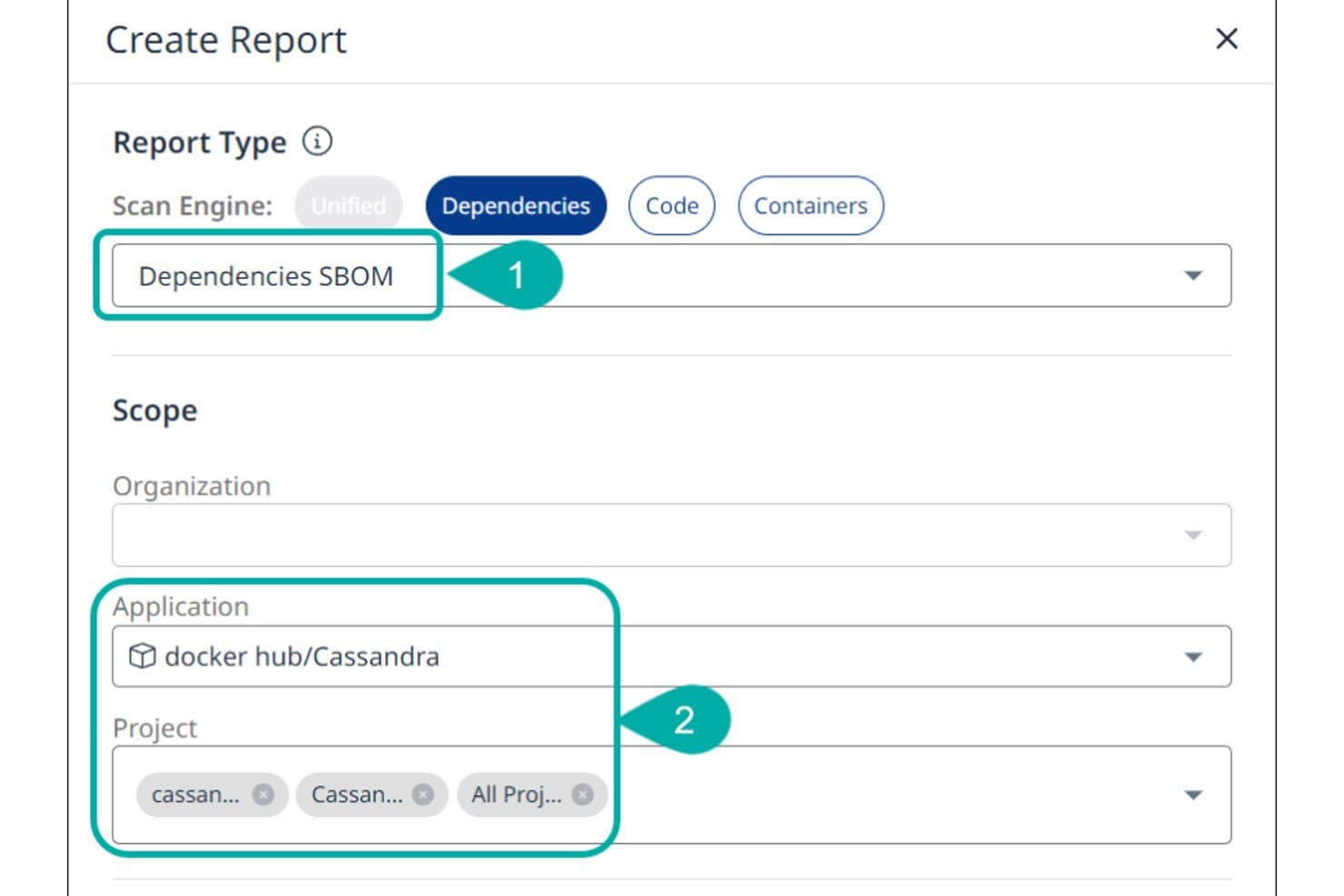
Mend.io lets users generate a Dependencies SBOM report by application and project. Mend is an application security platform that unifies SAST, SCA, and container scanning to generate, manage, and continuously update SBOMs in both SPDX and CycloneDX formats across your full dependency graph.
Who Is Mend.io Best For?
Mend is a strong fit for security and DevSecOps teams that need to move beyond raw vulnerability counts and prioritize open-source risk based on whether vulnerable code is actually reachable in their applications.
Why I Picked Mend.io
I picked Mend.io as one of the best because its reachability analysis sets it apart from tools that just dump a flat list of CVEs. Mend SCA traces whether your application code actually calls into a vulnerable dependency function, so you're triaging genuine exposure rather than theoretical risk. It then maps those reachability states directly to VEX properties in CycloneDX exports, marking unreachable findings as
not_affectedwithcode_not_reachableautomatically.Mend.io Key Features
- Multi-scope SBOM generation: Generate dependency SBOMs at the organization, application, or project level, with library- or file-level granularity and optional vulnerability inclusion.
- SPDX and CycloneDX export support: Export SBOMs in SPDX 2.2/2.3 and CycloneDX 1.4, 1.5, and 1.6 across JSON, XML, YAML, and other formats, all with PURL data included.
- Policy-as-code gating: Define policies that match libraries by license group or vulnerability severity and return exit codes to fail CI/CD builds on violations.
- Container image scanning: Scan Docker and OCI container images via the Mend CLI and export container-level SBOMs in both SPDX and CycloneDX formats.
Mend.io Integrations
Mend.io integrations include GitHub, GitLab, Azure DevOps, Bitbucket, Jenkins, Docker, JFrog Artifactory, and Amazon ECR. Mend API 3.0 supports custom integrations, while its CLI supports CI/CD workflows.
Pros and Cons
Pros:
- License reports help flag compliance issues
- Reviewers value direct and transitive visibility
- Reachability prioritizes callable vulnerable functions
Cons:
- Initial pipeline setup can be fiddly
- Reviewers report noisy vulnerability findings
Learn more about Mend.io: Best for shifting SBOM left in dev workflows
- Free trial available
- Pricing upon request
Visit WebsiteCustomer Rating:4.4/5
SonarQube filters vulnerabilities by risk severity across all dependencies. SonarQube is a code quality and security platform that combines SAST, SCA, and SBOM generation, exporting dependency inventories in both CycloneDX and SPDX formats across nine package ecosystems.
Who Is SonarQube Best For?
SonarQube is a strong fit for DevSecOps teams that want SBOM generation built into the same platform they already use for code quality and security scanning.
Why I Picked SonarQube
I've included SonarQube in my top picks because it's the only tool on this list that generates SBOMs inside the same platform your developers already use to catch bugs and security issues. When a scan runs in your CI pipeline, SonarQube simultaneously detects direct and transitive dependencies across nine package ecosystems and exports a ready-to-submit SBOM in CycloneDX or SPDX format. I also like that it layers EPSS and CISA KEV data on top of raw CVE scores, so you're not triaging every finding blindly.
SonarQube Key Features
- Dual-format SBOM export: Generate dependency inventories in CycloneDX and SPDX formats, each available in both JSON and XML encodings, for direct submission to regulatory workflows.
- License policy enforcement: Apply predefined or custom license profiles to flag incompatible or copyleft dependencies automatically across direct and transitive components.
- SBOM import analysis: Pass externally generated SBOMs to the Sonar scanner via the
sonar.sca.sbomImportPathsparameter to analyze dependencies not discovered by SonarQube itself. - Pull request decoration: Surface dependency vulnerability and license findings inline on PRs across GitHub, GitLab, Bitbucket, and Azure DevOps before code is merged.
SonarQube Integrations
SonarQube offers native integrations with six CI/CD platforms, including Jenkins, GitHub Actions, GitLab CI/CD, Azure Pipelines, Bitbucket Pipelines, and Codemagic. GitHub, GitLab, Bitbucket, and Azure DevOps support pull request decoration, while REST APIs and CLI tools enable custom SBOM workflows.
Pros and Cons
Pros:
- Imports and analyzes third-party SBOMs
- Embeds vulnerability and license checks in PRs
- Generates SBOMs in both SPDX and CycloneDX
Cons:
- SBOM export only in enterprise editions
- No binary or container SBOM scanning
Learn more about SonarQube: Best for firmware and device security
- Free demo available
- Pricing upon request

Finite State analyzes firmware, binaries, SBOMs, device risks, and lifecycles. Finite State is a product security platform built specifically for connected devices and embedded systems, offering automated SBOM generation from firmware binaries and source code, binary SCA, vulnerability enrichment, and end-to-end SBOM lifecycle management.
Who Is Finite State Best For?
Finite State is a natural fit for product security engineers and embedded systems teams at companies building connected devices, IoT hardware, or medical equipment that must meet regulatory SBOM requirements.
Why I Picked Finite State
I picked Finite State as one of the best because it solves a problem most SBOM tools ignore entirely: generating accurate SBOMs from firmware binaries, not just source code. Most tools work from manifest files or build declarations, which means they miss components that actually ship.
Finite State derives SBOMs directly from firmware and binaries, giving you a reconciled inventory grounded in what the device actually runs. I also like the reachability-tied VEX analysis, where every "not affected" decision is backed by exploit context and persists across releases automatically.
Finite State Key Features
- Post-market monitoring with living SBOMs: Tracks new CVE disclosures against your shipped firmware versions and updates the SBOM and VEX status continuously, so your product risk record stays current after release.
- Design-time architecture security: Connects threat models, security requirements, and verification plans directly to the software that ships, creating traceable design-to-build evidence across the product lifecycle.
- Policy-as-code enforcement: Lets you define security policies as code, version them alongside your applications, and enforce reviewable controls automatically during builds and releases.
- Assurance Studio compliance packaging: Generates audit-ready reports, VEX documents, and evidence packages for CRA, FDA, and ISO frameworks from the same artifact-backed analysis, without manual assembly.
Finite State Integrations
Finite State offers native integrations with GitHub Actions, GitLab CI, Jenkins, Azure DevOps, Bitbucket, Azure Repos, Travis CI, Jira, Slack, Microsoft Teams, and ServiceNow, plus supports SPDX and CycloneDX SBOM format ingestion. An API and CLI are available for custom integrations and CI/CD pipeline automation.
Pros and Cons
Pros:
- Supports diverse binary instruction architectures
- Reachability analysis filters unreachable findings
- Generates SBOMs from firmware and binaries
Cons:
- Only targets enterprise-scale organizations
- Limited customizable reporting options
Learn more about Finite State:

cdxgen generates CycloneDX SBOMs and SPDX exports from code and containers. cdxgen is an open-source CLI tool and library that generates CycloneDX SBOMs and SPDX exports from source code, container images, and package URLs across a wide range of languages, package managers, and BOM types, including SBOM, CBOM, OBOM, AI-BOM, and SaaSBOM.
Who is cdxgen Best For?
cdxgen is a natural fit for security engineers and DevSecOps teams working in polyglot environments where a single codebase spans multiple languages and runtimes.
Why I Picked cdxgen
I picked cdxgen as one of the best because no other open-source tool matches its language coverage for generating SBOMs across polyglot codebases. I use the -r recursive flag to scan a single repo spanning Java, Python, Go, and JavaScript in one pass, producing a unified CycloneDX BOM without running separate tools per language.
I also like the --profile appsec flag with --evidence mode, which adds reachability data and service context to the SBOM rather than just listing package manifests. For teams working across microservices with mixed runtimes, that depth of evidence makes triage significantly more actionable.
cdxgen Key Features
- SBOM server mode: Run cdxgen as a local REST API server to generate SBOMs on demand from any connected tool or script.
- VEX document generation: Produce Vulnerability Exploitability eXchange documents alongside SBOMs to capture exploitability status for identified CVEs.
- Container image scanning: Analyze container images directly to extract OS package layers and application dependencies into a single BOM.
- Multi-BOM type support: Generate CBOM, OBOM, SaaSBOM, and AI-BOM formats in addition to standard SBOMs, covering cryptographic assets, operations, and AI model inventories.
cdxgen Integrations
cdxgen features an official GitHub Action for CI/CD automation and integrates with OWASP Dependency-Track. It functions as an ESM library for Node.js/Deno, a local REST API server, and a CLI tool compatible with CI/CD systems, including Jenkins, GitLab CI, and Bitbucket Pipelines.
Pros and Cons
Pros:
- Fully free and open source under Apache 2.0
- Includes reachability analysis with call evidence
- Covers 20+ languages with auto-detection
Cons:
- Universal scans can produce noisy BOMs needing triage
- Requires Java 21+ for certain language scans
Learn more about cdxgen:
Trivy detects CVEs, secrets, license issues, and generates SBOM files. Trivy is an open source SBOM generation tool that scans containers, source code, artifacts, and cloud environments to inventory components, analyze dependencies, and produce machine-readable SBOMs in standard formats.
Who Is Trivy Best For?
Trivy is a great fit for DevSecOps engineers and security teams in organizations building and securing cloud-native applications at scale.
Why I Picked Trivy
I picked Trivy as one of the best because its unified open source scanning capabilities let me generate CycloneDX and SPDX SBOMs from containers, code, and dependencies. I can capture license data while correlating known vulnerabilities in a single workflow.
Trivy Key Features
- Multi-ecosystem scanning: Supports containers, VMs, filesystems, source code, and IaC templates.
- CI/CD integration: Offers a CLI and plugins for use in automated build and deployment pipelines.
- Package manager support: Detects dependencies across npm, pip, go modules, Maven, and more.
- REST API availability: Provides an API to trigger scans and retrieve SBOM and vulnerability data programmatically.
Trivy Integrations
Trivy offers native integrations with Docker, GitHub Actions, Harbor, and Kubernetes, and provides a CLI and REST API for custom integrations and CI/CD automation.
Pros and Cons
Pros:
- Exports SBOMs in CycloneDX and SPDX
- Scans containers, filesystems, and codebases
- Open source and highly community-supported
Cons:
- Limited role-based access control options
- Lacks graphical user interface
Learn more about Trivy: Best for policy-driven risk management
- Free demo available
- Pricing upon request

Black Duck SCA governs OSS risks, SBOMs, licenses, and security policies. Black Duck SCA is an enterprise software composition analysis tool that scans open source and third-party components for vulnerabilities, generates and manages SBOMs, and enforces license compliance and security policies across the SDLC.
Who Is Black Duck Software Composition Analysis Best For?
Black Duck SCA is a strong fit for enterprise security and compliance teams operating in regulated industries like finance, healthcare, and defence.
Why I Picked Black Duck Software Composition Analysis
I've included Black Duck SCA in my top picks because it has one of the most mature policy enforcement engines in the SCA space. What I like most is the ability to define custom policies that automatically block builds in CI/CD pipelines when a component violates a security or license rule, which removes the manual triage step entirely.
I also like the Black Duck KnowledgeBase, a proprietary vulnerability database with 20+ years of human-verified intelligence that catches issues the NVD frequently misses or delays reporting on.
Black Duck Software Composition Analysis Key Features
- SBOM generation and export: Produces SBOMs in both CycloneDX and SPDX formats, exportable for sharing with customers or regulatory bodies.
- Binary analysis: Scans compiled binaries and container images for open source components without requiring access to source code.
- Snippet scanning: Detects copied or modified open source code fragments embedded inside proprietary files that standard dependency scans miss.
- License obligation tracking: Identifies license types across all detected components and maps the legal obligations each license imposes on your codebase.
Black Duck Software Composition Analysis Integrations
Black Duck SCA offers native integrations with GitHub, GitLab, Bitbucket, Azure DevOps, Jenkins, CircleCI, Bamboo, Jira, Slack, and Microsoft Teams, along with binary repository integrations for Artifactory and Docker Registry. It exports SBOMs in CycloneDX and SPDX formats, and a REST API is available for custom integrations.
Pros and Cons
Pros:
- Scans binary files without source access
- Accurate dependency identification across codebases
- Automated policy gates block non-compliant builds
Cons:
- Scan results can be inconsistent between runs
- Initial setup requires heavy vendor support
Learn more about Black Duck Software Composition Analysis: Best for synchronized artifact tracking
- Free demo available
- From $1,200/year

Sonatype SBOM Manager governs SBOMs, VEX, licenses, and AI/ML components. Built on Sonatype's software composition analysis (SCA) engine, SBOM Manager is a dedicated SBOM lifecycle platform that handles automated SBOM ingestion, VEX annotation management, license obligation tracking, and AI/ML component governance across both first- and third-party software.
Who Is Sonatype SBOM Manager Best For?
Sonatype SBOM Manager is a strong fit for DevSecOps teams at mid-to-large software companies managing high-volume artifact pipelines across multiple product lines.
Why I Picked Sonatype SBOM Manager
I picked Sonatype SBOM Manager because of how it handles artifact synchronization across the entire SDLC, something I haven't seen executed this precisely elsewhere. The centralized SBOM repository keeps original, augmented, and versioned SBOMs in a single store with full traceability, so my team always has an audit-ready record tied to a specific release.
I also like the continuous monitoring layer, which re-scans previously ingested SBOMs when new vulnerability data arrives and triggers VEX status updates automatically.
Sonatype SBOM Manager Key Features
- AIBOM support: Inspect AI components and Hugging Face models across first- and third-party SBOMs to identify risks in your AI supply chain.
- License obligation management: Run an obligation workflow for each component and license, with a task checklist to resolve issues and log fulfilled obligations for future audits.
- Policy and compliance validation: Apply tailored policy rules to validate SBOMs against organizational and regulatory standards before releasing software.
- Multi-ecosystem component intelligence: Scan and analyze components across 13 supported ecosystems, covering open-source, commercial, and AI model components.
Sonatype SBOM Manager Integrations
Sonatype SBOM Manager integrates into CI/CD pipelines and supports SBOM ingestion via APIs. The broader Sonatype platform offers native integrations with Jenkins, GitHub, GitLab, Azure DevOps, Jira, Atlassian Bamboo, Atlassian Bitbucket, Eclipse, IntelliJ IDEA, and AWS, with an API available for custom integrations.
Pros and Cons
Pros:
- Covers AI models and Hugging Face components
- Automated attribution reports cut manual effort
- Facilitates broad compliance mapping
Cons:
- English-only interface limits global teams
- No built-in SBOM generation from source
Learn more about Sonatype SBOM Manager: Best for continuous component risk analysis
- Not available
- Free forever

Dependency-Track monitors CycloneDX SBOMs against NVD, OSV, and VulnDB. OWASP Dependency-Track is an open-source component analysis platform that ingests SBOMs in CycloneDX format and monitors them against vulnerability databases like the NVD, OSV, and VulnDB.
Who Is OWASP Dependency-Track Best For?
OWASP Dependency-Track is a strong fit for security and engineering teams in regulated industries that need ongoing, automated visibility into component risk across multiple projects.
Why I Picked OWASP Dependency-Track
I've included OWASP Dependency-Track in my top picks because it treats SBOM analysis as a continuous process, not a one-time scan. What I find distinctive is the portfolio-level dashboard: every component across every project version is re-evaluated automatically as new CVEs land, so risk surfaces the moment it emerges.
I also like the expression-based policy engine, which lets you codify your own standards and auto-triage findings or break a build on a violation without manual review.
OWASP Dependency-Track Key Features
- VEX document support: Import and associate Vulnerability Exploitability eXchange documents to record and share exploitability decisions alongside your SBOM data.
- Multi-source vulnerability feeds: Correlates findings against NVD, OSV, VulnDB, and Snyk simultaneously to reduce missed vulnerabilities.
- EPSS score display: Shows Exploit Prediction Scoring System scores alongside CVSS ratings for each finding to help prioritize remediation.
- REST API: Exposes all platform functions via API for automated SBOM ingestion and reporting within CI/CD pipelines.
OWASP Dependency-Track Integrations
OWASP Dependency-Track includes built-in notification publishers for Slack, Microsoft Teams, Mattermost, Cisco WebEx, and Jira, and offers a Jenkins plugin and a GitHub Action for CI/CD pipeline publishing. A REST API and configurable outbound webhooks are available for custom integrations.
Pros and Cons
Pros:
- Self-hosted with no per-user or per-project caps
- Tracks every component across all project versions
- Aggregates five vulnerability intelligence sources simultaneously
Cons:
- Requires self-hosting and infra handling
- Only ingests CycloneDX, not SPDX SBOMs
Learn more about OWASP Dependency-Track: Best for automated vulnerability insights
- 14-day free trial + free demo available
- Pricing upon request

Anchore SBOM examines SBOMs, drift, vulnerabilities, and SCA risks. Anchore SBOM is an SBOM-powered software composition analysis (SCA) platform that handles SBOM generation, storage, analysis, drift detection, and vulnerability monitoring across the full software development lifecycle.
Who Is Anchore SBOM Best For?
Anchore SBOM is a strong fit for security and DevSecOps teams in mid-to-large enterprises that need automated vulnerability tracking across container-based and cloud-native software environments.
Why I Picked Anchore SBOM
I picked Anchore SBOM as one of the best because of how it handles vulnerability detection across the full software lifecycle. I especially like the SBOM drift detection feature, which flags unexpected dependency changes in the build process, including potential malicious infiltrations.
I also use the centralized SBOM repository to search for impacted applications the moment a new vulnerability like Log4j surfaces, cutting incident response time significantly.
Anchore SBOM Key Features
- Multi-stage SBOM generation: Generate SBOMs at each stage of the development process, from source code repositories and CI/CD pipelines to container registries and runtimes.
- Automated policy enforcement: Define policies based on SBOM metadata for packages, files, configuration data, secrets, and malware, and get alerted when disallowed software is identified.
- Tag-based application reporting: Tag and group artifacts associated with a specific application or release to pinpoint vulnerabilities and risks across each new build.
- SBOM sharing and export: Produce and share SBOMs for individual artifacts or entire applications with external customers, compliance auditors, and internal security teams.
Anchore SBOM Integrations
Anchore offers native integrations across CI/CD systems, collaboration tools, container orchestration platforms, image registries, and security feeds, including Jenkins, GitHub Actions, GitLab CI, CircleCI, Azure DevOps, Jira, Slack, Microsoft Teams, Kubernetes, and Docker Hub. Anchore also provides 100% API coverage for custom integrations into your existing DevOps toolchain.
Pros and Cons
Pros:
- Imports third-party SBOMs from external suppliers
- Supports air-gapped and on-premises deployments
- Composite Anchore Score prioritizes vulnerability remediation
Cons:
- Focuses on cloud native
- SBOM data can be slow to load
Learn more about Anchore SBOM:
Outras ferramentas de geração de SBOM
Eis algumas opções adicionais de ferramentas de geração de SBOM que não entraram na minha lista final, mas que ainda vale a pena conhecer:
- 11Microsoft SBOM ToolBest for integration with Microsoft environments
- 12Cybeats SBOM StudioBest for enterprise compliance management
- 13TernBest for analyzing container images
- 14CycloneDXBest for advanced supply chain transparency
- 15Snyk Open SourceBest for open source security monitoring
- 16GitLabBest for integrated workflow automation in CI/CD
- 17KiuwanBest for detailed software health scoring
- 18FOSSABest for automated license compliance tracking
- 19JFrog XrayBest for deep artifact component analysis
- 20Checkmarx SCABest for code-to-cloud visibility in pipelines
How I Evaluate SBOM Generation Tools
I evaluate SBOM tools in two layers: core criteria around format output, transitive resolution, and pipeline fit, then differentiators like VEX support, binary analysis depth, and continuous monitoring.
Core Functionality (Table Stakes For This List)
When I'm selecting tools for my list, I rank each one on a scale from 0 (does not offer the functionality) to 5 (excels in this area) for each core functionality listed below. Then, I calculate the tool's total score as a percentage. Each tool needs to achieve a minimum total score of 65% to be considered for inclusion.
- Standard format support: I check whether a tool outputs SBOMs in SPDX and CycloneDX, including support for multiple serialization options like JSON and XML that downstream consumers typically require.
- Multi-ecosystem dependency scanning: Coverage across package managers like npm, Maven, PyPI, Go modules, and NuGet matters because most teams ship software built on more than one language stack.
- Container and binary analysis: I evaluate whether the tool can scan container images, compiled binaries, and filesystems, since production artifacts often contain components that source manifests alone won't capture.
- CI/CD pipeline integration: Tools should offer a CLI, REST API, or native plugins for systems like Jenkins, GitHub Actions, or GitLab CI so SBOM generation runs automatically at build time.
- Transitive dependency resolution: I look at how accurately the tool maps nested dependencies, not just top-level packages, since a single direct dependency can pull in dozens of transitive components.
- Vulnerability and license enrichment: Each SBOM should be enriched with CVE data, license identifiers, supplier info, and component hashes to meet NTIA minimum elements and support risk-based decision-making.
Once I have a list of tools that meet this criteria, I consider what sets each platform apart.
Differentiating Factors (What Sets Vendors Apart)
Here's how I compare and contrast different vendors:
Standout Features
I look for VEX support because it lets teams flag which CVEs actually apply to their shipped product, which cuts through alert noise when customers or auditors review the SBOM. Deep binary analysis also matters; tools that scan compiled artifacts and firmware catch components that manifest-only scanners miss entirely. Continuous SBOM drift detection is another separator. Automatic diffing between builds surfaces unexpected component additions or version changes, which is how you catch supply chain tampering early.
Beyond Features
Regulatory alignment is a major differentiator. I evaluate whether a tool supports NTIA minimum elements and can produce signed SBOMs for audit scenarios, especially for teams supplying software to government agencies or regulated sectors like healthcare and defence. Deployment model also weighs heavily; air-gapped and self-hosted options matter when your security posture rules out SaaS. I also consider ecosystem breadth, particularly how well a tool handles vendored or non-package-managed components alongside standard package managers.
Como escolher ferramentas de geração de SBOM
É fácil perder-se em listas extensas de funcionalidades e estruturas de preços complexas. Para o ajudar a manter o foco enquanto avalia o seu processo específico de seleção de software, apresentamos uma lista de verificação dos fatores a ter em conta:
| Fator | O que considerar |
|---|---|
| FatorEscalabilidade | O que considerarA ferramenta consegue lidar com a dimensão da sua base de código, os volumes de compilação e o crescimento futuro? Tenha em conta a dimensão dos repositórios empresariais e as necessidades de compilação paralela. |
| FatorIntegrações | O que considerarA ferramenta liga-se nativamente ao seu CI/CD, aos registos ou aos repositórios de artefactos? Avalie a disponibilidade de plug-ins para a sua pilha de desenvolvimento. |
| FatorPersonalização | O que considerarOs formatos de saída, os fluxos de trabalho e os modelos de conformidade podem ser configurados de acordo com os seus processos e as exigências do seu setor? |
| FatorFacilidade de utilização | O que considerarA experiência do utilizador é simples tanto para os engenheiros como para as equipas de conformidade? Avalie a curva de aprendizagem e a adequação do fluxo de trabalho a equipas diversificadas. |
| FatorImplementação e integração inicial | O que considerarQuanto tempo será necessário para a configuração, as análises iniciais e a formação? Verifique a documentação, os modelos de implementação suportados e o apoio à integração inicial disponibilizado pelo fornecedor. |
| FatorCusto | O que considerarO preço corresponde ao volume do seu projeto, das análises ou dos utilizadores? Perceba se os custos estão alinhados com o seu fluxo de entrega de software ou se poderão aumentar inesperadamente. |
| FatorMedidas de segurança | O que considerarQue mecanismos de autenticação, registos de auditoria e proteções de privacidade estão implementados? Analise cuidadosamente o suporte para ambientes isolados ou regulamentados. |
| FatorRequisitos de conformidade | O que considerarA ferramenta consegue gerar relatórios e declarações de conformidade para cumprir normas regulamentares como a NTIA, a EO 14028 ou requisitos específicos do setor? |
O que são ferramentas de geração de SBOM?
As ferramentas de geração de SBOM são plataformas de software que criam automaticamente listas de materiais de software (SBOM) legíveis por máquinas, documentando os componentes, as dependências e as licenças presentes no código, nos contentores e nos binários.
Estas ferramentas ajudam as equipas de segurança, conformidade e engenharia a manter a visibilidade em toda a cadeia de fornecimento de software e a cumprir os requisitos regulamentares, acompanhando os componentes de código aberto e de terceiros nas aplicações distribuídas.
Funcionalidades
Ao selecionar ferramentas de geração de SBOM, esteja atento às seguintes funcionalidades principais:
- Saída em formato padrão: Gera SBOMs em formatos reconhecidos, como SPDX, CycloneDX ou SWID, para garantir a compatibilidade com sistemas da cadeia de fornecimento e de conformidade.
- Análise de vários ecossistemas: Cria um inventário dos componentes de uma vasta gama de linguagens de programação e gestores de pacotes, suportando pipelines modernos de desenvolvimento poliglota.
- Análise de contentores e binários: Analisa imagens de contentores, binários e sistemas de ficheiros para identificar todos os componentes de software distribuídos — não apenas os declarados nos ficheiros de manifesto.
- Integração com pipelines de CI/CD: Automatiza a criação de SBOM como parte dos seus fluxos de trabalho de compilação e lançamento, reduzindo o trabalho manual e mantendo registos de auditoria.
- Deteção de dependências transitivas: Resolve e documenta dependências aninhadas e indiretas, e não apenas os pacotes de nível superior, para obter um inventário completo e preciso.
- Enriquecimento com vulnerabilidades e licenças: Adiciona detalhes como identificadores CVE, tipos de licença e dados do fornecedor a cada componente detetado, apoiando as análises de risco e conformidade.
- Monitorização de desvios e alterações: Assinala diferenças entre SBOMs geradas ao longo das compilações, ajudando as equipas a detetar alterações, atualizações ou manipulações não autorizadas.
- Relatórios personalizáveis: Disponibiliza modelos configuráveis ou opções de exportação para que os utilizadores possam adaptar os dados da SBOM a diferentes necessidades de conformidade, de clientes ou internas.
- Controlo de acesso baseado em funções: Suporta definições de permissões para que os dados sensíveis da cadeia de fornecimento possam ser restringidos aos utilizadores ou equipas adequados.
- Capacidades de exportação e integração: Disponibiliza APIs e opções de exportação para integração posterior com plataformas de governação, risco e conformidade.
As soluções de ferramentas de geração de SBOM normalmente não incluem IA como parte da sua oferta de funcionalidades.
Benefícios
A implementação de ferramentas de geração de SBOM proporciona vários benefícios à sua equipa e à sua empresa. Eis alguns dos que pode esperar:
- Maior visibilidade da cadeia de fornecimento: Cria automaticamente um inventário de todos os componentes de software e dependências, para que saiba sempre o que está na sua base de código ou nos artefactos distribuídos.
- Suporte à conformidade regulamentar: Gera SBOMs em formatos padrão que ajudam a cumprir os requisitos impostos por entidades governamentais, organizações de saúde ou clientes empresariais.
- Redução do risco de segurança: Enriquece os componentes com dados de vulnerabilidades e licenças, ajudando-o a identificar pacotes de código aberto de risco antes de chegarem à produção.
- Auditorias e respostas mais rápidas: Produz registos auditáveis e monitorização de alterações para apoiar a resposta a incidentes, as análises de fornecedores ou as verificações de conformidade.
- Fluxos de trabalho DevSecOps automatizados: Integra-se com ferramentas de CI/CD para incorporar tarefas de segurança e conformidade diretamente no seu processo de compilação e lançamento.
- Deteção de incidentes melhorada: Deteta alterações não autorizadas ou inesperadas entre compilações através da deteção automatizada de desvios nas SBOM.
- Melhor colaboração entre equipas: Disponibiliza dados de inventário claros e legíveis por máquinas, aos quais as partes interessadas das áreas de engenharia, segurança e conformidade podem aceder e dar seguimento.
Custos e preços
A seleção de ferramentas de geração de SBOM exige uma compreensão dos vários modelos de preços e planos disponíveis. Os custos variam consoante as funcionalidades, o tamanho da equipa, os complementos e outros fatores. A tabela abaixo resume os planos comuns, os respetivos preços médios e as funcionalidades normalmente incluídas nas soluções de ferramentas de geração de SBOM:
Tabela de comparação de planos para ferramentas de geração de SBOM
| Tipo de plano | Preço médio | Funcionalidades comuns |
|---|---|---|
| Tipo de planoPlano gratuito | Preço médio$0 | Funcionalidades comunsSuporte limitado a formatos, análise básica de dependências, suporte da comunidade e restrições de utilização. |
| Tipo de planoPlano pessoal | Preço médio$5-$25/utilizador/mês | Funcionalidades comunsExportação para vários formatos, suporte de ecossistemas de linguagens, acesso à CLI e suporte por e-mail. |
| Tipo de planoPlano empresarial | Preço médio$25-$60/utilizador/mês | Funcionalidades comunsIntegração com CI/CD, enriquecimento com vulnerabilidades, monitorização de alterações, acesso à API, controlos baseados em funções e SLAs. |
| Tipo de planoPlano empresarial avançado | Preço médio$60-$150/utilizador/mês | Funcionalidades comunsFuncionalidades avançadas de conformidade, implementação isolada da rede ou autoalojada, registos de auditoria, suporte dedicado e assistência na integração. |
Perguntas frequentes sobre ferramentas de geração de SBOM
Aqui ficam algumas respostas a perguntas comuns sobre ferramentas de geração de SBOM:
Como se integram as ferramentas de geração de SBOM numa cadeia de CI/CD?
As ferramentas de geração de SBOM integram-se normalmente diretamente na sua cadeia de CI/CD, para que cada compilação gere automaticamente uma SBOM. Isto ajuda as equipas a manter registos atualizados e auditáveis dos componentes incluídos em cada versão, melhorando significativamente a postura geral de segurança das aplicações.
As ferramentas de geração de SBOM são úteis para software proprietário ou legado?
Sim, as ferramentas de geração de SBOM podem analisar ficheiros binários e contentores, e não apenas o código-fonte, para analisar nomes e detalhes de pacotes. Isto é especialmente útil para acompanhar componentes em aplicações legadas ou produtos de terceiros sem manifestos acessíveis, permitindo que uma ferramenta padrão de análise de vulnerabilidades avalie com precisão o pacote de software.
Que normas de conformidade ajudam as ferramentas de geração de SBOM a cumprir?
Estas ferramentas ajudam a cumprir requisitos de normas como os elementos mínimos da NTIA, a Ordem Executiva 14028 e mandatos específicos de determinados setores, como os requisitos de cibersegurança pré-comercialização da FDA ou a Lei de Ciber-resiliência da UE. Também facilitam a troca automatizada de dados de pacotes, garantindo que os relatórios regulamentares são fáceis de partilhar.
Como identificam as ferramentas de geração de SBOM as dependências transitivas?
A maioria das ferramentas não captura apenas as dependências de nível superior, mas também analisa e mapeia todas as dependências transitivas (indiretas), ajudando a garantir uma visibilidade completa da sua cadeia de fornecimento de software.
As ferramentas de geração de SBOM podem detetar alterações entre compilações de software?
Sim, muitas soluções disponibilizam deteção de desvios ou alterações, comparando SBOM de diferentes compilações para destacar componentes novos, removidos ou alterados que possam indicar um risco ou uma adulteração da cadeia de fornecimento.