

Reseña de QA.tech 2026: Ventajas, Desventajas, Funciones y Resumen de Precios
Exploro cómo QA.tech automatiza las pruebas de extremo a extremo con agentes de IA. Aquí te cuento lo que funciona, dónde falla y si es la herramienta adecuada para tu stack.

Revisamos herramientas de forma independiente y las comisiones ayudan a financiar nuestras pruebas. Consulta nuestra política de transparencia, nuestra metodología o sugiere una herramienta.
End-to-end testing can quickly become difficult to maintain as applications grow and user flows become more complex. Test coverage gaps, broken tests, and repetitive maintenance work can make it harder for teams to catch issues before they reach users.
QA.tech is an AI-native end-to-end testing tool designed to solve this problem with autonomous agents that create, run, and adapt tests based on user interactions with your application. It helps teams maintain reliable test coverage while reducing the manual work involved in traditional QA processes.
In this review, I’ll cover QA.tech’s features, pros and cons, pricing, and more to help you decide if it fits your testing needs.
QA.tech Evaluation Summary

4.8/5
- Pricing upon request
- Free demo available
Por qué confiar en nuestras recomendaciones de software
6,700+
Reviews
20
Industry experts
16+
Evaluation factors
14
Years
Nuestro equipo lleva probando y evaluando software desde 2012. Como líderes tecnológicos, sabemos lo difícil —y lo importante— que es elegir el software adecuado.
Para esta guía, evaluamos las herramientas mediante pruebas prácticas e investigación independiente, puntuando las herramientas según nuestros criterios de selección.
Nuestras reseñas reflejan nuestro criterio editorial humano, no un discurso de ventas.
Revisores expertos:
- Paulo Gardini MiguelDirector técnico
 Tim FisherVP de IA
 Gabriel RosasTech Lead y arquitecto de software
 Christhian GruhnTech Lead y arquitecto de plataforma

QA.tech Overview
When judging QA.tech against its competitors, I think its biggest edge is its autonomous testing approach, in which AI agents understand applications and validate user goals rather than relying on traditional scripts. Its PR testing, CI/CD integrations, and parallel execution make it a strong fit for engineering teams shipping frequent updates.
However, I’d consider another solution if you need broader cross-browser coverage, performance testing, or ownership of exported test code. For teams looking to scale end-to-end testing while reducing manual test creation and maintenance, QA.tech stands out.
Pros
- AI agents automate end-to-end test creation and execution
- Strong CI/CD integrations with automated pull request testing
- Parallel test execution speeds up regression testing workflows
Cons
- Limited cross-browser testing beyond Chromium
- Tests cannot be exported as code-based scripts
- Teams may need time to adapt to autonomous testing workflows
Is QA.tech Right For Your Needs?
Who Would be a Good Fit for QA.tech?
QA.tech is a strong fit for software-driven organizations that ship modern web and mobile applications frequently. It works best for companies with active engineering teams, CI/CD workflows, and growing testing needs that are difficult to manage with traditional test automation.
- B2B SaaS CompaniesSaaS companies can use QA.tech to maintain test coverage across frequent product releases and changing application workflows.
- Software Development CompaniesDevelopment teams can automate end-to-end testing and integrate quality checks directly into CI/CD and pull request workflows.
- Fintech CompaniesFintech companies can validate critical user flows involving accounts, transactions, and complex authentication requirements.
- Healthtech PlatformsHealthtech platforms can automate regression testing as their applications, features, and user workflows continue to evolve.
- HR Tech and Recruiting PlatformsHR and recruiting platforms can test multi-step processes like onboarding, profiles, and user management across different roles.
- Ecommerce BusinessesEcommerce businesses can validate important customer journeys like account flows and checkout experiences during frequent updates.
Who Would be a Bad Fit for QA.tech?
QA.tech may not be the right fit for organizations without frequent releases, stable applications, or engineering involvement in QA workflows. Companies that need physical testing, full ownership of test scripts, or self-managed automation frameworks may benefit from a different solution.
- Pre-Product StartupsEarly-stage companies without a stable application or regular release cycle may not get enough value from continuous AI testing.
- Static Website BusinessesCompanies managing brochure sites or rarely updated pages may not need QA.tech’s continuous regression testing capabilities.
- Traditional QA OrganizationsOrganizations where QA operates separately from engineering may struggle to adopt development-focused testing workflows.
- Hardware CompaniesCompanies testing physical devices, hardware integrations, or robotics will need solutions built beyond software application testing.
- Script-Based Testing TeamsTeams that require ownership of exported Selenium or Playwright scripts may prefer traditional automation frameworks.
- Self-Managed Testing TeamsTeams looking for free, open-source frameworks they manage internally may not align with QA.tech’s managed testing approach.
Nuestra metodología de revisión
Cómo probamos y puntuamos las herramientas
Hemos invertido años construyendo, refinando y mejorando nuestro sistema de pruebas y puntuación de software. La rúbrica está diseñada para captar los matices de la selección de software y lo que hace a una herramienta efectiva, enfocándose en aspectos críticos del proceso de toma de decisiones.
A continuación, puedes ver exactamente cómo nuestro sistema de prueba y puntuación funciona a través de siete criterios. Esto nos permite ofrecer una evaluación imparcial del software basada en funcionalidad central, características destacadas, facilidad de uso, incorporación, soporte al cliente, integraciones, reseñas de clientes y relación calidad-precio.
Funcionalidad principal (25% de la puntuación final)
El punto de partida de nuestra evaluación siempre es la funcionalidad central de la herramienta. ¿Tiene las características y funciones básicas que un usuario esperaría encontrar? ¿Alguna de esas funciones principales está limitada a planes de precios superiores? Esperamos que una herramienta esté a la altura de las capacidades básicas de sus competidores.
Características destacadas (25% de la puntuación final)
Luego, evaluamos las características poco comunes y sobresalientes que van más allá de la funcionalidad principal que normalmente se encuentra en herramientas de su tipo. Una puntuación alta refleja características especializadas o únicas que hacen el producto más rápido, eficiente o que ofrecen valor adicional al usuario.
También evaluamos qué tan fácil es integrar con otras herramientas que normalmente forman parte del ecosistema tecnológico para expandir la funcionalidad y utilidad del software. Las herramientas que ofrecen abundantes integraciones nativas, conexiones de terceros y acceso API para crear integraciones personalizadas obtienen la mejor puntuación.
Facilidad de uso (10% de la puntuación final)
Consideramos cuán rápido y sencillo es ejecutar las tareas definidas por la funcionalidad principal usando la herramienta. El software con mejor puntuación está bien diseñado, es intuitivo, ofrece aplicaciones móviles, proporciona plantillas y hace que tareas relativamente complejas parezcan sencillas.
Incorporación (10% de la puntuación final)
Sabemos lo importante que es la adopción rápida por parte del equipo para una nueva plataforma, por lo que evaluamos cuán fácil es aprender y usar una herramienta con entrenamiento mínimo. Evaluamos cuán rápido un miembro del equipo puede configurarla y comenzar a utilizarla sin experiencia previa. Las soluciones con mayor puntuación requieren poco o ningún soporte.
Soporte al cliente (10% de la puntuación final)
Revisamos qué tan rápido y sencillo es resolver dudas y encontrar ayuda por teléfono, chat en vivo o base de conocimientos. Las herramientas y compañías que proporcionan soporte en tiempo real obtienen la mejor puntuación, mientras que los chatbots obtienen la peor.
Reseñas de clientes (10% de la puntuación final)
Además de nuestras pruebas y evaluaciones, consideramos la puntuación neta de promotores por parte de clientes actuales y anteriores. Revisamos la probabilidad de que elijan la herramienta de nuevo para la funcionalidad principal. Una puntuación alta refleja una alta puntuación neta de promotores actuales o pasados.
Relación calidad-precio (10% de la puntuación final)
Por último, considerando todos los demás criterios, revisamos el precio promedio de los planes de nivel básico comparado con las funciones principales y consideramos el valor de los demás criterios de evaluación. El software que ofrezca más, por menos, obtendrá una puntuación mayor.
Core Features
PR Testing
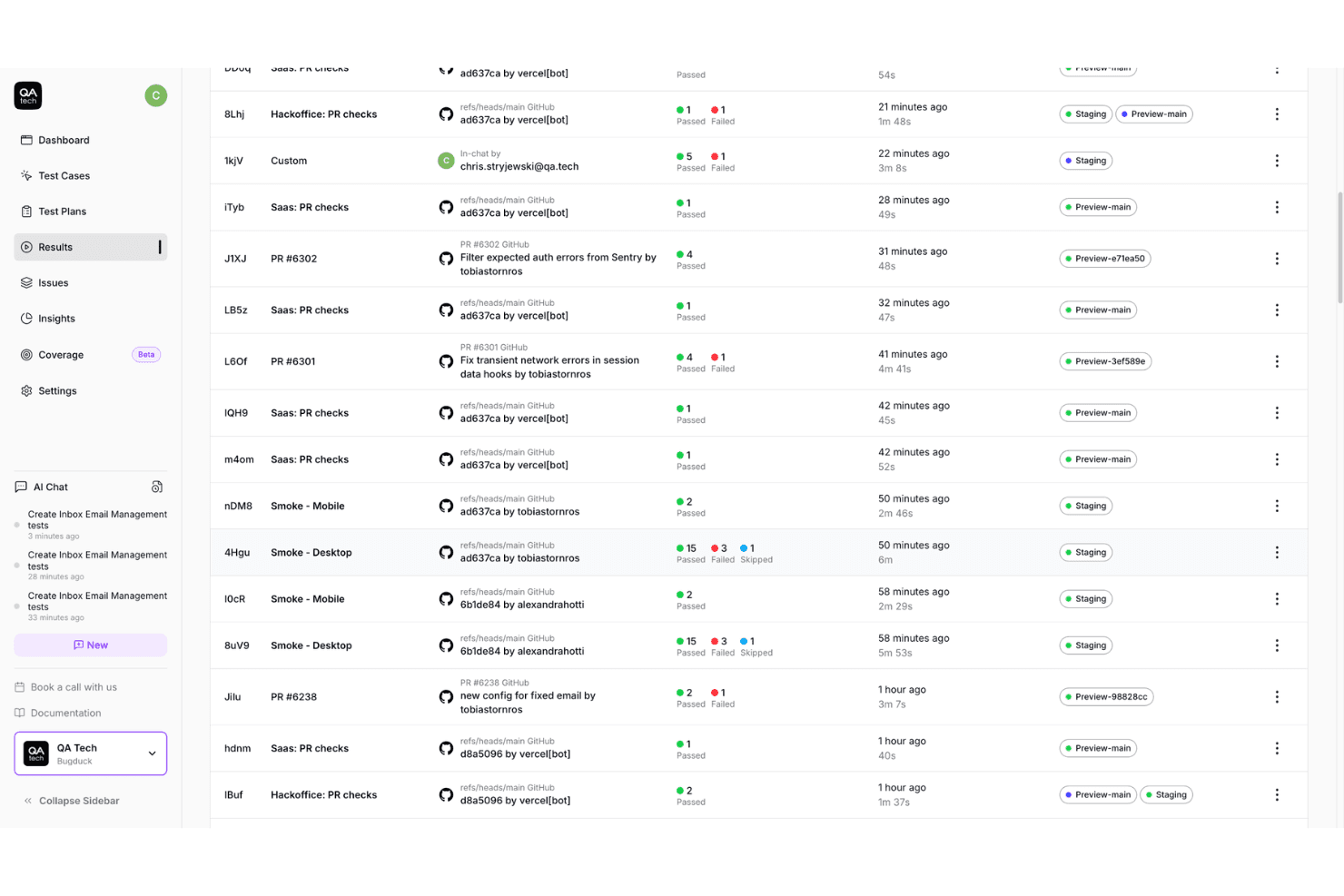
Generate and run tests from pull requests by analyzing code changes and identifying coverage gaps. This helps teams catch issues earlier while keeping test coverage aligned with new releases.
Autonomous AI Agents
Test applications with AI agents that reason through user goals instead of following fixed scripts. This reduces manual test maintenance when interfaces, workflows, or product features change.
Mobile App Testing
Test native iOS and Android applications using the same AI agent approach as web testing. Teams can validate mobile experiences across user flows while using the same knowledge system, configuration management, and agent-based approach.
Parallel Test Execution
Run test suites across multiple agents simultaneously to shorten regression testing cycles. This helps teams maintain reliable testing without slowing down frequent deployments.
Conversational Test Workspace
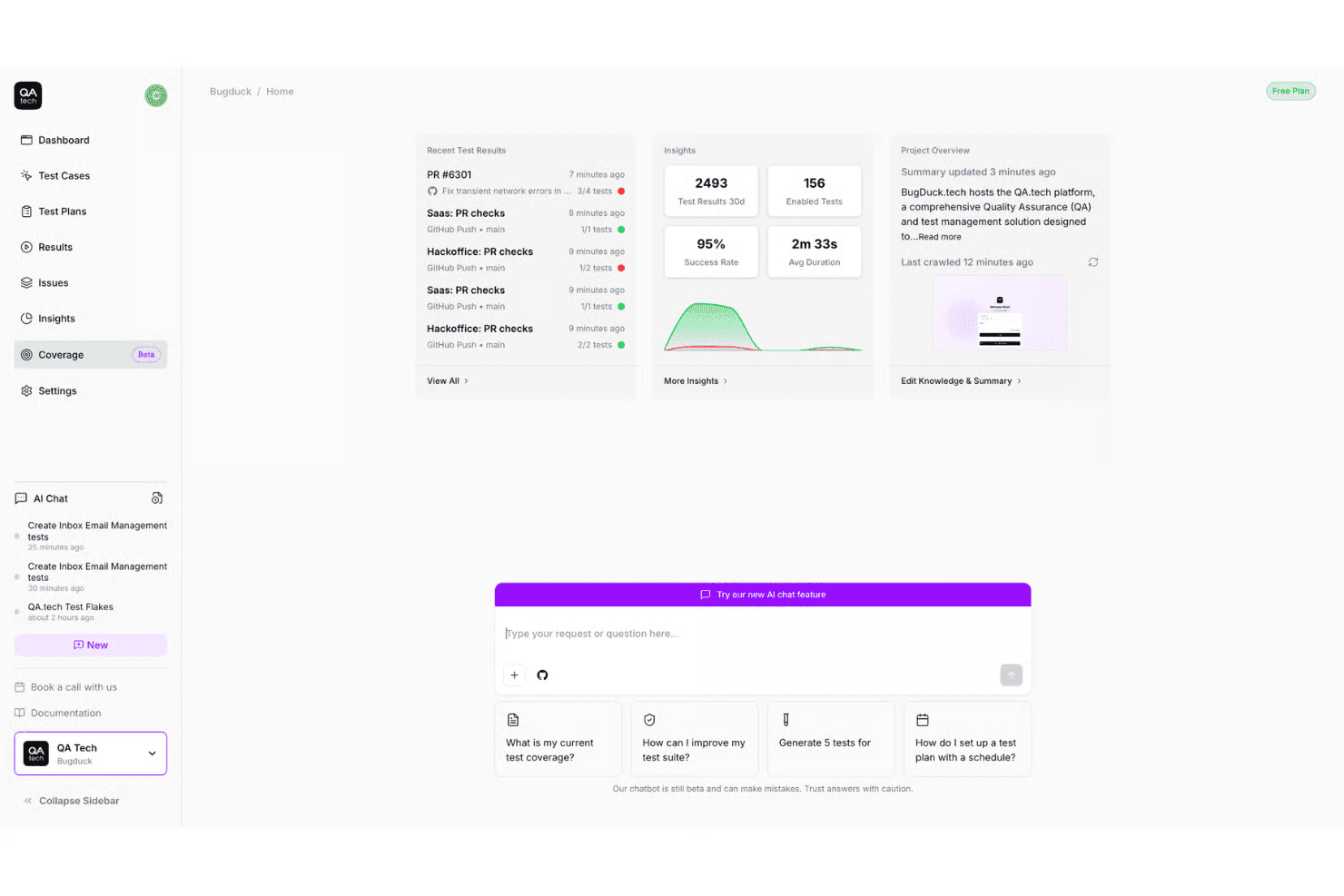
Create, edit, and run tests through a chat assistant that understands your application context. Teams can manage testing workflows without manually configuring every test step.
Issue Detection and Reporting
Identify failures with screenshots, playback context, and structured issue details. This gives developers the information they need to reproduce and resolve problems faster.
Standout Features
MCP Integration
Connect QA.tech with AI coding assistants like Cursor and Continue. Developers can run tests and review results directly within their existing coding workflows.
Shared Knowledge System
Build product context through a knowledge graph, documentation, and persistent rules. This helps agents understand application behavior and apply team standards across tests.
Ease of Use
QA.tech feels user-friendly by reducing the manual setup typically required in test automation. Its conversational workspace lets teams create, edit, and manage tests with AI assistance, while guided onboarding helps users build reliable workflows without needing deep automation expertise.

Onboarding
QA.tech provides a structured onboarding process led by a dedicated solutions engineer who helps teams connect their environment, set up initial tests, and build reliable testing workflows. Rather than a one-time setup, onboarding happens in phases with hands-on workshops, guided test creation, and implementation support to help teams understand how to work with AI agents.
Customers also receive ongoing assistance via shared Slack or Teams channels, email support, and follow-up sessions as their testing needs evolve.

Customer Support
QA.tech provides hands-on support through guided onboarding, dedicated solutions engineers, email support, and shared Slack or Teams channels. Teams receive structured setup guidance, from configuring environments to building their first tests, helping them establish reliable testing workflows faster.

Integrations
QA.tech integrates with GitHub, GitHub Actions, GitLab, Bitbucket Pipelines, Azure DevOps, CircleCI, Jenkins, Bitrise, Slack, Microsoft Teams, Jira, Linear, and Trello.
QA.tech also offers a REST API for custom workflows and API-driven testing, allowing teams to trigger test plans through their existing CI/CD pipelines.

Value for Money
QA.tech’s pricing is designed to scale with testing needs, from small teams starting with AI testing to organizations running larger QA workflows. While pricing is quote-based, the plans add value through expanded parallel testing, mobile testing, PR testing, integrations, and enterprise-level security and support.
- Starter: AI testing for individuals and small teams, including 1 user, 3 parallel test runs, exploratory testing, 2 environments, self-made integrations, and email support.
- Growth: Expanded testing for product teams with up to 5 users, custom parallel runs, mobile testing, PR testing, coverage reports, built-in integrations, and guided onboarding.
- Enterprise: Advanced testing for organizations needing unlimited parallel runs, unlimited environments, custom integrations, SLA-backed support, security reviews, and custom contracts.

QA.tech Specs
- A/B Testing: No
- API: Yes
- Automated Testing: Yes
- Browser Compatibility Testing: Yes
- Bug Tracking: Yes
- Calendar Management: No
- CI/CD Integration: Yes
- Dashboard: Yes
- Data Export: Yes
- Data Import: Yes
- Data Visualization: Yes
- Developer Tools: Yes
- External Integrations: Yes
- History/Version Control: Yes
- Manual Testing: No
- Multi-User: Yes
- Notifications: Yes
- Performance Testing: No
- Regression Testing: Yes
- Scheduling: Yes
- Status Notifications: Yes
- Third-Party Plugins/Add-Ons: Yes
QA.tech FAQs
QA.tech Company Overview & History
QA.tech is an AI-native software testing company founded in 2023 and headquartered in Stockholm, Sweden. The company helps engineering teams automate end-to-end testing for web and mobile applications using autonomous AI agents that create tests, validate releases, and reduce manual QA maintenance.
QA.tech Major Milestones
- 2023: QA.tech was founded by Daniel Mauno Pettersson, Vilhelm von Ehrenheim, and Patrick Lef with a mission to reduce the time developers spend writing and maintaining software tests.
- 2024: QA.tech secured $5 million in funding as it expanded its AI-powered platform for autonomous end-to-end testing.
- {{year}}: QA.tech continues advancing its agent-based testing platform with expanded support for web and mobile testing, PR validation, and developer workflows.