

Reseña de Elastic: Ventajas, Desventajas, Características y Precios
Elastic destaca por sus capacidades de búsqueda escalable, lo que lo convierte en una opción superior para equipos orientados a los datos que necesitan un análisis robusto en el panorama de DataOps.

Revisamos herramientas de forma independiente y las comisiones ayudan a financiar nuestras pruebas. Consulta nuestra política de transparencia, nuestra metodología o sugiere una herramienta.
Elastic is a DataOps tool built around search, log management, and real-time analytics across infrastructure, application, and security data. I'd primarily consider it if your team needs to query and monitor high-volume data without locking into a proprietary platform. Compared to Splunk, Elastic gives you more flexibility over your data pipeline and lower licensing costs at scale. That tradeoff matters most when ingestion volumes are high and your team has the technical depth to manage the stack.
Elastic Evaluation Summary
0/5
- From $0.07/GB data ingested
- Free trial + free demo available
Por qué confiar en nuestras recomendaciones de software
6,700+
Reviews
20
Industry experts
16+
Evaluation factors
14
Years
Nuestro equipo lleva probando y evaluando software desde 2012. Como líderes tecnológicos, sabemos lo difícil —y lo importante— que es elegir el software adecuado.
Para esta guía, evaluamos las herramientas mediante pruebas prácticas e investigación independiente, puntuando las herramientas según nuestros criterios de selección.
Nuestras reseñas reflejan nuestro criterio editorial humano, no un discurso de ventas.
Revisores expertos:
- Paulo Gardini MiguelDirector técnico
 Tim FisherVP de IA
 Gabriel RosasTech Lead y arquitecto de software
 Christhian GruhnTech Lead y arquitecto de plataforma

Elastic Overview
In my opinion, Elastic is a solid choice for teams looking for scalable data management solutions. It shines with its powerful search capabilities and flexibility across different environments, making it a strong contender against other DataOps tools. However, some users might find the onboarding process a bit challenging. It's best suited for data-intensive industries like finance or healthcare, where handling large datasets is crucial. If you're evaluating DataOps tools, Elastic should be on your shortlist due to its comprehensive feature set and competitive pricing.
Pros
- Handles large volumes of data with scalable search capabilities.
- Fits well across on-premise and cloud environments.
- Near real-time observability with sub-second query latency.
- Rich AI and ML capabilities.
Cons
- The onboarding process may be a bit complex.
- Steep learning curve requiring expertise in Query DSL and cluster operations.
- High resource demand for RAM and CPU.
- Customer support response times could be improved.
Is Elastic Right For Your Needs?
Who Would be a Good Fit for Elastic?
Elastic is well-suited for data-intensive industries like finance, healthcare, and e-commerce, where handling large datasets is crucial. If your team needs scalable search capabilities and flexibility in data management, Elastic is a strong option. It’s particularly beneficial for businesses that require robust data analysis tools to make informed decisions quickly. Elastic's functionalities allow you to process and search through vast amounts of data efficiently, making it a valuable tool for data engineering and operations teams aiming to enhance their data handling capabilities.
- Finance TeamsElastic is ideal for finance teams needing to analyze large datasets for insights and forecasting.
- E-commerce BusinessesProvides superior, relevance-scored full-text search (handling synonyms, misspellings, and AI-powered vector search) crucial for product discovery and improving customer support portals.
- Healthcare ProvidersHealthcare providers benefit from Elastic's ability to handle vast amounts of patient data securely and effectively.
- Large EnterprisesElastic's scalable architecture makes it a good fit for large enterprises with extensive data operations.
- Data Engineering DepartmentsData engineering departments can leverage Elastic for its powerful data processing and search capabilities.
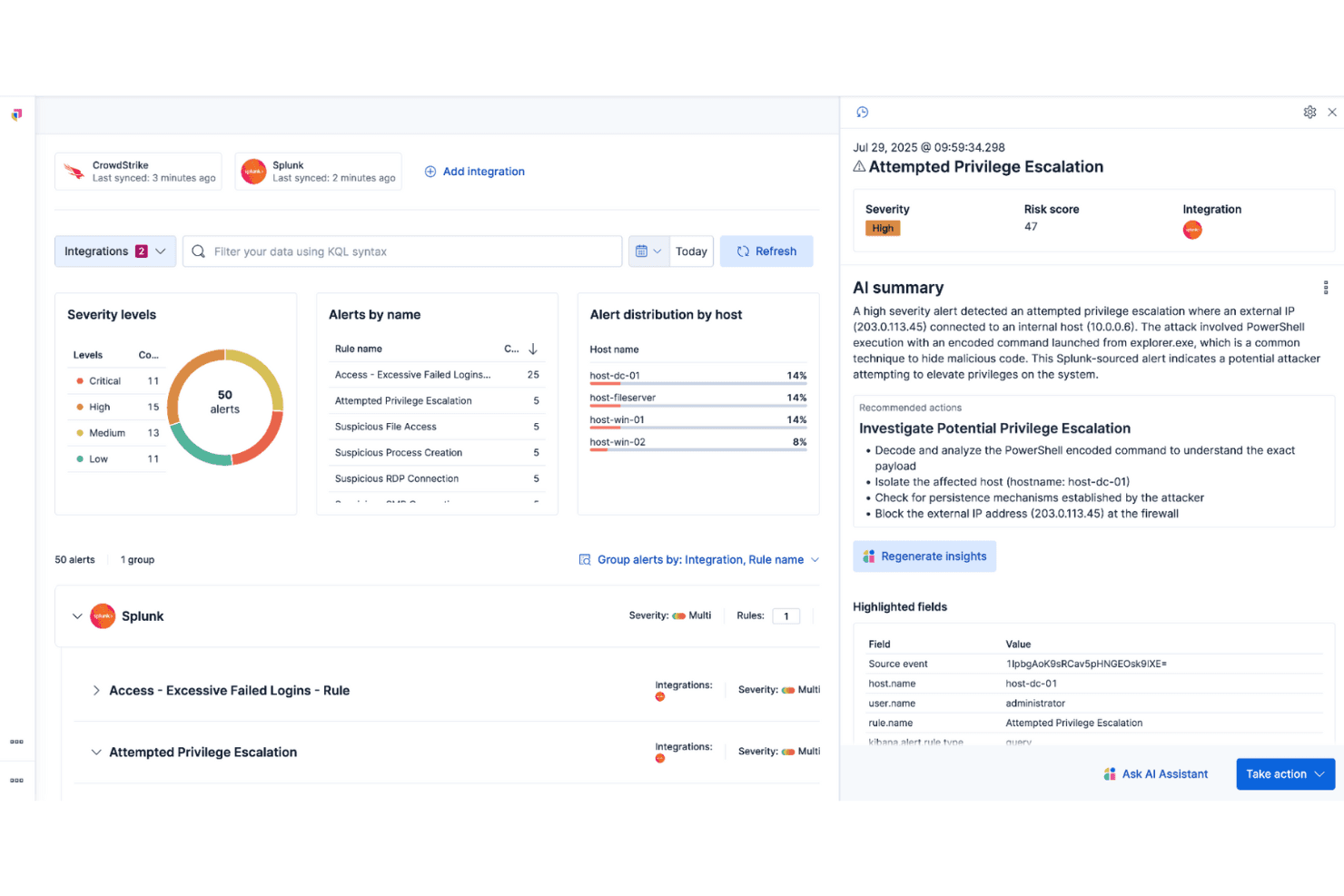
- Analytics TeamsAnalytics teams will find Elastic valuable for its ability to provide deep insights through robust data analysis features. The security analytics team use it for high-speed security incident and event management (SIEM), applying AI/ML to detect anomalies and behavioral deviations within massive security datasets.
Who Would be a Bad Fit for Elastic?
Elastic is often not the best fit for small businesses or early-stage teams with limited data workloads, since its distributed architecture and open-source codebase require meaningful engineering investment. Organizations without in-house expertise may find the onboarding, cluster tuning, and mapping configuration too complex, especially compared to managed tools like Splunk that offer faster time-to-value. Elastic’s slower support response times can also be a challenge for teams needing immediate assistance. In such cases, simpler monitoring or search platforms with more guided workflows and quicker support are typically a better operational fit.
- Small StartupsSmall startups may find Elastic's robust features excessive for their limited data needs. The operational complexity of managing a distributed cluster, even in the cloud, is overkill and too costly for simple data storage or search requirements.
- Non-Technical TeamsThe required expertise in sharding, mapping, and JVM tuning mandates specialized DevOps or Data Engineering expertise. It is not an out-of-the-box solution for non-technical users.
- Retail ShopsRetail shops with minimal data operations could find Elastic's capabilities more than they need.
- Artisanal BusinessesArtisanal businesses typically don't require the extensive data analysis features Elastic offers.
- Local Service ProvidersAs a document database, it does not support ACID transactions or complex SQL-style joins, making it fundamentally unsuitable as the primary data store for relational or transactional applications.
- Solo EntrepreneursSolo entrepreneurs could find Elastic's setup and management too complex for their simple data tasks.
Nuestra metodología de revisión
Cómo probamos y puntuamos las herramientas
Hemos invertido años construyendo, refinando y mejorando nuestro sistema de pruebas y puntuación de software. La rúbrica está diseñada para captar los matices de la selección de software y lo que hace a una herramienta efectiva, enfocándose en aspectos críticos del proceso de toma de decisiones.
A continuación, puedes ver exactamente cómo nuestro sistema de prueba y puntuación funciona a través de siete criterios. Esto nos permite ofrecer una evaluación imparcial del software basada en funcionalidad central, características destacadas, facilidad de uso, incorporación, soporte al cliente, integraciones, reseñas de clientes y relación calidad-precio.
Funcionalidad principal (25% de la puntuación final)
El punto de partida de nuestra evaluación siempre es la funcionalidad central de la herramienta. ¿Tiene las características y funciones básicas que un usuario esperaría encontrar? ¿Alguna de esas funciones principales está limitada a planes de precios superiores? Esperamos que una herramienta esté a la altura de las capacidades básicas de sus competidores.
Características destacadas (25% de la puntuación final)
Luego, evaluamos las características poco comunes y sobresalientes que van más allá de la funcionalidad principal que normalmente se encuentra en herramientas de su tipo. Una puntuación alta refleja características especializadas o únicas que hacen el producto más rápido, eficiente o que ofrecen valor adicional al usuario.
También evaluamos qué tan fácil es integrar con otras herramientas que normalmente forman parte del ecosistema tecnológico para expandir la funcionalidad y utilidad del software. Las herramientas que ofrecen abundantes integraciones nativas, conexiones de terceros y acceso API para crear integraciones personalizadas obtienen la mejor puntuación.
Facilidad de uso (10% de la puntuación final)
Consideramos cuán rápido y sencillo es ejecutar las tareas definidas por la funcionalidad principal usando la herramienta. El software con mejor puntuación está bien diseñado, es intuitivo, ofrece aplicaciones móviles, proporciona plantillas y hace que tareas relativamente complejas parezcan sencillas.
Incorporación (10% de la puntuación final)
Sabemos lo importante que es la adopción rápida por parte del equipo para una nueva plataforma, por lo que evaluamos cuán fácil es aprender y usar una herramienta con entrenamiento mínimo. Evaluamos cuán rápido un miembro del equipo puede configurarla y comenzar a utilizarla sin experiencia previa. Las soluciones con mayor puntuación requieren poco o ningún soporte.
Soporte al cliente (10% de la puntuación final)
Revisamos qué tan rápido y sencillo es resolver dudas y encontrar ayuda por teléfono, chat en vivo o base de conocimientos. Las herramientas y compañías que proporcionan soporte en tiempo real obtienen la mejor puntuación, mientras que los chatbots obtienen la peor.
Reseñas de clientes (10% de la puntuación final)
Además de nuestras pruebas y evaluaciones, consideramos la puntuación neta de promotores por parte de clientes actuales y anteriores. Revisamos la probabilidad de que elijan la herramienta de nuevo para la funcionalidad principal. Una puntuación alta refleja una alta puntuación neta de promotores actuales o pasados.
Relación calidad-precio (10% de la puntuación final)
Por último, considerando todos los demás criterios, revisamos el precio promedio de los planes de nivel básico comparado con las funciones principales y consideramos el valor de los demás criterios de evaluación. El software que ofrezca más, por menos, obtendrá una puntuación mayor.
Core Features
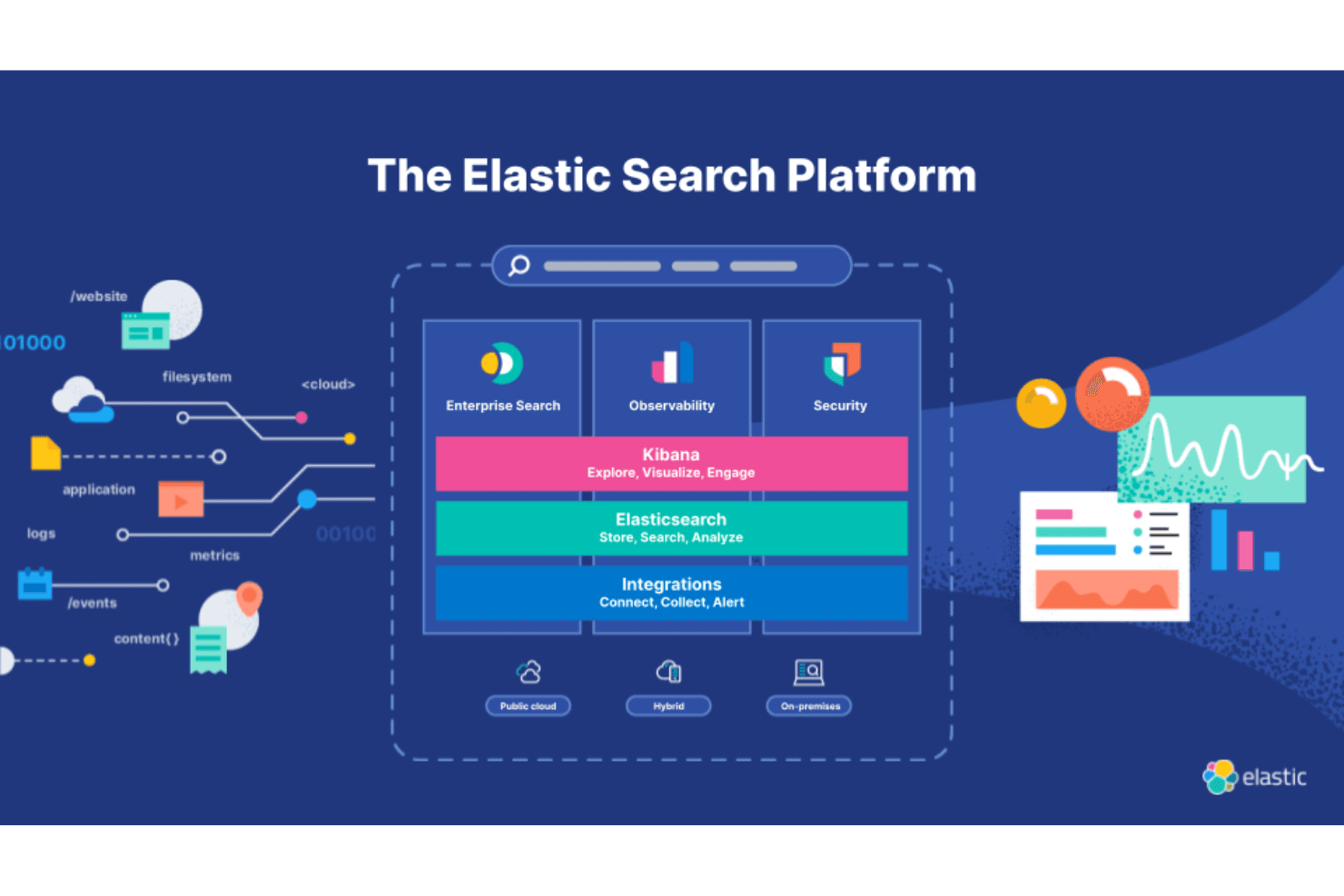
Scalable Search Capabilities: Enables semantic search and superior relevance scoring by combining traditional BM25 text search with vector embeddings from its integrated vector database.
Flexible Data Management: You can manage data across various environments, whether on-premise or in the cloud, giving your team the flexibility it needs. Elastic adapts to different setups, ensuring smooth operations.
Powerful Data Analysis: Your team can perform deep analyses of data to make informed decisions. Elastic's tools offer detailed insights that are crucial for strategic planning.
Real-Time Data Processing: With Elastic, you process data as it comes in, which is essential for time-sensitive operations. This feature ensures that your data is always up-to-date.
Security Features: Provides advanced security features necessary for large organizations, including role-based access control (RBAC), SSO, and audit logging (often requiring a proprietary license).
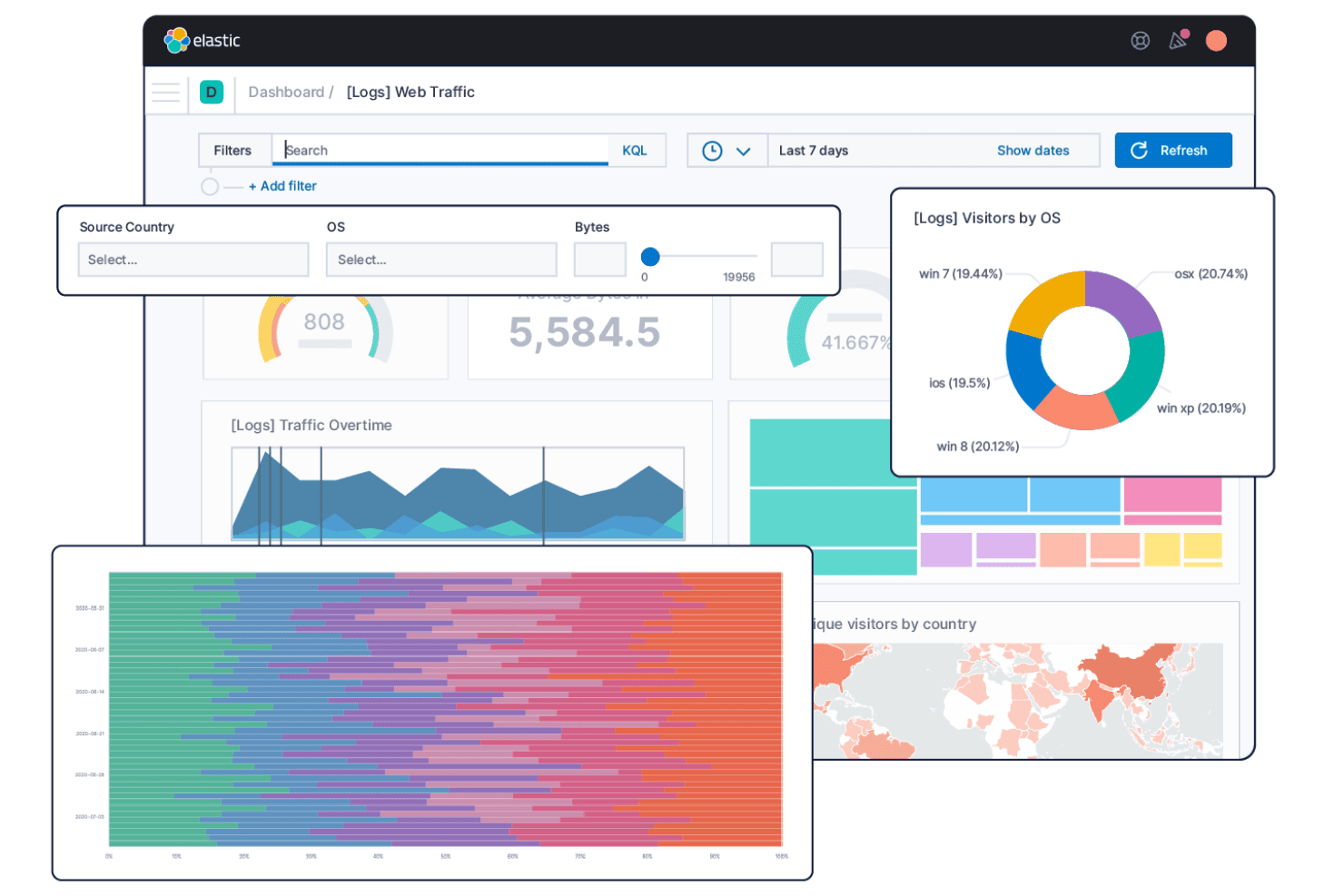
Customizable Dashboards: Leverages Kibana to provide a feature-rich, customizable interface for building dashboards. This feature helps in presenting data clearly and effectively.
Ease of Use
Elastic’s usability varies by user role. Kibana is mature and intuitive for software engineers, analysts and security teams, but the operational learning curve is steep for administrators who must configure mapping schemas, JVM heap settings, and cluster parameters. Many users report that the initial setup feels complex and the UI can be confusing compared to managed search or observability platforms.
Integrations
Elastic integrates with AWS, Azure, Google Cloud, Active Directory, Jira, Microsoft 365, Docker, Kubernetes, Apache, and PostgreSQL.
Elastic also offers an API and connects with third-party integration tools for expanded functionality.
.png&w=3840&q=75)
Elastic Specs
- A/B Testing: No
- API: Yes
- Collaboration Support: Yes
- Custom Data Forms: No
- Dashboard: Yes
- Dashboards: No
- Data Export: Yes
- Data Import: Yes
- Developer Tools: Yes
- External Integrations: Yes
- Feedback Management: No
- Gantt Charts: No
- Google Apps Integration: No
- Multi-User: Yes
- Notifications: Yes
- Prioritization: No
- Product Catalog: No
- Release Management: No
- Reports: Yes
- Resource Management: No
- Review Monitoring: No
- Roadmapping: No
- Scheduling: Yes
- Task Scheduling/Tracking: No


