

Vertex AI Review 2026: Pros, Cons, Features, and Pricing

We review tools independently, and commissions help fund our testing. See our transparency policy, our methodology, or suggest a tool.
Vertex AI is a machine learning software from Google Cloud for data science and ML engineering teams that need a single platform to build, train, and deploy models at scale. I'd consider it over AWS SageMaker if your infrastructure is already on Google Cloud—the native integrations with BigQuery and Vertex AI Pipelines give you a more connected workflow than you'd get piecing together SageMaker's separate services.
Vertex AI Evaluation Summary
4.3/5
- Pricing upon request
- Free plan available
Why Trust Our Software Recommendations
6,700+
Reviews
20
Industry experts
16+
Evaluation factors
14
Years
Our team has been testing and reviewing software since 2012. As tech leaders ourselves, we know how difficult—and important—it is to choose the right software.
For this guide, we evaluated tools using hands-on testing and independent research, scoring tools using our selection criteria.
Our reviews reflect our human editorial judgment, not a sales pitch.
Expert reviewers:
- Paulo Gardini MiguelTech Director
 Tim FisherVP of AI
 Gabriel RosasTech Lead & Software Architect
 Christhian GruhnTech Lead & Platform Architect

Vertex AI Overview
Vertex AI is a computer vision and machine learning software platform on Google Cloud that brings together model training, deployment, generative AI, and MLOps in one managed environment. It offers access to Gemini and other models, along with scalable infrastructure for production AI workloads.
Its strengths include deep cloud integration and enterprise governance, though its usage-based pricing and cloud setup may require careful cost monitoring and technical familiarity.
Pros
- Managed pipelines automate model training and deployment.
- AutoML supports custom model creation without deep coding.
- Model monitoring tools help track drift and performance.
Cons
- Pricing structure is complex and hard to predict.
- Onboarding is challenging for teams new to Google Cloud.
- Limited transparency in resource usage and billing details.
Is Vertex AI Right For Your Needs?
Who Would be a Good Fit for Vertex AI?
Vertex AI is well suited for organizations running AI initiatives at scale, especially those operating within Google Cloud. It supports predictive and generative AI workloads, managed training pipelines, and enterprise MLOps across departments. Teams that require scalable infrastructure, centralized governance, and integration across cloud services will benefit most.
- AI & Generative AI TeamsTeams building large language models, multimodal systems, or AI agents can leverage managed training, evaluation, and Gemini model access.
- Healthcare & Life Sciences DepartmentsOrganizations handling sensitive clinical or research data can use Google Cloud’s compliance-backed infrastructure and monitoring tools.
- Retail & Ecommerce Data TeamsSupports demand forecasting, personalization, and computer vision workflows at scale.
- Financial Services & Insurance DivisionsModel monitoring, governance, and scalable compute align with regulated AI initiatives.
- Logistics & Supply Chain OperationsEnables predictive analytics and optimization models using large, distributed datasets.
- Government & Public Sector ProgramsAgencies running secure, cloud-based AI initiatives can leverage Google Cloud’s infrastructure and certifications.
- Budget-Constrained Educational ProgramsVariable cloud pricing may be difficult to manage for classroom environments.
Who Would be a Bad Fit for Vertex AI?
Vertex AI may not be ideal for teams with limited cloud experience, small-scale AI needs, or environments requiring fully on-prem deployment. Its pay-as-you-go pricing and cloud-native design are best suited for organizations prepared to manage cloud infrastructure.
- Small Teams with Limited AI ScopeThe platform’s scale and complexity may exceed basic project needs.
- Solo Developers or FreelancersEnterprise-level infrastructure and billing may not align with individual workloads.
- Organizations Requiring Fully On-Prem AIVertex AI is designed for Google Cloud and not intended for standalone on-prem deployment.
- Low-Volume Annotation ProjectsTeams needing simple labeling or lightweight workflows may not require full cloud AI infrastructure.
- Rapid Prototype-Only InitiativesTeams seeking minimal setup experimentation may prefer simpler, tool-specific platforms.
Our Review Methodology
How We Test & Score Tools
We’ve spent years building, refining, and improving our software testing and scoring system. The rubric is designed to capture the nuances of software selection and what makes a tool effective, focusing on critical aspects of the decision-making process.
Below, you can see exactly how our testing and scoring works across seven criteria. It allows us to provide an unbiased evaluation of the software based on core functionality, standout features, ease of use, onboarding, customer support, integrations, customer reviews, and value for money.
Core Functionality (25% of final scoring)
The starting point of our evaluation is always the core functionality of the tool. Does it have the basic features and functions that a user would expect to see? Are any of those core features locked to higher-tiered pricing plans? At its core, we expect a tool to stand up against the baseline capabilities of its competitors.
Standout Features (25% of final scoring)
Next, we evaluate uncommon standout features that go above and beyond the core functionality typically found in tools of its kind. A high score reflects specialized or unique features that make the product faster, more efficient, or offer additional value to the user.
We also evaluate how easy it is to integrate with other tools typically found in the tech stack to expand the functionality and utility of the software. Tools offering plentiful native integrations, 3rd party connections, and API access to build custom integrations score best.
Ease of Use (10% of final scoring)
We consider how quick and easy it is to execute the tasks defined in the core functionality using the tool. High scoring software is well designed, intuitive to use, offers mobile apps, provides templates, and makes relatively complex tasks seem simple.
Onboarding (10% of final scoring)
We know how important rapid team adoption is for a new platform, so we evaluate how easy it is to learn and use a tool with minimal training. We evaluate how quickly a team member can get set up and start using the tool with no experience. High scoring solutions indicate little or no support is required.
Customer Support (10% of final scoring)
We review how quick and easy it is to get unstuck and find help by phone, live chat, or knowledge base. Tools and companies that provide real-time support score best, while chatbots score worst.
Customer Reviews (10% of final scoring)
Beyond our own testing and evaluation, we consider the net promoter score from current and past customers. We review their likelihood, given the option, to choose the tool again for the core functionality. A high scoring software reflects a high net promoter score from current or past customers.
Value for Money (10% of final scoring)
Lastly, in consideration of all the other criteria, we review the average price of entry level plans against the core features and consider the value of the other evaluation criteria. Software that delivers more, for less, will score higher.
Core Features
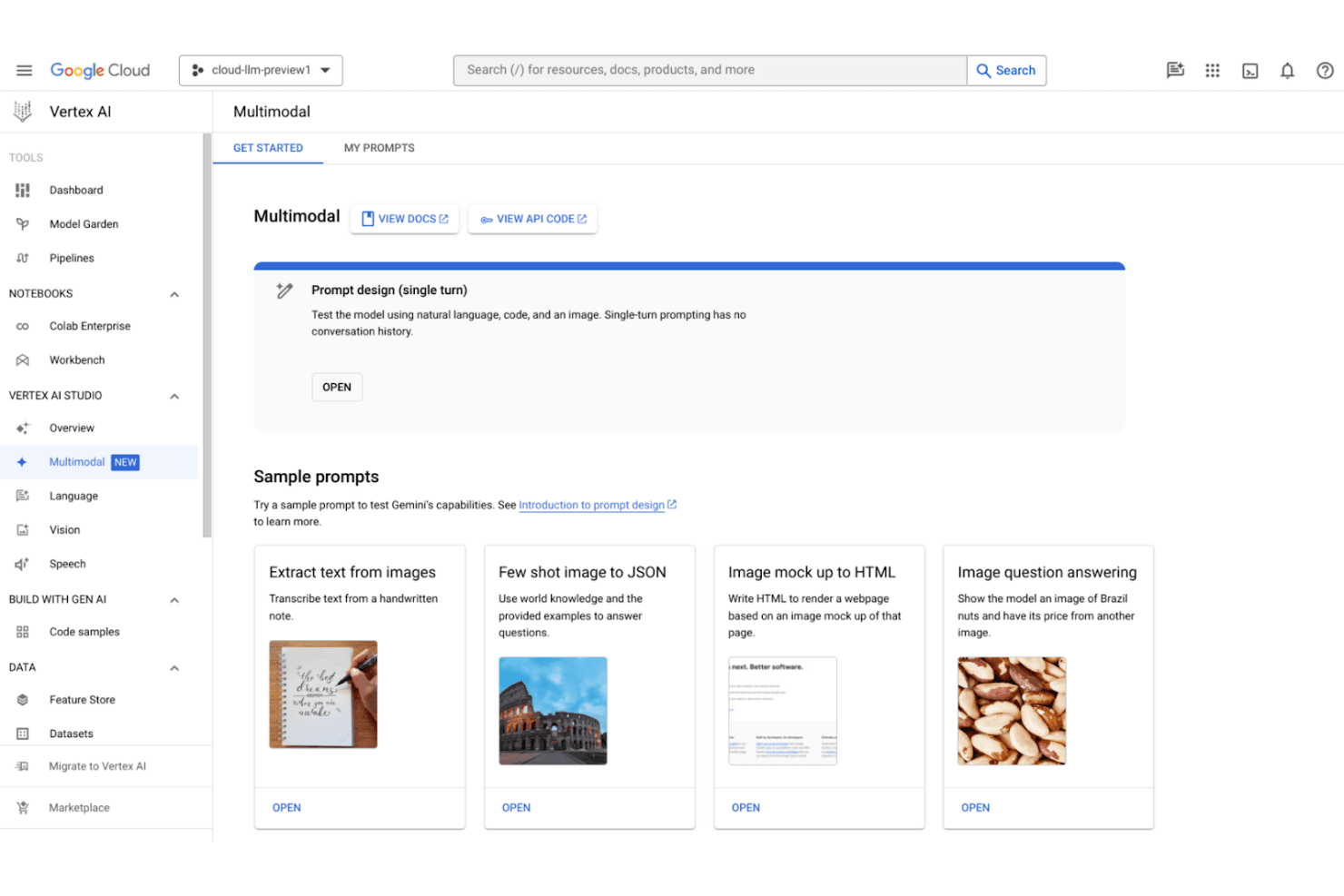
Gemini Multimodal Models
Access Google’s Gemini models for text, image, video, code, and multimodal generation. Developers can prompt, test, and build applications using Gemini through Vertex AI Studio and APIs.
Model Garden
Choose from 200+ first-party, third-party, and open models, including Gemini, Imagen, Claude, and Llama. Models can be tuned and customized for specific enterprise use cases.
Managed Training & Prediction
Train custom machine learning models using managed infrastructure and deploy them to production with scalable prediction services.
Integrated Notebooks & BigQuery
Work within Vertex AI Workbench or Colab Enterprise, with native BigQuery integration to unify data, experimentation, and deployment workflows.
MLOps & Model Lifecycle Management
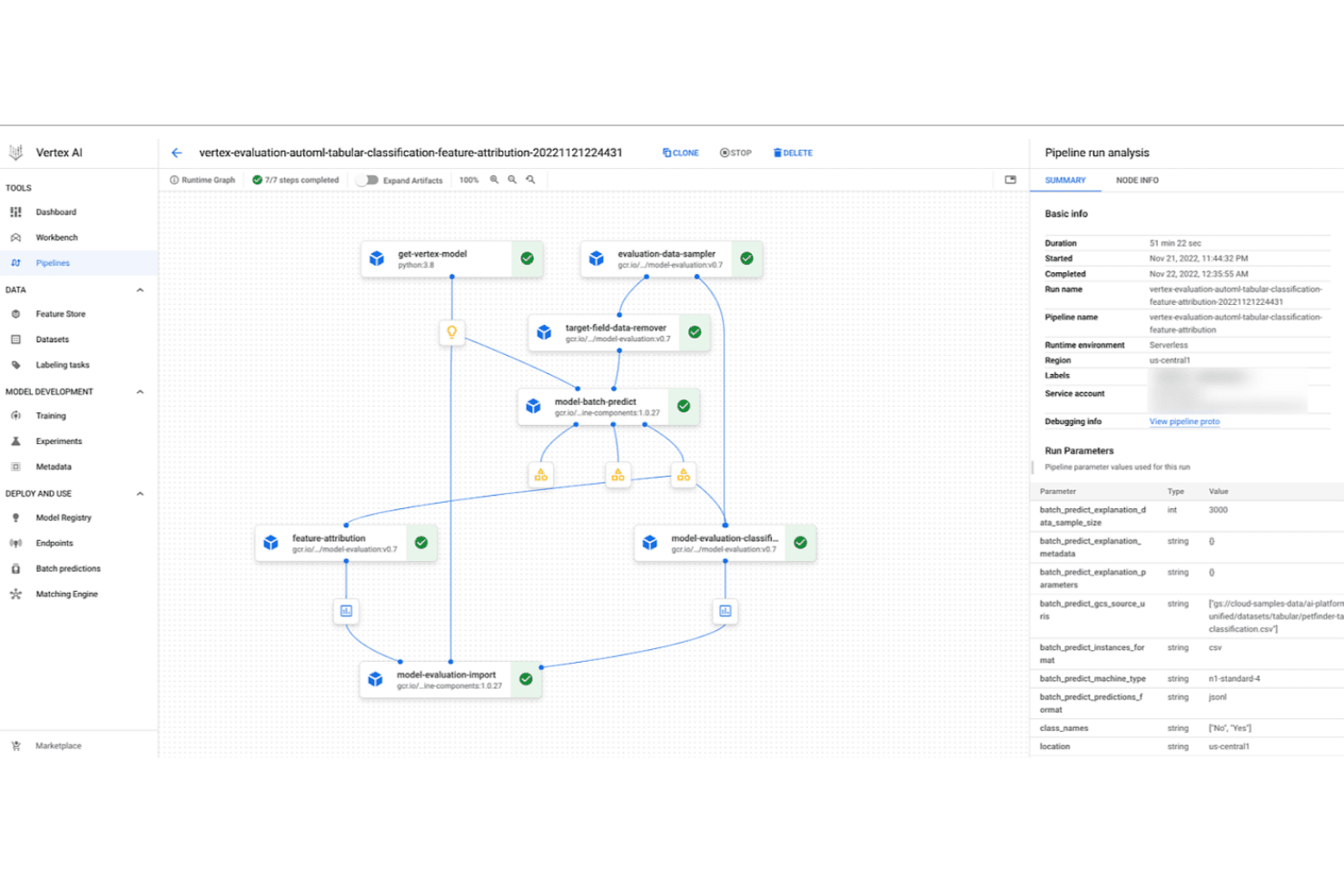
Use built-in tools like Pipelines, Model Registry, Feature Store, and Evaluation to manage, automate, and monitor models across their lifecycle.
AI Agent Development
Build, deploy, and govern enterprise AI agents powered by Gemini models, designed for scalable, production-ready applications.
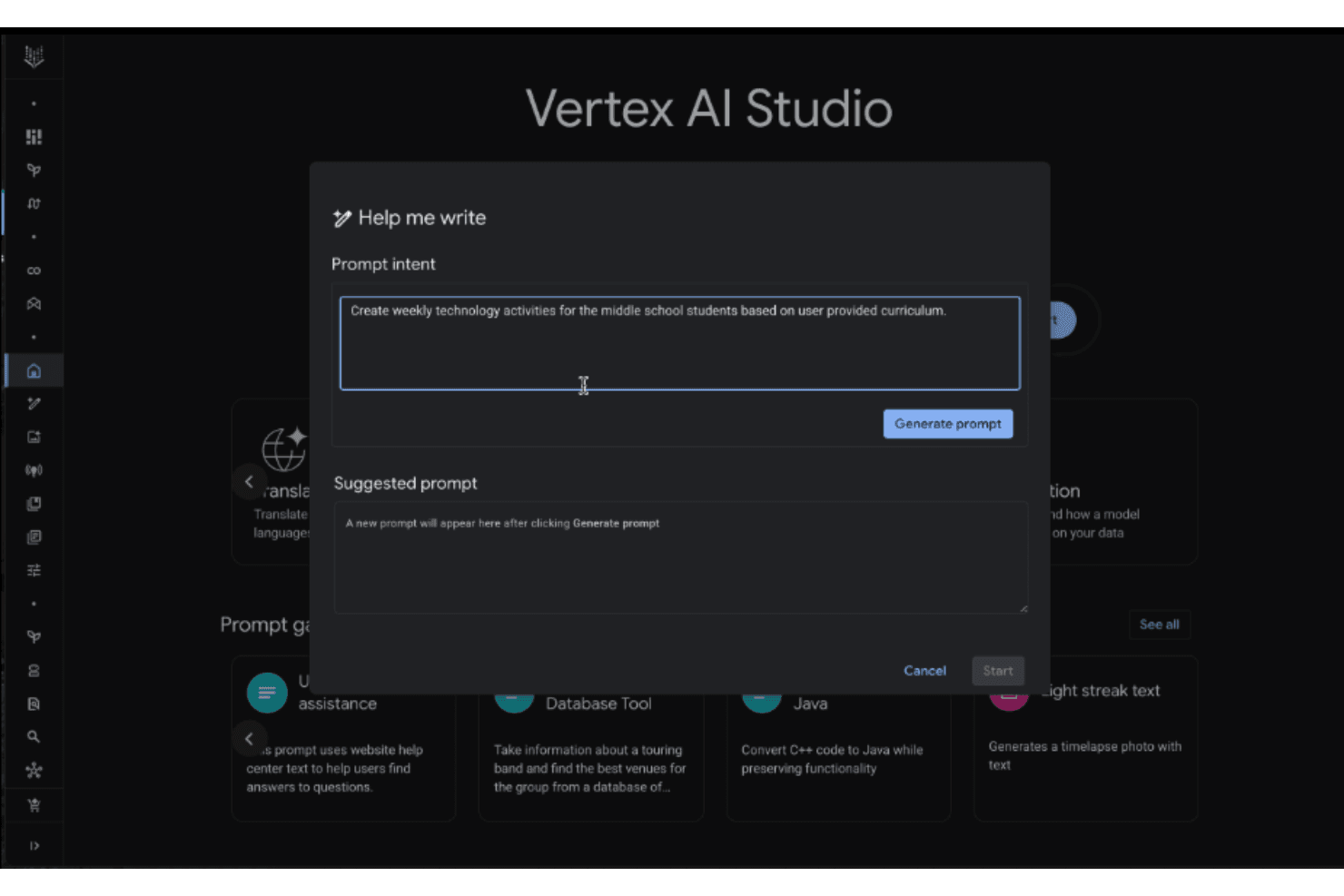
Standout Features
Vertex Explainable AI
Provides interpretability tools to analyze model predictions and feature importance, supporting transparency and compliance requirements.
Generative AI Evaluation Service
Offers structured evaluation tools for assessing generative AI outputs using data-driven metrics, helping teams measure quality and performance at scale.
Ease of Use
Vertex AI offers a polished interface and guided workflows, but its usability depends heavily on your familiarity with Google Cloud. Many users appreciate the streamlined AutoML and Workbench environments for rapid prototyping, yet the platform’s depth and configuration options can feel overwhelming for newcomers. Documentation is thorough, but onboarding often requires cloud expertise and time to navigate the full range of features, making it best suited for technically proficient teams.

Onboarding
Vertex AI’s onboarding experience is thorough but can be daunting for those new to Google Cloud. Users report that setup involves multiple steps, including configuring cloud resources and permissions, which can slow initial progress. However, the platform offers extensive documentation, tutorials, and community forums, helping users troubleshoot and learn. Dedicated support channels and training resources are available, but teams without prior cloud experience may face a steeper learning curve before reaching full productivity.
Customer Support
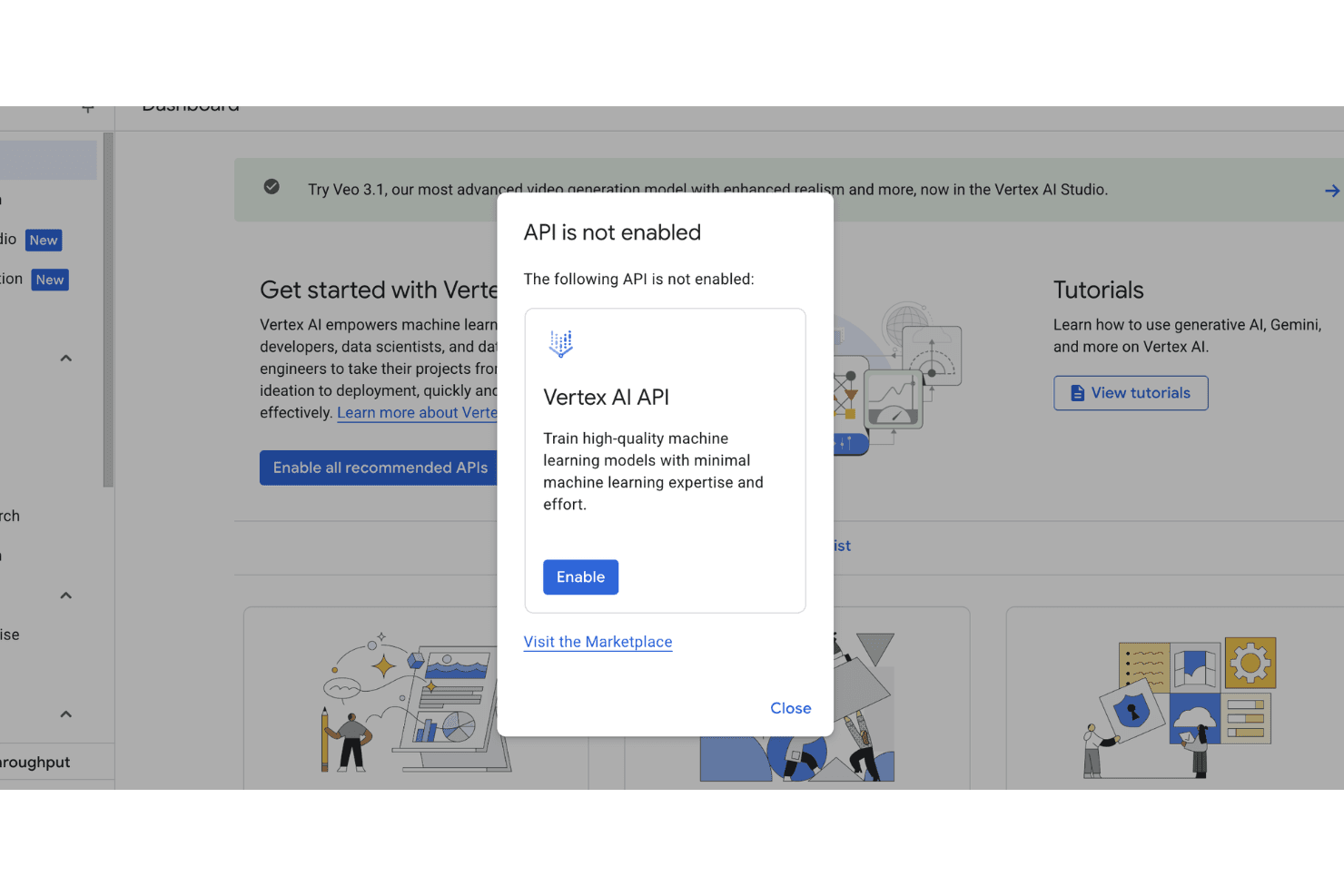
Vertex AI offers multiple support channels, including detailed documentation, community forums, and paid support plans. Users note that while documentation is comprehensive, direct support response times can vary depending on your subscription level. Many find the community resources helpful for troubleshooting, but complex issues may require escalation through official support. Overall, support quality is solid for enterprise customers, but smaller teams may experience slower resolution for technical questions.

Integrations
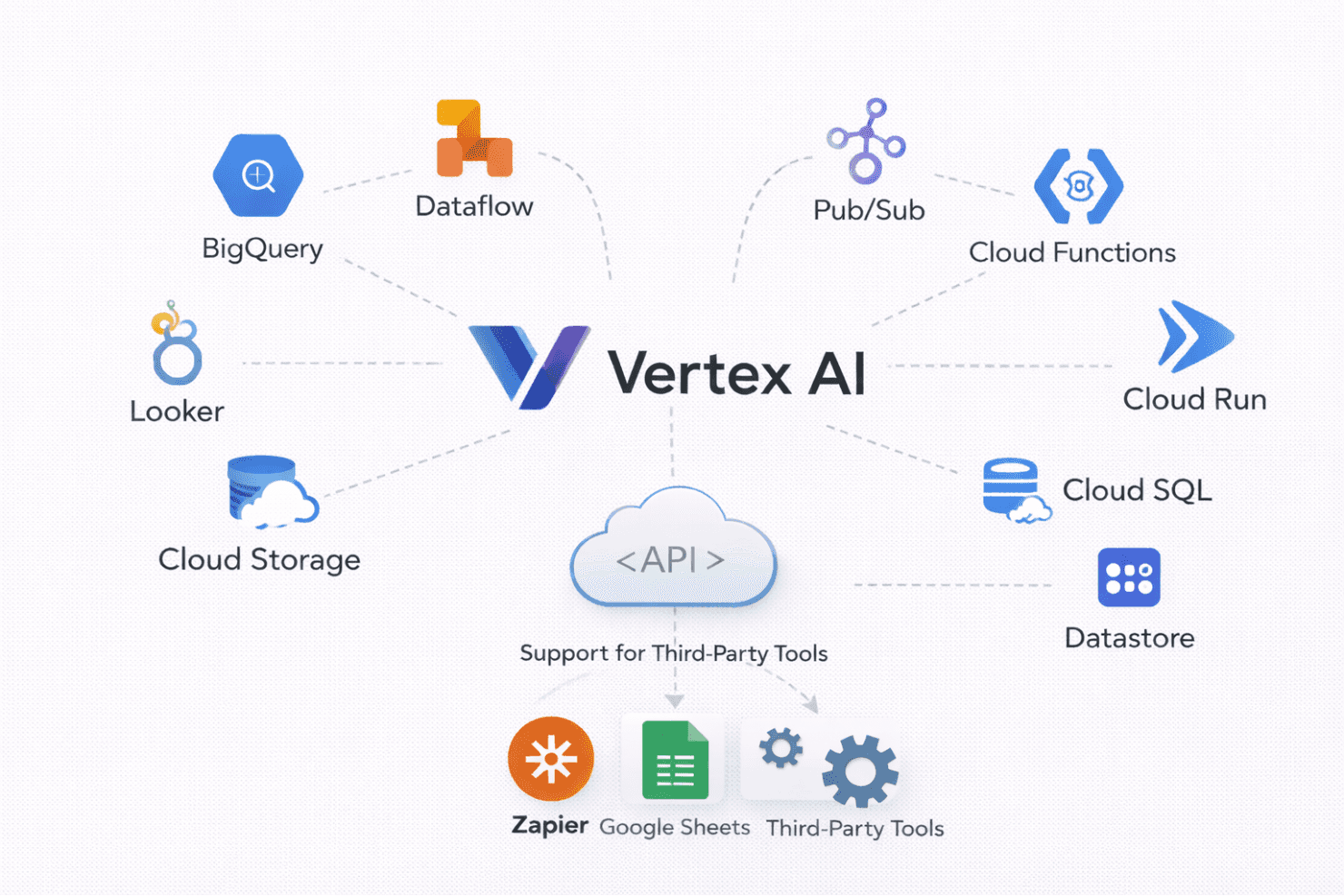
Vertex AI integrates with BigQuery, Dataflow, Dataproc, Looker, Cloud Storage, Pub/Sub, Cloud Functions, Cloud Run, Cloud SQL, and Datastore, among others.
Vertex AI also offers a robust API and supports connections with third-party integration tools.
Value for Money
Vertex AI uses a pay-as-you-go pricing model within Google Cloud, meaning you’re billed based on the resources and services you consume rather than per-user subscription tiers. Costs vary depending on workload type, compute configuration, and usage scale.
- Generative AI Usage: Priced based on input/output usage (e.g., characters for text models or image generation volume), starting at very low per-unit rates.
- Custom Model Training: Billed hourly based on machine type, region, and accelerators used.
- Managed Services & Infrastructure: Includes charges for notebooks, pipelines (per run), storage, vector search, and other cloud resources consumed.
- Management Fees: Additional charges may apply depending on configuration and region.
- Promotional Credits: New Google Cloud customers receive credits to test Vertex AI services.
.png&w=3840&q=75)
Vertex AI Specs
- A/B Testing: No
- Analytics: Yes
- API: Yes
- Big Data: Yes
- Cloud Deployment: Yes
- Dashboard: Yes
- Data Export: Yes
- Data Import: Yes
- Data Mining: Yes
- Data Visualization: Yes
- External Integrations: Yes
- Local Deployment: No
- Multi-User: Yes
- Optimized Search Processing: No
- SAP Integration: No
- Sentiment Analysis: No
Vertex AI FAQs
Vertex AI Company Overview & History
Vertex AI is Google Cloud’s unified AI development platform, launched to help organizations build, deploy, and manage machine learning and generative AI models at scale. Developed and operated by Google, Vertex AI is headquartered in Mountain View, California, as part of Google’s global workforce of over 180,000 employees. The platform is tightly integrated with Google Cloud’s suite of data, analytics, and AI products, and is used by organizations across industries such as finance, healthcare, retail, and manufacturing. Notable clients include GA Telesis and other large enterprises, with Google Cloud recognized as a leader in AI/ML platforms by industry analysts.
Vertex AI Major Milestones
- 2021: Vertex AI is officially launched by Google Cloud as a unified machine learning platform.
- 2023: Integration of Gemini models and expansion of generative AI capabilities.
- 2024: Recognized as a leader in AI/ML platforms by Forrester and IDC MarketScape.
- 2025: Adoption by major enterprises and continued expansion of model support and MLOps features.