
Trustible Review: Pros, Cons, Features and Pricing Details
I cut through the hype to show how Trustible’s AI governance platform makes real-world compliance practical, not just possible—here’s what sets it apart from other 2026 solutions.

We review tools independently, and commissions help fund our testing. See our transparency policy, our methodology, or suggest a tool.
AI adoption is spreading through enterprises faster than anyone can govern it, and the gap between what's deployed and what's accounted for is exactly where the risk lives. For teams facing regulators and auditors, closing that gap can't wait.
Trustible is an AI governance platform built for regulated enterprises that need to manage AI risk, prove compliance, and bring transparency to their AI initiatives. As organizations adopt AI faster than their governance teams can track it, the need for clear oversight, regulatory alignment, and audit-ready records becomes urgent. Trustible steps in by covering the full AI lifecycle—from use-case intake and approval through risk scoring, ongoing monitoring, and compliance reporting—in a single platform. With risk taxonomies, mitigation guidance, and framework mappings built in, Trustible could make governance more actionable for your team without the bloat or complexity
Let’s dig into its features, use cases, pros and cons, and how pricing compares to other options.
Trustible Evaluation Summary
5/5
- Pricing upon request
- Free demo available
Why Trust Our Software Recommendations
6,700+
Reviews
20
Industry experts
16+
Evaluation factors
14
Years
Our team has been testing and reviewing software since 2012. As tech leaders ourselves, we know how difficult—and important—it is to choose the right software.
For this guide, we evaluated tools using hands-on testing and independent research, scoring tools using our selection criteria.
Our reviews reflect our human editorial judgment, not a sales pitch.
Expert reviewers:
- Paulo Gardini MiguelTech Director
 Tim FisherVP of AI
 Gabriel RosasTech Lead & Software Architect
 Christhian GruhnTech Lead & Platform Architect

Trustible Overview
When it comes to compliance and AI risk management, I think Trustible stands out for its embedded risk intelligence and guided onboarding, making it approachable even if you’re starting your governance program from scratch. Its pricing is transparent and competitive, plus you get automated policy management and multi-framework regulatory mapping that many tools lack.
I’d pick Trustible for regulated enterprises needing clarity and quick adoption, although its still-growing integration library may mean some configuration work in very complex environments. For IT leaders who want oversight without headaches, I judge Trustible a strong choice that makes governance less of a chore and more of a routine.
Pros
- Automates regulatory mapping across major AI standards and frameworks
- Embeds expert-curated risk taxonomies, mitigation recommendations, and regulatory guidance
- Covers the full AI lifecycle in one platform
Cons
- Native integrations are limited
- No dedicated mobile app
- Enforces policy at the governance layer, not the technical layer, so it can’t block a model deployment or a non-compliant output at runtime
Is Trustible Right For Your Needs?
Who Would be a Good Fit for Trustible?
Trustible is best for enterprise organizations in regulated sectors such as financial services, insurance, healthcare, the public sector, and technology, where centralized oversight of AI risk and compliance with changing regulations are priorities.
- Financial Services ComplianceTrustible’s multi-framework mapping and audit-ready trails help banks and financial institutions meet demanding oversight and reporting obligations.
- InsuranceInsurers use Trustible to govern high-stakes models like pricing and underwriting, against evolving regulations and to document every risk decision.
- HealthcareBuilt-in privacy and risk checks support healthcare teams complying with complex patient-data and algorithm-transparency requirements.
- Public Sector & GovernmentTemplates for regulatory and ethical review speed up public sector assessments, approvals, and reporting.
- TechnologyTechnology companies shipping AI features rely on Trustible to govern use cases without slowing product delivery.
- Enterprise OrganizationsLarge, often global enterprises use Trustible’s centralized inventory and policy tools to manage AI deployments across multiple legal environments.
Who Would be a Bad Fit for Trustible?
Trustible is not suitable for teams focused only on model monitoring or MLOps tooling, organizations with minimal regulatory obligations, or environments where cloud deployment of SaaS is prohibited.
- Model Monitoring & Observability NeedsIf your primary requirement is tracking output quality, detecting statistical drift, or alerting on model degradation in production, a purpose-built ML observability tool is a better fit.
- MLOps Pipeline ManagementTeams looking for experiment tracking, model versioning, feature stores, or deployment automation should evaluate dedicated MLOps platforms—Trustible doesn’t sit in the pipeline.
- Early-Stage StartupsThe platform’s regulatory depth and pricing are overkill for early-stage startups running only one or two simple AI workflows.
- Consumer Technology CompaniesCompanies building consumer-facing AI with few compliance obligations will find Trustible’s regulatory depth more than they need.
- Unregulated IndustriesOrganizations in industries with minimal AI regulatory exposure get limited value from the platform’s compliance tooling.
- On-Premises-Only EnvironmentsTeams that strictly prohibit cloud deployment of governance tooling aren’t supported today, though single-tenant deployment is available.
Our Review Methodology
How We Test & Score Tools
We’ve spent years building, refining, and improving our software testing and scoring system. The rubric is designed to capture the nuances of software selection and what makes a tool effective, focusing on critical aspects of the decision-making process.
Below, you can see exactly how our testing and scoring works across seven criteria. It allows us to provide an unbiased evaluation of the software based on core functionality, standout features, ease of use, onboarding, customer support, integrations, customer reviews, and value for money.
Core Functionality (25% of final scoring)
The starting point of our evaluation is always the core functionality of the tool. Does it have the basic features and functions that a user would expect to see? Are any of those core features locked to higher-tiered pricing plans? At its core, we expect a tool to stand up against the baseline capabilities of its competitors.
Standout Features (25% of final scoring)
Next, we evaluate uncommon standout features that go above and beyond the core functionality typically found in tools of its kind. A high score reflects specialized or unique features that make the product faster, more efficient, or offer additional value to the user.
We also evaluate how easy it is to integrate with other tools typically found in the tech stack to expand the functionality and utility of the software. Tools offering plentiful native integrations, 3rd party connections, and API access to build custom integrations score best.
Ease of Use (10% of final scoring)
We consider how quick and easy it is to execute the tasks defined in the core functionality using the tool. High scoring software is well designed, intuitive to use, offers mobile apps, provides templates, and makes relatively complex tasks seem simple.
Onboarding (10% of final scoring)
We know how important rapid team adoption is for a new platform, so we evaluate how easy it is to learn and use a tool with minimal training. We evaluate how quickly a team member can get set up and start using the tool with no experience. High scoring solutions indicate little or no support is required.
Customer Support (10% of final scoring)
We review how quick and easy it is to get unstuck and find help by phone, live chat, or knowledge base. Tools and companies that provide real-time support score best, while chatbots score worst.
Customer Reviews (10% of final scoring)
Beyond our own testing and evaluation, we consider the net promoter score from current and past customers. We review their likelihood, given the option, to choose the tool again for the core functionality. A high scoring software reflects a high net promoter score from current or past customers.
Value for Money (10% of final scoring)
Lastly, in consideration of all the other criteria, we review the average price of entry level plans against the core features and consider the value of the other evaluation criteria. Software that delivers more, for less, will score higher.
Core Features
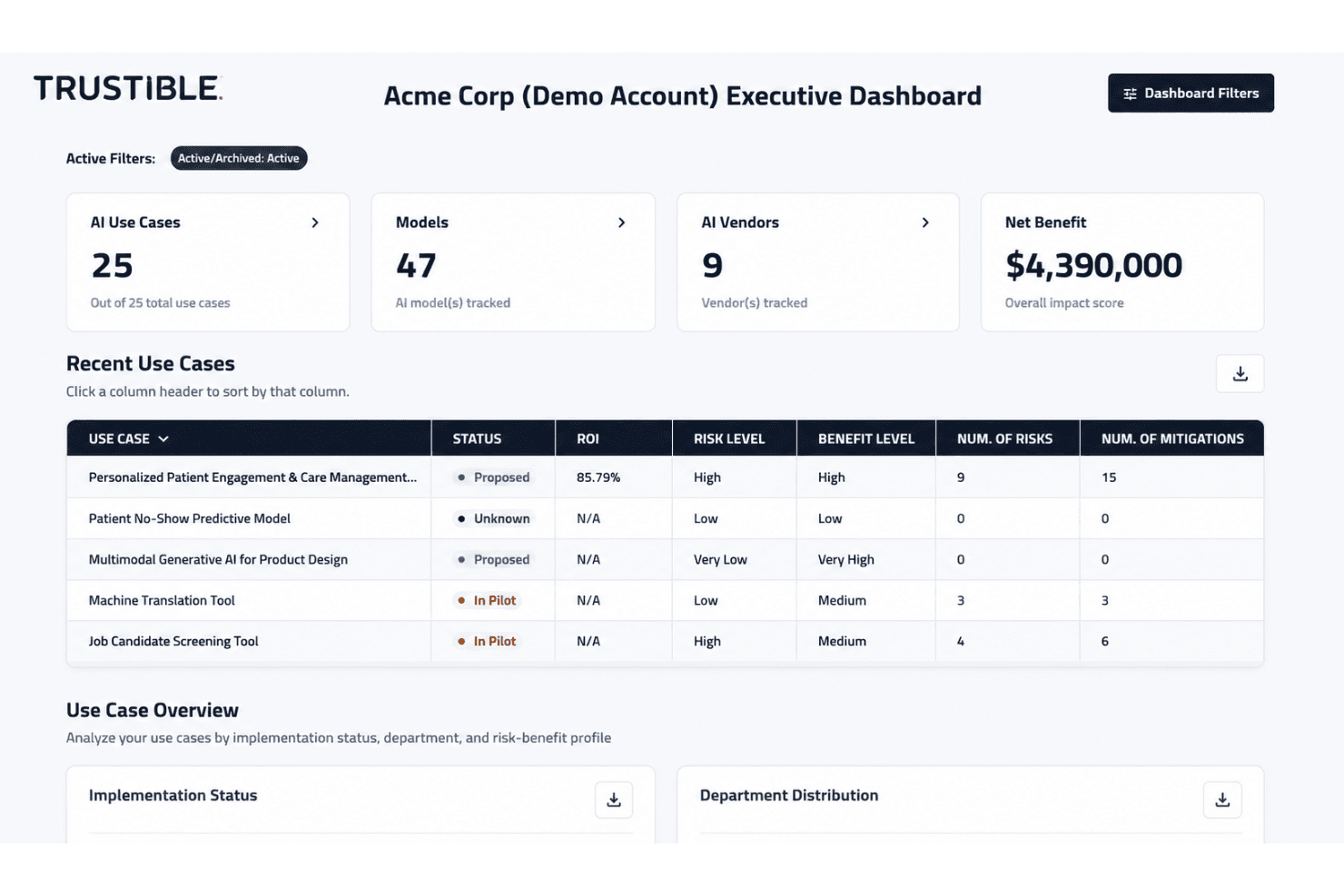
AI Intake & Risk-Based Triage
Capture every AI use case, model, agent, and vendor through structured intake, then let Trustible route each request by risk automatically. Low-risk AI moves through quickly while high-risk use cases get full review.
Centralized AI System Inventory
Log every AI asset and model and use case in one searchable catalog. This gives you a single source of truth for tracking ownership, provenance, and accountability.
Automated Risk Scoring
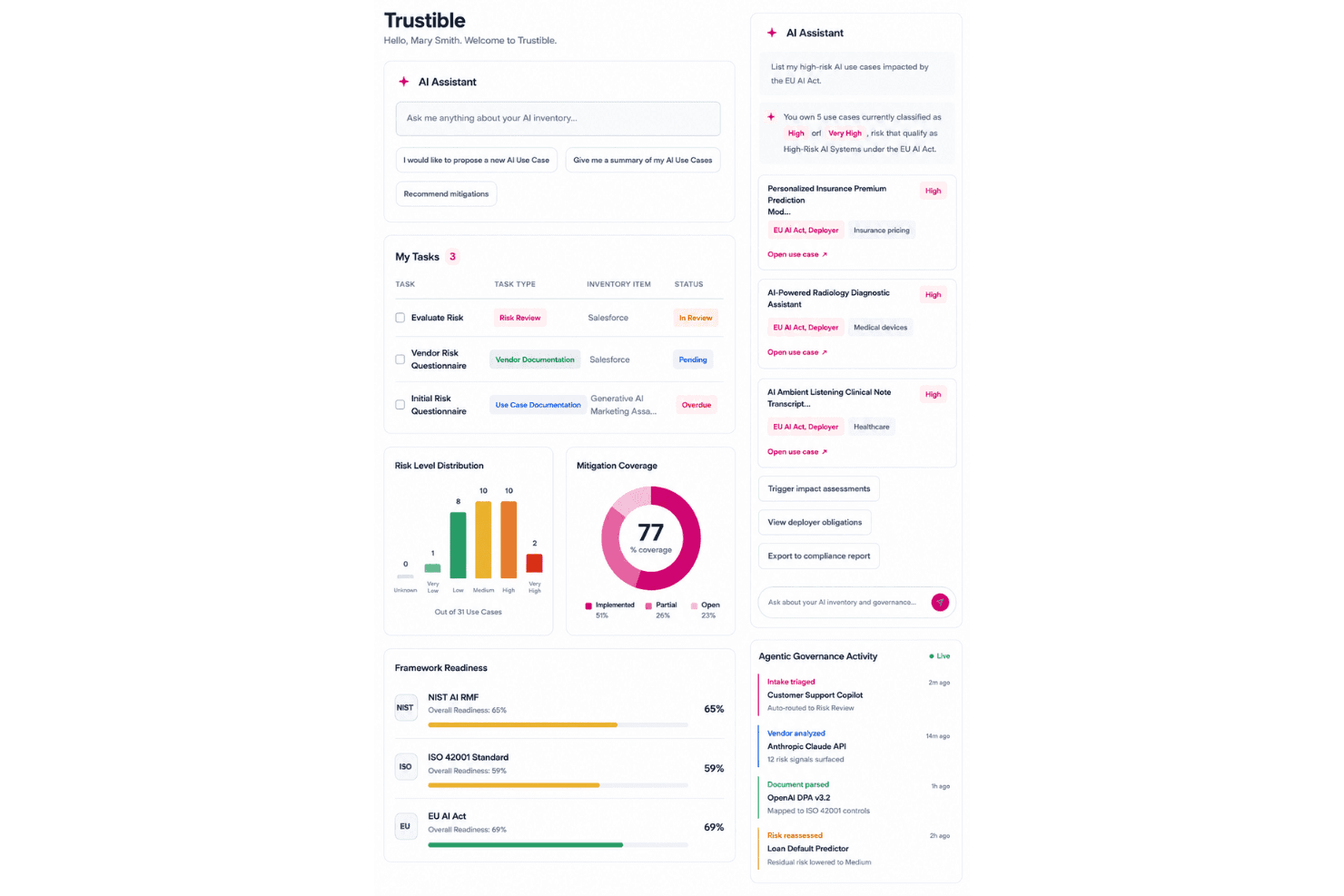
Structured assessments score each AI system and surface recommended mitigations automatically. Visual risk levels make it clear where action is needed.
Policy Management
Manage AI policies from a central repository with built-in gap analysis. Policies link directly to reviews and compliance frameworks, so they’re enforced in practice rather than filed away.
Multi-Framework Compliance
Document governance once and map it simultaneously to the EU AI Act, NIST AI RMF, ISO 42001, and more. Exportable, audit-ready evidence supports both internal reviews and external audits.
Model & Vendor Evaluations
Structured frameworks assess third-party vendors and internal models across governance maturity, cybersecurity, data privacy, and documentation quality. AI-assisted analysis of vendor documents surfaces gaps and risk signals.
Standout Features
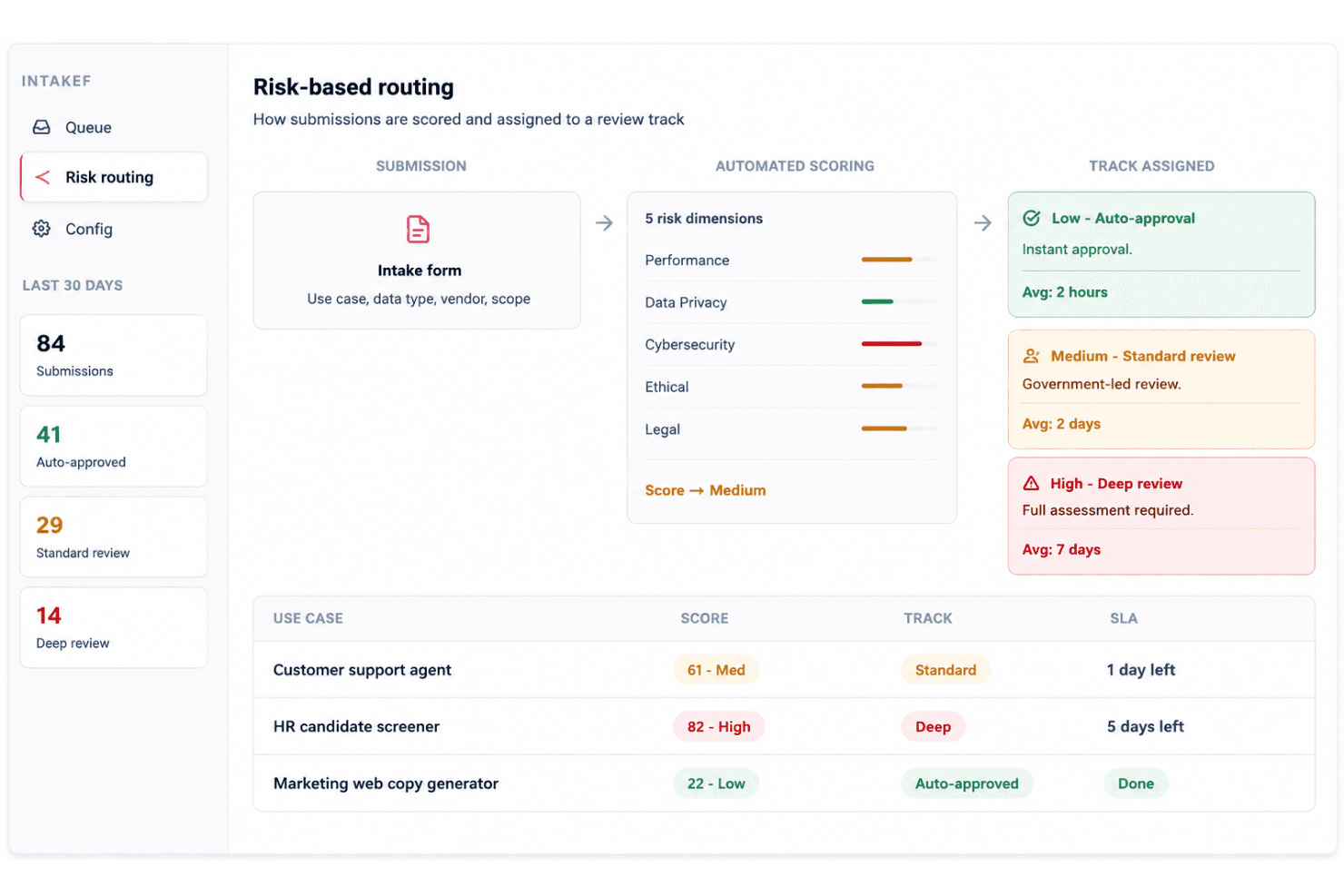
Embedded Risk Intelligence Engine
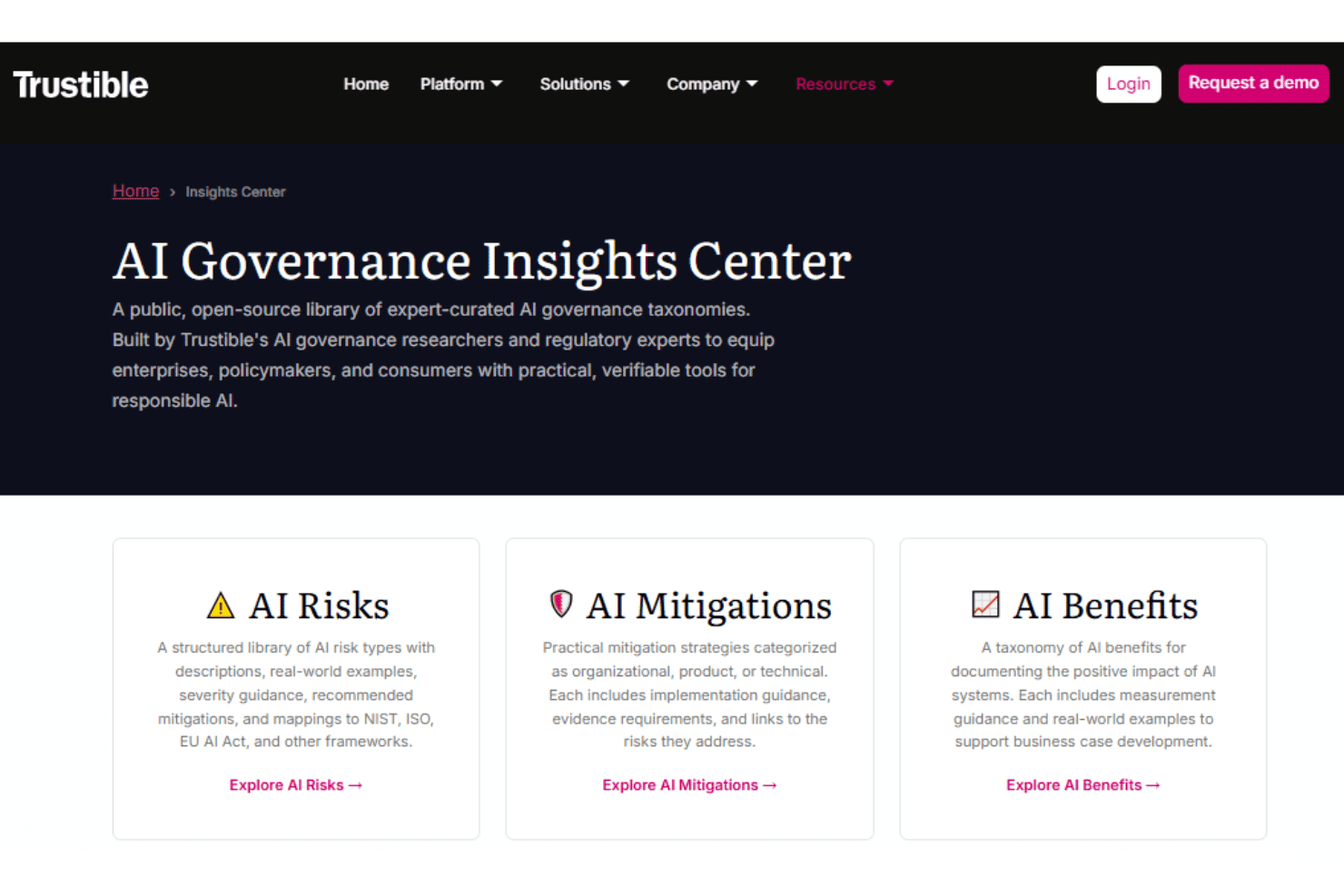
Rather than making you interpret and apply frameworks manually, Trustible’s rules-based engine applies expert-curated risk taxonomies, mitigation recommendations, and regulatory mappings automatically.
Continuous Monitoring
Use-case-level monitoring tracks internal metrics with threshold and trend alerts, alongside external signals like vendor disclosures and public AI incidents. Alerts can trigger governance actions so oversight continues well after deployment.
Ease of Use
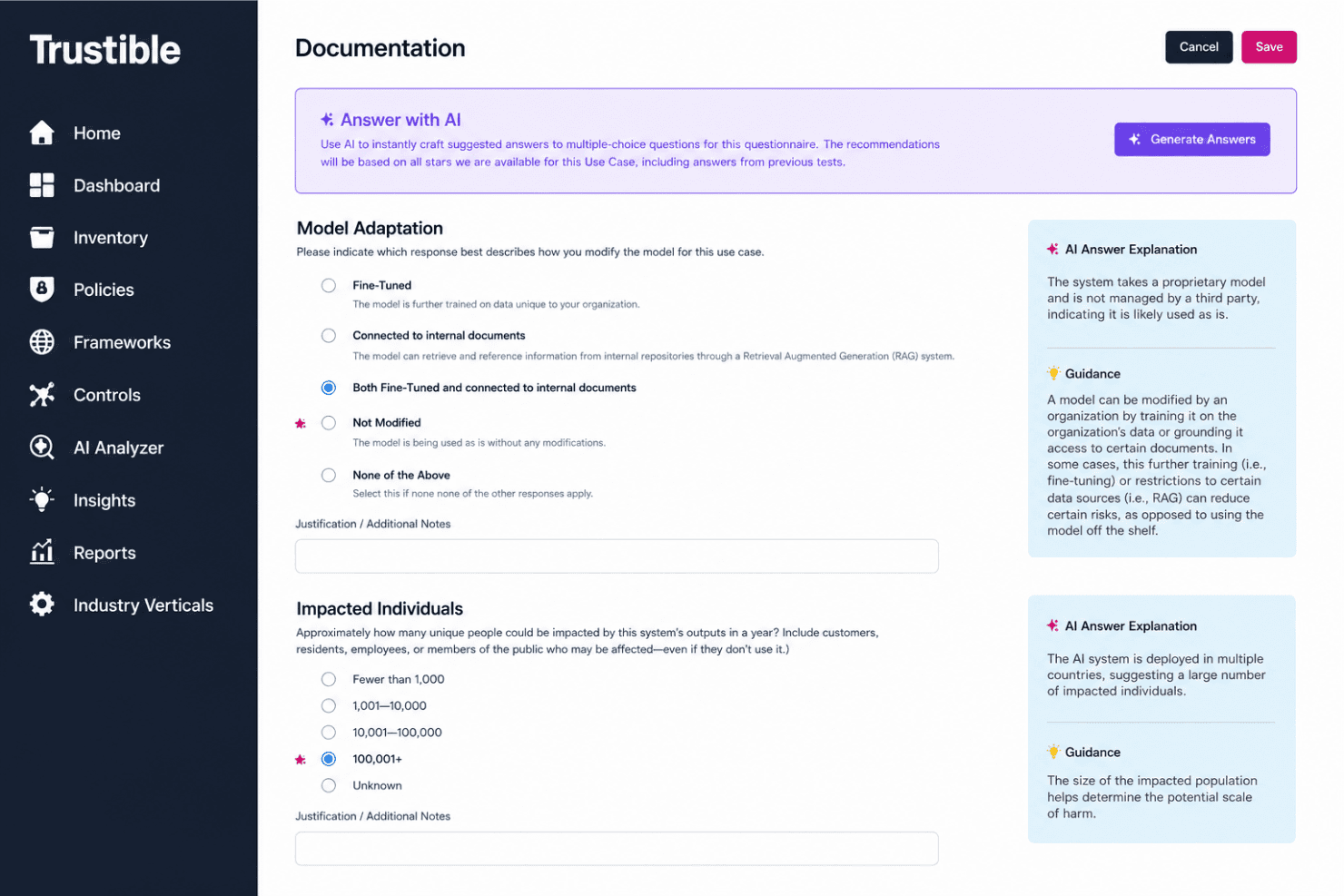
Trustible nails user-friendliness with a clear dashboard, guided workflows, and pre-loaded risk taxonomies and intake templates that make AI compliance feel manageable. Because implementation doesn’t depend on IT or engineering, governance professionals can configure and run the platform themselves. The unified inventory and visual risk and policy status give you fast clarity on governance tasks, setting it apart for busy teams.
Onboarding
Onboarding is guided, not self-serve: every customer is assigned a dedicated customer success team that assists with configuration, workflow customization, and implementation planning. Trustible follows a structured 30-60-90 day plan; by day 30 your AI inventory and intake workflows are live, by day 60 automated risk scoring and framework-aligned policies are operational, and by day 90 executive dashboards and compliance reporting are running. The team helps import existing use-case and model data, though organizations migrating from heavily customized spreadsheets should expect some manual translation of records.
Customer Support
Trustible leans on a hands-on support model: a dedicated customer success team helps you design, scale, and operate the whole governance program, not just stand up the tool. Beyond onboarding, customers work with a named advisor and get expert help interpreting evolving regulations. I think this human, expertise-led approach makes a real difference for teams navigating unfamiliar regulatory territory.
Integrations
Trustible integrates with Jira, Microsoft Forms, and SSO providers like Okta and Microsoft Entra ID.
Trustible doesn’t currently offer a public API for developer use, nor does it connect to third-party integration platforms.
Value for Money
Trustible’s pricing is not publicly transparent and is tailored to each organization’s compliance needs, team size, and implementation requirements. Even so, users often feel its regulatory mapping, audit, and risk management features deliver strong value, particularly for teams that need scalable AI governance without stitching together multiple tools.
Trustible Specs
- A/B Testing: Yes
- AI Integration: Yes
- Analytics: Yes
- API: Yes
- Calendar Management: Yes
- Comparative Reporting: Yes
- Custom Reports: Yes
- Dashboard: Yes
- Data Export: Yes
- Data Import: Yes
- Data Mining: Yes
- Data Visualization: Yes
- External Integrations: Yes
- Forecasting: Yes
- Historical Data Analysis: Yes
- Multi-User: Yes
- Notifications: Yes
- Process Reporting: Yes
- Real-time Alerts: Yes
- Scenario Planning: Yes
- Scheduling: Yes
- Sentiment Analysis: Yes
- SEO: Yes
- Time Series Modeling: Yes
- Workflow Management: Yes
Trustible FAQs
Trustible Company Overview & History
Trustible is an AI-native Public Benefit Corporation headquartered in Washington, D.C., focused on AI governance, compliance, and risk management for regulated enterprises. It was co-founded by CEO Gerald Kierce and CTO Andrew GaminoCheong, who previously spent nearly a decade at policy-and-AI company FiscalNote. Trustible has raised over $6 million in venture capital and is backed by advisors including former FTC Chair Jon Leibowitz and former FCC Chair Julius Genachowski. An early mover in operationalizing AI governance, the platform is now used by enterprises across regulated sectors, including Leidos, Guardian, Olympus, and Nuix.
Trustible Major Milestones
- 2022: Trustible founded in the Washington, D.C. area by former FiscalNote leaders Gerald Kierce and Andrew Gamino-Cheong.
- 2023: Emerged from stealth with the public launch of its AI governance platform, backed by early investors including Harlem Capital and Vamos Ventures.
- 2025: Raised a $4.6M Series Seed round led by Lookout Ventures, bringing total venture funding to over $6 million.
- 2026: SOC 2 Type 2 certified and expanding across regulated enterprises, with ISO 27001 certification expected in Q4.