

Aikido Security vs. Snyk: Comparison & Expert Reviews For 2026

We review tools independently, and commissions help fund our testing. See our transparency policy, our methodology, or suggest a tool.
It’s not enough to merely compare feature lists when deciding between Aikido Security and Snyk. You also need to know how each platform deals with the day-to-day realities of application security. Aikido Security secures the entire SDLC end-to-end in a complete platform for code, cloud and runtime, with aggressive noise reduction and transparent, flat-rate pricing. Snyk is a developer-first security tool with deep IDE, Git, and CI/CD integrations, strongest in software composition analysis for open-source dependencies.
I’ve looked into their features, price structures, and use cases to help you make a smart choice. If you’re a fast-moving startup drowning in false positives or an enterprise team that needs full compliance coverage, you’ll receive a clear overview of where each tool shines, what hidden expenses to look out for, and which platform fits your team’s workflow.
Aikido Security


4.7/5
- Free plan available
- From $350/month
Snyk

4.6/5
- Free plan + free demo available
- From $25/contributing developer/month
Why Trust Our Software Recommendations
6,700+
Reviews
20
Industry experts
16+
Evaluation factors
14
Years
Our team has been testing and reviewing software since 2012. As tech leaders ourselves, we know how difficult—and important—it is to choose the right software.
For this guide, we evaluated tools using hands-on testing and independent research, scoring tools using our selection criteria.
Our reviews reflect our human editorial judgment, not a sales pitch.
Expert reviewers:
- Paulo Gardini MiguelTech Director
 Tim FisherVP of AI
 Gabriel RosasTech Lead & Software Architect
 Christhian GruhnTech Lead & Platform Architect

| Aikido Security | Snyk | |
|---|---|---|
| Free Trial | Free plan available | Free plan + free demo available |
| Pricing | From $350/month | From $25/contributing developer/month |
Aikido Security vs. Snyk Hidden Costs
Aikido has a tiered pricing system, starting with a free Developer plan and moving through Basic, Pro, and Advanced tiers before reaching custom Enterprise pricing. Paid plans are flat-rate, with each tier bundling set allowances for repositories, container images, cloud accounts, and other usage rather than charging per-unit add-ons, so teams know what they're paying up front. With that being said, it is easier to forecast Aikido's pricing if you're planning to scale up.
Snyk’s pricing structure is considerably more complex, ranging from a Free tier all the way to Enterprise costs ranging in the thousands to tens of thousands, depending on how you set it up. As your team expands with more than 100 developers, the hidden charges start to show up because each new developer, product module, and higher testing limitations will contribute to your final price.
Aikido cuts down on noise where a lot of tools drown you in it. Its reachability analysis traces whether a vulnerability is actually exploitable in your environment, then downgrades or filters the ones that aren’t, so you’re triaging real issues instead of a wall of alerts.. The platform employs its own algorithms to eliminate false positives and lower the priority of vulnerabilities that can’t be exploited in your specific environment. You get broad coverage in a single platform, including SAST, DAST, SCA, secrets scanning, container security, cloud security posture management, and infrastructure-as-code. AI-powered capabilities such as AutoTriage and pentesting help automate vulnerability prioritization, remediation, and validation, helping teams spend less time triaging alerts and more time addressing real risks. The consolidated dashboard brings together the results of all scans, making it easier for security professionals to sort through and prioritize what is really important instead of becoming overwhelmed by too many alerts.
Snyk is great at developer-first security because it has extensive connections with IDEs, Git workflows, and CI/CD pipelines, allowing developers to find vulnerabilities in real time as they write code. The platform’s strongest feature is its SCA backed by a large vulnerability database. You can pick between Snyk Code, Snyk Open Source, Snyk Container, and Snyk IaC; however, this versatility means you have to manage more than one tool and may have to pay more.
| Aikido Security | Snyk | |
|---|---|---|
| API | Yes | Yes |
| Dashboard | Yes | No |
| Data Export | Yes | Yes |
| Data Import | Yes | Yes |
| External Integrations | Yes | Yes |
| Multi-User | Yes | Yes |
| Notifications | Yes | Yes |
| Tool | Aikido Security | Snyk |
| GitHub | ✅ | ✅ |
| GitLab | ✅ | ✅ |
| Bitbucket | ✅ | ✅ |
| Azure DevOps | ✅ | ✅ |
| Jira | ✅ | ✅ |
| Slack | ✅ | ✅ |
| AWS | ✅ | ✅ |
| Google Cloud Platform | ✅ | ✅ |
| Microsoft Azure | ✅ | ✅ |
| Docker | ✅ | ✅ |
| Kubernetes | ✅ | ✅ |
| Jenkins | ✅ | ✅ |
| CircleCI | ✅ | ✅ |
| VS Code | ✅ | ✅ |
| IntelliJ IDEA | ✅ | ✅ |
Both platforms have strong ecosystems that make it easy to connect the cloud infrastructure and DevOps tools that your team probably already uses. Aikido covers the major Git platforms, cloud providers like AWS, GCP, and Azure, CI/CD tools, and ticketing and chat systems like Jira and Slack, with 100+ integrations in its directory. Snyk offers a similarly extensive integration library with more than 100 connections, including options for the CI/CD pipeline, broad IDE support for multiple editors, and special connectors for managing SBOMs, container registries, and compliance tools.
| Factor | Aikido Security | Snyk |
| Compliance Certifications | Aikido is SOC 2 Type II certified and ISO 27001:2022 compliant, and provides automated evidence generation for SOC 2, ISO 27001, PCI DSS, HIPAA, DORA, and CIS Controls v8. | Snyk’s infrastructure is certified with ISO 27001, ISO 27017, and SOC 2 Type II, and helps customers achieve compliance with SOC 2, ISO 27001, PCI DSS 4.0, CRA, and OWASP Top 10 standards. |
| Compliance Monitoring | Integrates with compliance monitoring platforms like Vanta, Drata, Secureframe, and Thoropass to continuously sync security controls and maintain a strong security posture. | Infrastructure adheres to ISO 27017 cloud security controls and maintains regular internal audits with extensive reporting capabilities for demonstrating compliance to auditors. |
| Access Controls | Offers SSO and SAML support with role-based access controls as part of their Enterprise plan to manage team permissions and secure authentication. | Provides enterprise-grade access controls, including SSO, SAML, and granular RBAC to manage user permissions across organizations and projects. |
| Uptime and Reliability | Provides automated, continuous security across code and cloud infrastructure with real-time monitoring and alert capabilities through integrations with Slack and ticketing systems. | Offers enterprise SLAs with dedicated support channels and maintains high availability through a distributed infrastructure designed for large-scale scanning operations. |
| Audit Logging | Generates comprehensive audit trails and compliance evidence reports that map directly to specific controls in SOC 2, ISO 27001, and other frameworks for auditor review. | Delivers extensive reporting capabilities with audit logs, compliance dashboards, and detailed vulnerability tracking to demonstrate security posture to auditors and stakeholders. |
Both platforms care about security and compliance, and they have certifications that meet the needs of regulated industries.
| Factor | Aikido Security | Snyk |
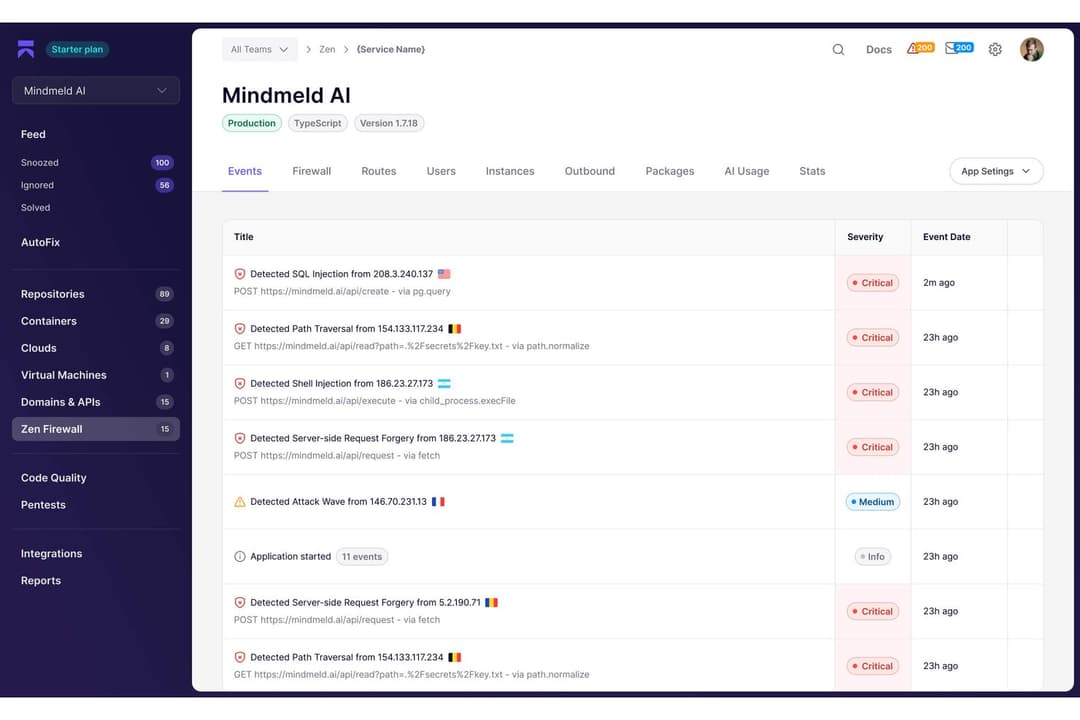
| User Interface | Aikido features a clean, developer-friendly dashboard with intuitive navigation that prioritizes vulnerabilities in a central feed without overwhelming users. | Snyk offers a functional interface, though there’s a steeper learning curve and more complex navigation, especially when managing multiple product modules across large organizations. |
| Setup Time | Delivers remarkably fast onboarding, mostly within 10 minutes, through a simple OAuth connection to Git repositories, with initial scan results appearing within minutes and no complex agents to install. | Setup is generally straightforward for common tools, though you may encounter integration challenges with less common platforms and may need more configuration time for enterprise deployments. |
| Onboarding and Learning Curve | Offers a simple setup with minimal configuration requirements, allowing developers to start finding issues immediately without extensive training or documentation review. | Provides comprehensive documentation and the Snyk Learn platform with bite-sized security training lessons, though the learning curve can be steeper for teams unfamiliar with DevSecOps practices or managing multiple security products. |
| Administration | Provides ease of administration, with straightforward team management, permission controls, and integration settings that remain simple even as organizations scale. | Offers robust controls but has increasing complexity in larger enterprises when managing multiple organizations, projects, and granular policy configurations. |
| Customer Support | Has impressive support quality, with a consistently responsive, knowledgeable team and direct access to founders for quick issue resolution. | Has generally reliable assistance, though free-tier users can see slower response times, and enterprise customers sometimes experience delays compared to Aikido’s personalized approach. |
Aikido prioritizes speed and clarity. Connect your repositories, get results in minutes, and work from a single dashboard that covers code, cloud, and runtime without juggling separate product modules. Snyk's advantage is its ecosystem. Teams already embedded in Snyk's IDE plugins and CI/CD workflows get real-time feedback where they code, and Snyk Learn gives developers structured security training that Aikido doesn't offer. But that ecosystem comes with tradeoffs. Snyk splits its coverage across separate products, each with its own setup and learning curve, and full coverage requires investing in additional modules. Aikido bundles broader coverage into one interface from the start, which means less configuration overhead and less time spent learning multiple tools.
Aikido Security
- High-quality developer experience and workflow integration.
- Dramatically reduces remediation time compared to manual fixes with its AutoFix feature.
- Enterprise-grade SAST and SCA.
- No built-in developer security training program.
- Limited support for retaining historic container image scan records
- Teams needing custom detection logic built from scratch will need different tooling.
Snyk
- Continuous monitoring with actionable remediation guidance
- Strong coverage across the modern application stack
- Developer-first security that fits into existing workflows
- Users mention slow scans, bugs, and gaps in integrations or support responsiveness.
- Teams often need planning and tuning before the platform runs smoothly.
- Some users report frequent false positives that make vulnerability triage more time-consuming.
Aikido Security
- Enterprise Development TeamsEnterprise customers get custom onboarding and direct access to the Aikido team regardless of contract size. One customer onboarded 150+ developers in 45 minutes, and the flat-rate enterprise pricing means no surprise costs as headcount grows.
- HealthTech and MedTech CompaniesHealthcare teams rely on Aikido to monitor security from code commits through cloud deployments, with automated compliance evidence for HIPAA, SOC 2, and ISO 27001.
- Cloud-Native Startups and Scale-UpsStartups with two team members get Aikido for free, then scale with affordable per-month pricing, so you can avoid that budget-crushing security hire during your critical growth phase.
- B2B SaaS ProvidersSaaS providers who connect Aikido to their GitHub repos get auto-generated SBOMs and compliance evidence reports, which cuts the manual work involved in answering vendor security questionnaires.
- DevOps and Platform Engineer TeamsDevOps teams integrating Aikido with Jenkins or GitHub Actions catch more critical vulnerabilities pre-production, slashing emergency patching and stopping security issues from derailing their release timelines.
- Small Dev TeamsJunior developers can fix their own security bugs thanks to Aikido’s clear step-by-step guides and ready-to-use patch snippets—even without any security background.
Snyk
- Teams using AI-generated code and modern workflowsSnyk helps secure AI-generated code and modern development practices by scanning code early and continuously.
- Companies managing software supply-chain riskSnyk provides visibility across code, dependencies, containers, and infrastructure with risk-based prioritization.
- Organizations adopting shift-left securitySnyk helps developers fix vulnerabilities early in the SDLC, improving collaboration between security and engineering teams.
- Cloud-native teams using containers and IaCSnyk secures Docker, Kubernetes, and infrastructure-as-code to help teams prevent misconfigurations before deployment.
- Teams heavily using open-source softwareSnyk continuously scans third-party dependencies and alerts teams to newly discovered vulnerabilities with fix suggestions.
- Fast-moving DevOps and platform teamsSnyk integrates with CI/CD pipelines, repositories, and IDEs so teams can catch issues during development instead of after release.
Who Should Use Aikido Security, and Who Should Use Snyk?
Aikido Security is a mature platform suitable for organizations of all sizes, from early-stage startups and growing businesses to large enterprise teams, particularly SaaS companies with developers who need comprehensive application security without dedicated security staff. If you're overwhelmed by false positives from multiple security vendors, drowning in tool sprawl, or simply want to start with AppSec in less than 10 minutes without complicated configuration, Aikido's complete platform with flat pricing eliminates the complexity and financial headaches. Additionally, Aikido's support team is accessible regardless of contract size. Teams that value rapid deployment, clear pricing, and a single dashboard to manage everything from cloud security to SAST will find the platform particularly useful.
Snyk is a better choice for mid-sized to large companies where open-source dependency management is a top priority and developers want real-time security feedback inside their IDE as they write code. Businesses with strict compliance requirements that include mandatory developer security training will benefit from Snyk Learn, which offers structured learning paths aligned to OWASP Top 10 and NIST NICE and lets security leaders assign courses and pull completion reports as audit evidence. Whether your team needs deep IDE integrations across multiple editors, specialized SCA coverage for open-source dependencies, extensive developer security training through Snyk Learn, or you’re already managing policy configurations and testing pipelines around Snyk's modular structure, Snyk’s established ecosystem and training resourcesmodular approach give it an edge for teams where those needs come first.
| Aikido Security | Snyk | |
|---|---|---|
| AI-Powered Automation | Aikido Security Aikido leverages proprietary AI for AutoFix and AutoTriage features that automatically generate fix pull requests and downgrade false positives using reachability analysis across 100+ custom rules to reduce manual remediation. | Snyk Snyk provides AI-assisted code suggestions through Snyk Code and automated dependency upgrade PRs for open source, but its DeepCode AI autofix is limited to the IDE on the enterprise plan, and it lacks comprehensive AI auto-triage for false positives. |
| Customer Support | Aikido Security Aikido Security’s customers can contact the founding team directly, no matter how big or small their contract is, so everyone gets personalized help. | Snyk Snyk offers tiered support based on pricing plans. Free and lower-tier users get slower response times and less access to dedicated support resources than enterprise customers. |
| Noise Reduction | Aikido Security Aikido Security uses its own reachability analysis with more than 100 custom rules and AI-powered auto-triage to cut down on false positives and automatically downgrade vulnerabilities that don’t affect functions you’re actually using. | Snyk Snyk does standard vulnerability scanning, but its limited reachability analysis is only available for a few languages, which makes a lot of alert noise that needs to be sorted through by hand. |
| Platform Architecture | Aikido Security Aikido Security offers a single platform that combines SAST, DAST, SCA, secret scanning, container security, and CSPM into one interface and setup process. | Snyk Snyk is a collection of different products that each need their own settings, dashboards, and buying decisions for each scanning feature. |
| Setup Complexity | Aikido Security Aikido Security offers a 10-minute onboarding process that includes a simple OAuth connection to repositories, automatic initiation, and no need to install an agent for immediate security coverage. | Snyk Snyk needs more configuration across several products, CI/CD pipeline integrations, and policy setup, which is especially hard for teams that want to use all of its security scanning features. |
| Automated Remediation | Both tools can fix problems automatically, with as little human help as possible. For example, they can make pull requests that suggest changes to the code or upgrades to dependencies. These systems speed up the process of fixing things and cut down on the time coders spend looking for fixes by giving them real solutions that are ready to be used. |
|---|---|
| CI/CD Pipeline Integration | Aikido and Snyk both work well with developer routines because they are connected to GitHub, GitLab, Bitbucket, and CI/CD systems. This lets security checking happen automatically during pull requests and build processes. By adding security checks early in the software creation process, the platforms let developers find and fix problems before the code is used. |
| Governance & Compliance | Both systems are SOC 2 Type II and ISO 27001 approved and help businesses follow rules like PCI DSS, HIPAA, SOC 2, and ISO 27001 by using automatic controls and reports that are ready for audits. Both are good for businesses that need to follow the rules and have security stances that can be verified and long audit trails, because they both focus on compliance. |
| Multi-Layered Scanning | Both platforms give cover the core application security categories including SAST, SCA, container security, secrets discovery, and infrastructure-as-code security. Where they differ is in how far that coverage extends. Aikido includes full DAST, secrets detection across the codebase, CSPM, and malware detection as part of its standard platform. Snyk offers partial DAST and limits secrets detection to the IDE, so teams with broader requirements may need to supplement with additional tools. |
| Risk Prioritization | Aikido and Snyk both use smart priority systems that go beyond basic CVSS scores to help teams focus on the most dangerous vulnerabilities first, factoring in exploitability and environmental context. Aikido's reachability analysis covers all supported languages out of the box and auto-downgrades findings that don't reach functions your code actually calls. Snyk offers reachability analysis for a smaller set of languages, and some users report inconsistent policy thresholds across different product modules, which can make triage less predictable. |