

În peisajul digital de astăzi, protejarea datelor și a sistemelor este mai importantă ca niciodată. Amenințările de securitate cibernetică evoluează, ceea ce face dificilă ținerea pasului. Ai nevoie de soluții de încredere care oferă protecție fără să îți complice fluxul de lucru.
Am petrecut ani întregi testând și evaluând software, așa că știu ce funcționează. Din experiența mea, instrumentele potrivite de securitate cibernetică pot face o diferență semnificativă în eficiența și liniștea echipei tale.
În acest articol, îți voi prezenta principalele mele alegeri pentru soluții de securitate cibernetică. Vei găsi o evaluare imparțială a fiecărei opțiuni, axată pe ceea ce contează cu adevărat: eficiență, ușurință în utilizare și valoare. Să găsim cea mai potrivită soluție pentru nevoile tale.
Why Trust Our Software Recommendations
6,700+
Reviews
20
Industry experts
16+
Evaluation factors
14
Years
Our team has been testing and reviewing software since 2012. As tech leaders ourselves, we know how difficult—and important—it is to choose the right software.
For this guide, we evaluated tools using hands-on testing and independent research, scoring tools using our selection criteria.
Our reviews reflect our human editorial judgment, not a sales pitch.
Expert reviewers:
- Paulo Gardini MiguelTech Director
 Tim FisherVP of AI
 Gabriel RosasTech Lead & Software Architect
 Christhian GruhnTech Lead & Platform Architect

Tabel comparativ: soluții de securitate cibernetică
Compară prețurile și specificațiile, unul lângă altul, pentru soluțiile de securitate cibernetică incluse în lista mea scurtă.
Sorted by: Default
| Tool | Starting Price | Website | |
|---|---|---|---|
Best for developer-led vulnerability fixes | 4.3 out of 5 | $300/month Free plan + free demo available | Book Demo |
Best for DDoS protection | 4.7 out of 5 | Pricing upon request 30-day free trial + free demo available | Website |
Best for AI-powered ransomware detection | 4.7 out of 5 | $179.99/endpoint Free demo available | Website |
Best for unified EDR and threat intelligence | 4.6 out of 5 | $7.99/device/month 15-day free trial available | Website |
Best for compliance testing | 4.6 out of 5 | $149/month 30-day free trial + free demo available | Website |
Best for integrated security controls | Not rated | Pricing upon request Free demo available | Website |
Best for API attack protection | Not rated | Pricing upon request 30-day free trial available | Website |
Best for zero-trust application control | Not rated | Pricing upon request 30-day free trial + free demo available | Website |
Best for government solutions | Not rated | Pricing upon request Not available | Website |
Best for global DDoS and attack surface defense | Not rated | Pricing upon request Free trial + free demo available | Website |


Recenzii ale celor mai bune soluții de securitate cibernetică
Mai jos sunt rezumatele mele detaliate ale celor mai bune soluții de securitate cibernetică incluse în lista mea scurtă. Recenziile mele oferă o privire detaliată asupra funcțiilor principale, avantajelor și dezavantajelor, integrărilor și cazurilor de utilizare ideale pentru fiecare instrument, pentru a te ajuta să îl găsești pe cel mai potrivit pentru tine.
 Best for developer-led vulnerability fixes
- Free plan + free demo available
- From $300/month
Visit WebsiteCustomer Rating:4.3/5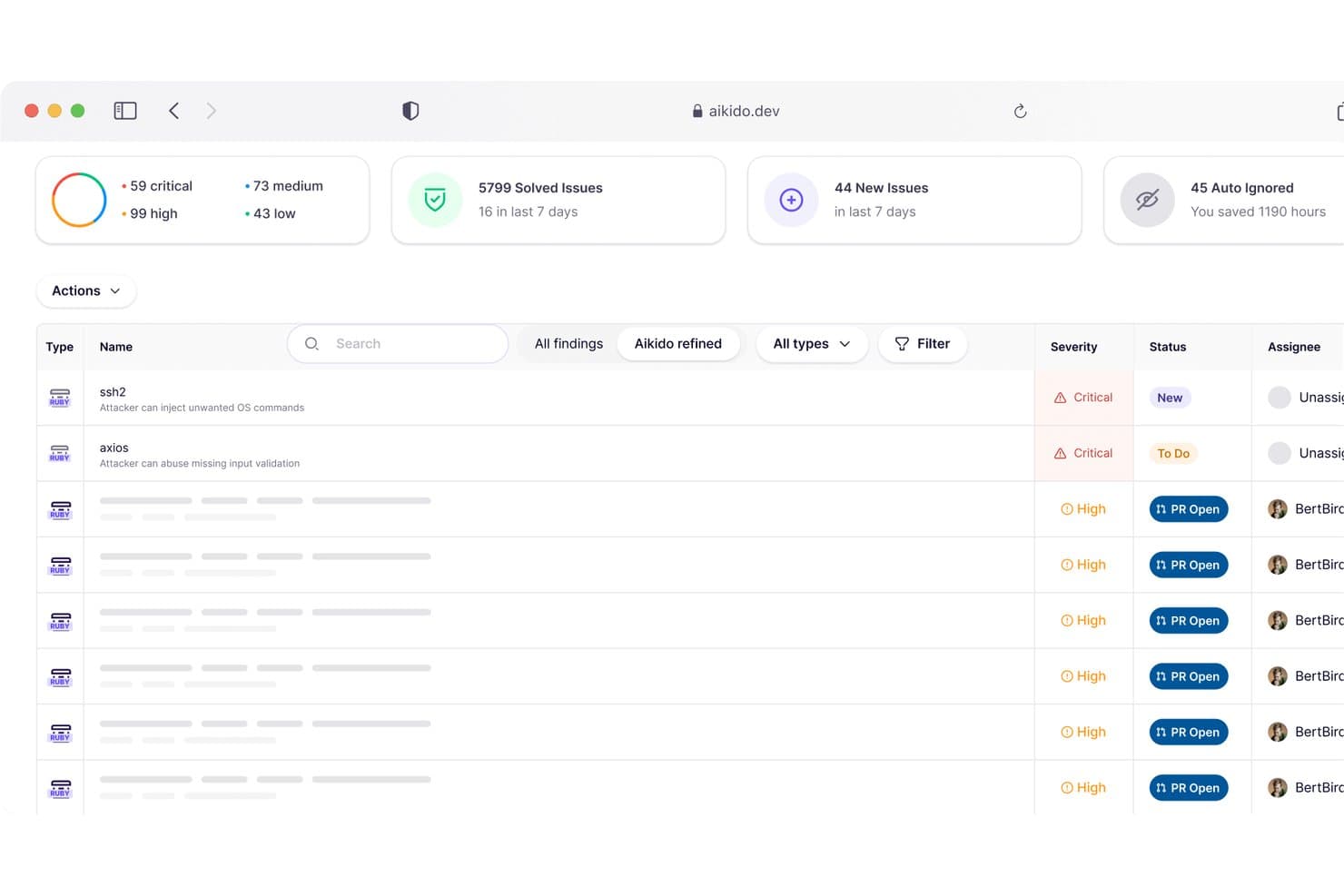
Aikido Security centralizes vulnerability findings by severity and status. Aikido Security is an application security platform that unifies code, cloud, and runtime protection—covering dependency scanning, SAST, secrets detection, container scanning, CSPM, and runtime threat blocking in a single system.
Who Is Aikido Security Best For?
Aikido Security is a strong fit for development-focused engineering teams that need to find and fix vulnerabilities across code, cloud, and containers without managing a stack of separate tools.
Why I Picked Aikido Security
I picked Aikido Security as one of the best because it closes the gap between finding a vulnerability and actually fixing it—something most security tools leave to the developer to figure out. I love that its reachability analysis filters out CVEs that can't actually be triggered in your codebase, so your team spends time on real risk, not noise. Its AutoFix feature goes further by generating pull requests with the dependency upgrades already written, which means a developer can remediate a confirmed issue without ever leaving their workflow.
Aikido Security Key Features
- CISA KEV and EPSS integration: Syncs exploit intelligence data daily to automatically adjust vulnerability severity scores based on known exploited CVEs and exploit prediction scoring.
- Runtime threat blocking (Zen): Instruments your application at runtime to stop risky operations mid-execution, with controls for bot blocking, Tor traffic, geographic restrictions, and user-aware rate limiting.
- Multi-framework compliance reporting: Generates audit-ready reports mapped to ISO 27001, SOC 2, PCI DSS, HIPAA, NIST 800-53, DORA, NIS2, and several other frameworks.
- Attack surface monitoring: Scans internet-facing assets for exposed subdomains, open ports, TLS issues, DNS takeover risks, and email-spoofing vulnerabilities.
Aikido Security Integrations
Aikido Security offers native integrations with GitHub, GitLab, Azure DevOps, AWS, Google Cloud, Jira, Linear, Slack, Microsoft Teams, Drata, and Vanta. It also supports REST APIs and webhooks, plus a Datadog SIEM connector available by request.
Pros and Cons
Pros:
- One dashboard unifies code, cloud, runtime
- Reachability prioritizes vulnerabilities by actual use
- Reviewers praise actionable, lower-noise findings
Cons:
- Device protection misses existing malware
- No documented automated incident playbooks
Learn more about Aikido Security: Best for DDoS protection
- 30-day free trial + free demo available
- Pricing upon request
Visit WebsiteCustomer Rating:4.7/5
Radware delivers DDoS defense to keep networks and applications available. Radware is a cybersecurity solution specializing in DDoS protection, catering mainly to large enterprises and service providers. It offers advanced threat detection and mitigation to protect networks and applications. Radware's main functions include safeguarding against cyberattacks and ensuring service availability.
Why I picked Radware: Its exceptional DDoS protection capabilities make it ideal for organizations facing frequent cyber threats. Radware's real-time threat intelligence helps identify and mitigate attacks quickly. The hybrid DDoS protection combines on-premise devices with cloud-based mitigation for full coverage. Its ability to maintain service availability during attacks ensures your operations remain uninterrupted.
Standout Features and Integrations:
Features include AI-powered behavioral detection to distinguish legitimate from malicious traffic, automated attack mitigation to respond quickly to threats, and advanced protection against SSL attacks to secure communications and infrastructure.
Integrations include AWS, Microsoft Azure, Google Cloud, Splunk, and more.
Pros and Cons
Pros:
- Effective bot management
- Hybrid DDoS protection solutions
- Real-time threat intelligence
Cons:
- Policy tuning requires expertise
- UI reporting depth can feel fragmented
Learn more about Radware: Best for AI-powered ransomware detection
- Free demo available
- From $179.99/endpoint (billed annually)
Visit WebsiteCustomer Rating:4.7/5
SentinelOne delivers AI-driven endpoint protection with threat defense. SentinelOne is an AI-driven cybersecurity platform delivering extended detection and response (XDR) across endpoints, primarily serving large enterprises in sectors such as finance, health care, and education. It includes built-in antivirus capabilities and advanced malware protection.
Why I picked SentinelOne: It offers AI-powered threat management by detecting malware, ransomware, zero-day attacks, and insider threats. The Singularity platform integrates various security functions and generative AI to automate security processes, helping to improve your team's efficiency by reducing manual tasks.
Standout Features and Integrations:
Features include a cloud-native application protection platform for complete security, automated incident response to minimize manual intervention, and advanced threat intelligence for insights into potential cyber threats.
Integrations include AWS, IBM QRadar, Palo Alto Networks, Microsoft Azure, Google Cloud, Slack, and more.
Pros and Cons
Pros:
- Generative AI operations
- Strong ransomware protection
- Detects and blocks malware threats
Cons:
- Rollback features require careful policy setup
- Complex initial setup
Learn more about SentinelOne: Best for unified EDR and threat intelligence
- 15-day free trial available
- From $7.99/device/month
Visit WebsiteCustomer Rating:4.6/5
CrowdStrike Falcon helps you monitor and secure cloud and container workloads with centralized visibility across multi-cloud environments. CrowdStrike Falcon delivers endpoint security through a single lightweight agent, unifying next-gen antivirus, EDR, threat hunting, and cloud workload protection on one platform.
Who Is CrowdStrike Falcon Best For?
CrowdStrike Falcon is a strong fit for mid-to-large enterprises with security operations teams that need centralized visibility across a distributed, multi-platform environment.
Why I Picked CrowdStrike Falcon
I've included CrowdStrike Falcon in my top picks because it's one of the few endpoint security platforms that genuinely unifies EDR and threat intelligence in a single agent, rather than bolting them together. Falcon Insight XDR correlates endpoint telemetry with adversary intelligence from CrowdStrike's Counter Adversary Operations team, so detections come with real context: who the attacker is, what their known tactics are, and what they're likely to do next. I also like how Falcon's indicators of attack (IOAs) go beyond signature matching to catch malware-free intrusions, including the kind of living-off-the-land techniques that show up in 82% of {{year}} detections according to CrowdStrike's own threat data.
CrowdStrike Falcon Key Features
- Falcon Prevent: A next-generation antivirus (NGAV) module that blocks malware, ransomware, and fileless attacks using AI-based detection models trained on trillions of events.
- Falcon OverWatch: A managed threat hunting service that runs 24/7 searches across your environment to surface hidden intrusions that automated detections miss.
- Falcon Identity Protection: Monitors identity-based threats in real time, detecting credential-based attacks, privilege escalation, and lateral movement across Active Directory and Azure AD.
- Falcon Spotlight: An agent-based vulnerability management module that surfaces exploitable CVEs on your endpoints without requiring separate scanning infrastructure.
CrowdStrike Falcon Integrations
CrowdStrike Falcon offers 460+ marketplace integrations from over 240 partners, including Splunk, ServiceNow, Okta, Zscaler, Palo Alto Networks, AWS, Google Cloud, and tools across the Microsoft ecosystem like Microsoft 365, Azure, and Microsoft Entra ID. An API is available for custom integrations.
Pros and Cons
Pros:
- MITRE ATT&CK detection with no false positives
- Strong cross-platform coverage across Linux, Windows, macOS
- Full process chain tracing for root cause
Cons:
- Lacks deep content inspection for DLP
- Limited functionality on air-gapped or offline networks
Learn more about CrowdStrike Falcon: Best for compliance testing
- 30-day free trial + free demo available
- From $149/month (billed annually)
Visit WebsiteCustomer Rating:4.6/5
Astra finds vulnerabilities and gives clear steps to fix security risks. Astra is a cybersecurity tool designed for penetration testing and vulnerability assessment, mainly used by businesses needing to meet compliance standards. It helps identify security weaknesses and ensure that applications and networks are secure. Astra’s primary functions include detecting vulnerabilities and providing actionable insights for remediation.
Why I picked Astra: Its focus on compliance testing makes it ideal for businesses needing to adhere to regulatory standards. Astra provides detailed vulnerability reports that help you understand and address security gaps.
Standout Features and Integrations:
Features include continuous vulnerability scanning to keep your systems secure, detailed reporting to identify and address issues, and an intuitive dashboard for easy management of security tasks.
Integrations include Slack, Jira, GitHub, Bitbucket, GitLab, and more.
Pros and Cons
Pros:
- Actionable remediation insights
- Intuitive management dashboard
- Effective compliance testing
Cons:
- SMB budgets may find pricing restrictive
- Pentest scheduling may delay urgent scans
Learn more about Astra:

Fortinet offers threat management, secure networking, and endpoint protection. Fortinet is a cybersecurity solution that provides integrated security services through its Fortinet Security Fabric, catering to enterprises, service providers, and mid-sized organizations. It focuses on protecting networks, applications, and data with its broad suite of security products. Fortinet’s key functions include threat protection, secure networking, and endpoint security.
Why I picked Fortinet: Its integrated security approach makes it ideal for businesses needing a unified strategy. Fortinet's Security Fabric architecture connects different security tools to amplify threat visibility and operational coordination. The FortiGate firewalls offer advanced threat protection and secure networking. This thorough coverage helps your team efficiently manage security across the entire network.
Standout Features and Integrations:
Features include advanced firewalls to block malicious activities, secure SD-WAN for optimized network connectivity, and endpoint protection to safeguard devices on your network.
Integrations include AWS, Microsoft, Google Cloud, IBM, Splunk, ServiceNow, and more.
Pros and Cons
Pros:
- Extensive endpoint protection
- Efficient network management
- Unified security platform
Cons:
- Hardware dependency for full capabilities
- Complex licensing structure
Learn more about Fortinet:

Imperva protects applications and data from external threats. Imperva is a cybersecurity solution designed to protect applications and data in cloud environments from external threats. It is widely used by cybersecurity companies and security teams needing to protect their digital assets. Imperva is frequently recognized in Gartner reports for its leadership in application and data security.
Why I picked Imperva: It delivers real-world protection for sensitive data through its web application firewall (WAF), distributed denial of service (DDoS) mitigation, and API security. Imperva’s key functionalities protect data across cloud and hybrid environments. Its platform integrates well with SIEM tools for centralized monitoring and threat response.
Standout Features and Integrations:
Features include advanced threat analytics for real-time insights into potential risks, a user behavior analytics tool to detect insider threats, and automated security incident responses to reduce manual intervention.
Integrations include AWS, Microsoft Azure, Google Cloud, Splunk, CrowdStrike, IBM, and more.
Pros and Cons
Pros:
- Automated incident response
- Real-time threat insights
- Effective DDoS mitigation
Cons:
- High cost for small businesses
- Limited customization options
Learn more about Imperva: Best for zero-trust application control
- 30-day free trial + free demo available
- Pricing upon request

ThreatLocker ensures only approved applications run for stronger security. ThreatLocker is a cybersecurity solution focused on application control and endpoint protection, catering mainly to businesses of all sizes, including small and medium-sized organizations. It helps manage application permissions and prevent unauthorized software from running. The key function is to improve security by ensuring only approved applications can execute.
Why I picked ThreatLocker: It excels in application control, making it ideal for businesses needing strict software usage policies. Its policy-driven approach allows you to define what applications are permitted. The ringfencing feature isolates applications, reducing the risk of data breaches. This tool's simplicity and focus on application control make it an asset for maintaining a secure environment.
Standout Features and Integrations:
Features include storage control to manage access to data, audit logs for tracking application activity, and a simple interface that makes managing permissions straightforward.
Integrations include ConnectWise Manage, ConnectWise Automate, Datto SaaS Protection, and more.
Pros and Cons
Pros:
- Detects insider threats
- Protects against zero-day exploits
- Granular security controls
Cons:
- Can be restrictive
- Requires policy setup
Learn more about ThreatLocker:

Carahsoft links public sector teams to IT tools for safe, compliant operations. Carahsoft is an IT solutions provider and distributor, primarily serving government agencies and educational institutions. It offers a wide range of cybersecurity products that support secure operations and compliance with government standards. The platform connects public sector organizations with leading software vendors through established government contract vehicles.
Why I picked Carahsoft: Its focus on government solutions supports compliance with stringent regulations. Carahsoft provides access to a variety of cybersecurity tools tailored for public sector needs. The ability to bundle software solutions adds value for teams managing complex IT environments.
Standout Features and Integrations:
Features include a broad marketplace for easy procurement, tailored solutions for government compliance, and bundled offerings that combine multiple software tools for more efficient operations.
Integrations are not publicly listed.
Pros and Cons
Pros:
- Strong partner ecosystem
- Offers bundled solutions
- Simplifies procurement processes
Cons:
- High dependency on partnerships
- Limited to public sector
Learn more about Carahsoft: Best for global DDoS and attack surface defense
- Free trial + free demo available
- Pricing upon request

Akamai Security provides global coverage to secure and optimize digital assets. Akamai Security is a cybersecurity solution tailored for businesses needing extensive global coverage. It serves enterprises that need protection and performance at internet scale. Akamai Security offers content delivery, cloud security, and application performance services.
Why I picked Akamai Security: Its massive ecosystem is unmatched, making it ideal for businesses operating in multiple countries. Akamai Security's content delivery network ensures fast and reliable access to your digital assets, and the application performance services optimize the user experience. For teams needing a broad international presence, Akamai Security provides the necessary infrastructure.
Standout Features and Integrations:
Features include cloud security services, SIEM integrations, bot protection, advanced web application security, and automated threat mitigation for global environments.
Integrations are not publicly listed.
Pros and Cons
Pros:
- Protects cloud workloads
- Secures applications and APIs
- Extensive global network
Cons:
- Debugging false positives can be time-intensive
- Complex configuration
Learn more about Akamai Security:
Alte soluții de securitate cibernetică
Iată câteva opțiuni suplimentare de soluții de securitate cibernetică care nu au ajuns în lista mea scurtă, dar merită totuși analizate:
- 11ARIA CybersecurityBest managed SOC for small teams
- 12HoneywellBest for securing industrial IoT environments
- 13Cisco SecurityBest for enterprise network security
- 14NordLayerBest for remote access to cloud apps
- 15Palo Alto NetworksBest for cloud workload threat protection
- 16SophosBest for endpoint malware and ransomware defense
- 17Miratech PrevalentBest for third-party cyber risk management
How I Evaluate Cybersecurity Solutions
Whether I'm evaluating threat detection coverage for a SOC team or compliance reporting for a CISO, I split my approach into core requirements and the differentiators that actually separate vendors.
Core Functionality (Table Stakes For This List)
When I'm selecting tools for my list, I rank each one on a scale from 0 (does not offer the functionality) to 5 (excels in this area) for each core functionality listed below. Then, I calculate the tool's total score into a percentage. Each tool needs to achieve a minimum total score of 75% to be considered for inclusion.
- Threat Detection & Response: I evaluate whether a platform can surface real threats in real time and give analysts clear paths to contain them, from isolating a compromised endpoint to blocking lateral movement.
- Vulnerability & Risk Management: Each tool should scan and prioritize weaknesses across assets, so your team can patch an exploitable CVE on a public-facing server before it becomes an incident.
- Access & Identity Controls: I look for MFA, RBAC, and SSO support at a minimum, and I check how well the platform enforces least-privilege policies across user accounts and service credentials.
- Data Protection & Encryption: Encryption at rest and in transit is the baseline, but I also consider whether a tool offers DLP or classification to prevent sensitive records from leaving the environment.
- Compliance & Audit Reporting: The platform should map controls to frameworks like PCI-DSS, HIPAA, or SOC 2 and generate audit-ready reports without requiring your team to build them from scratch.
- Centralized Security Visibility: I check whether the tool aggregates logs and alerts from endpoints, cloud workloads, and network devices into a single pane, making cross-source correlation practical for a lean SOC team.
Once I have a list of tools that meet this criteria, I consider what sets each platform apart.
Differentiating Factors (What Sets Vendors Apart)
Here's how I compare and contrast different vendors:
Standout Features
AI-driven threat intelligence separates strong platforms from average ones—I evaluate how well a tool correlates global threat feeds with your environment's telemetry to surface emerging attack patterns. SOAR capabilities matter just as much, since automated playbooks that handle initial triage and containment free analysts to focus on complex investigations. Attack surface management is another differentiator I look for, especially for teams with sprawling infrastructure where unknown exposed assets can become blind spots.
Beyond Features
Integration ecosystem is one of the first things I check—your security stack needs to connect with SIEM, ITSM, and identity providers like Okta or Azure AD without custom workarounds. Deployment model matters too, since some teams need air-gapped or on-premise options that a SaaS-only vendor can't deliver. I also evaluate vendor support tiers, particularly whether a provider offers MDR services or incident response retainers for teams that lack 24/7 SOC coverage in-house.
Cum să alegi o soluție de securitate cibernetică
Este ușor să te pierzi în liste lungi de funcții și structuri complexe de prețuri. Pentru a te ajuta să rămâi concentrat în timp ce parcurgi procesul unic de selecție a software-ului, iată o listă de factori de care să ții cont:
| Factor | Ce trebuie să iei în considerare |
|---|---|
| FactorScalabilitate | Ce trebuie să iei în considerarePoate soluția să crească odată cu afacerea ta? Ia în considerare nevoile viitoare și dacă instrumentul poate gestiona un volum mai mare de date sau utilizatori fără o scădere a performanței. |
| FactorIntegrări | Ce trebuie să iei în considerareSe conectează la sistemele existente? Verifică compatibilitatea cu stiva software actuală pentru a evita întreruperile fluxului de lucru. |
| FactorPosibilitate de personalizare | Ce trebuie să iei în considerarePoți adapta instrumentul la nevoile tale specifice? Caută opțiuni care permit ajustări pentru a se potrivi proceselor și preferințelor tale unice. |
| FactorUșurință în utilizare | Ce trebuie să iei în considerareEste instrumentul intuitiv pentru echipa ta? O interfață ușor de utilizat reduce timpul de instruire și crește rata de adoptare. |
| FactorImplementare și integrare inițială | Ce trebuie să iei în considerareCât de repede poate începe echipa ta să îl utilizeze eficient? Evaluează resursele oferite pentru configurare, inclusiv tutoriale, asistență și documentație. |
| FactorCost | Ce trebuie să iei în considerareSe aliniază prețul cu bugetul tău? Ia în considerare costul total de deținere, inclusiv orice taxe sau costuri ascunse care depășesc prețul inițial. |
| FactorMăsuri de protecție a securității | Ce trebuie să iei în considerareExistă măsuri solide pentru protejarea datelor tale? Caută criptare, controale de acces și actualizări regulate de securitate pentru a asigura integritatea și siguranța datelor. |
| FactorCerințe de conformitate | Ce trebuie să iei în considerareRespectă reglementările din domeniu? Asigură-te că soluția permite respectarea standardelor relevante pentru domeniul tău, precum GDPR sau HIPAA, pentru a evita problemele juridice. |
Ce sunt soluțiile de securitate cibernetică?
Soluțiile de securitate cibernetică sunt instrumente concepute pentru a proteja sistemele, rețelele și datele împotriva amenințărilor informatice și a accesului neautorizat. Specialiștii IT, analiștii de securitate și administratorii de rețea folosesc de obicei aceste instrumente pentru a proteja informațiile sensibile și pentru a contribui la asigurarea continuității activității. Funcții precum detectarea amenințărilor, criptarea datelor și controlul accesului contribuie la prevenirea amenințărilor și la menținerea integrității datelor. În general, aceste instrumente oferă protecție esențială și liniște companiilor care operează în mediul digital.
Funcții
Atunci când alegi soluții de securitate cibernetică, fii atent la următoarele funcții principale:
- Detectarea amenințărilor: Identifică amenințările potențiale în timp real pentru a preveni breșele de date și atacurile.
- Criptarea datelor: Protejează informațiile sensibile transformându-le într-un cod imposibil de citit de utilizatorii neautorizați.
- Controlul accesului: Gestionează cine poate accesa sistemele și datele dumneavoastră, asigurând accesul doar utilizatorilor autorizați.
- Scanarea vulnerabilităților: Detectează punctele slabe din sistemul dumneavoastră care ar putea fi exploatate de atacatori.
- Răspunsul la incidente: Oferă instrumente și protocoale pentru a răspunde rapid la breșele de securitate și pentru a minimiza daunele.
- Asistență pentru conformitate: Ajută la respectarea reglementărilor și standardelor din domeniu, reducând riscul problemelor juridice.
- Monitorizarea rețelei: Supraveghează traficul din rețea pentru a detecta tipare neobișnuite și amenințări potențiale.
- Actualizări automate: Asigură că software-ul dumneavoastră este întotdeauna actualizat cu cele mai recente corecții de securitate și îmbunătățiri.
- Analiza comportamentului utilizatorilor: Analizează acțiunile utilizatorilor pentru a identifica un comportament anormal care poate indica o amenințare de securitate.
- Rapoarte și tablouri de bord: Oferă informații vizuale clare despre nivelul de securitate și domeniile care necesită atenție.
Beneficii
Implementarea soluțiilor de securitate cibernetică oferă mai multe beneficii echipei și companiei dumneavoastră. Iată câteva dintre acestea:
- Protecția datelor: Protejează informațiile sensibile împotriva breșelor prin criptare și controale stricte ale accesului.
- Conformitatea cu reglementările: Ajută la asigurarea faptului că afacerea dumneavoastră respectă standardele și reglementările din domeniu, evitând sancțiunile juridice.
- Prevenirea amenințărilor: Identifică și reduce riscurile înainte ca acestea să devină probleme grave, menținând sistemele în siguranță.
- Continuitatea operațională: Sprijină desfășurarea neîntreruptă a activității în timpul intruziunilor cibernetice, prin capacități eficiente de răspuns la incidente.
- Încredere sporită: Consolidează încrederea clienților și partenerilor, demonstrând angajamentul față de securitate.
- Eficiența resurselor: Automatizează numeroase sarcini de securitate, eliberând echipa pentru a se concentra asupra altor priorități.
- Vizibilitate sporită: Oferă informații clare despre nivelul de securitate prin rapoarte și analize extinse.
Costuri și prețuri
Selectarea soluțiilor de securitate cibernetică necesită înțelegerea diferitelor modele de preț și planuri disponibile. Costurile variază în funcție de caracteristici, dimensiunea echipei, suplimente și alți factori. Tabelul de mai jos rezumă planurile obișnuite, prețurile medii ale acestora și caracteristicile incluse de regulă în soluțiile de securitate cibernetică:
Tabel comparativ al planurilor pentru soluțiile de securitate cibernetică
| Tipul planului | Preț mediu | Caracteristici comune |
|---|---|---|
| Tipul planuluiPlan gratuit | Preț mediu$0 | Caracteristici comuneDetectarea de bază a amenințărilor, criptarea limitată a datelor și controlul de bază al accesului utilizatorilor. |
| Tipul planuluiPlan personal | Preț mediu$5-$25/utilizator/lună | Caracteristici comuneDetectarea îmbunătățită a amenințărilor, criptarea avansată a datelor și controale personalizabile ale accesului utilizatorilor. |
| Tipul planuluiPlan pentru companii | Preț mediu$30-$75/utilizator/lună | Caracteristici comuneDetectarea completă a amenințărilor, asistență detaliată pentru conformitate și raportare și analize detaliate. |
| Tipul planuluiPlan pentru întreprinderi | Preț mediu$80-$150/utilizator/lună | Caracteristici comuneDetectarea completă a amenințărilor, răspuns automat la incidente și capacități complete de integrare. |
Întrebări frecvente despre soluțiile de securitate cibernetică
Iată câteva răspunsuri la întrebările frecvente despre soluțiile de securitate cibernetică:
Cum măsur eficiența unei soluții de securitate cibernetică?
Începeți prin urmărirea unor indicatori esențiali, precum ratele de detectare, alarmele fals pozitive, timpii de răspuns și numărul de amenințări blocate. Verificați periodic jurnalele de incidente și testați-vă măsurile de apărare prin atacuri simulate. Comparați rezultatele cu obiectivele de securitate pentru a vedea dacă soluția răspunde cerințelor dumneavoastră. Solicitați feedback de la echipa IT privind ușurința de utilizare și performanța, pentru a completa evaluarea.
Cât de des ar trebui să îmi actualizez sau să îmi reevaluez soluția de securitate cibernetică?
Ar trebui să vă verificați soluția de securitate cibernetică la fiecare șase până la 12 luni. Modificările majore ale sistemului, noile amenințări sau actualizările cerințelor de conformitate pot necesita verificări mai frecvente. Programați periodic teste de penetrare și audituri și ajustați configurația pe baza rezultatelor acestora. Mențineți-vă la curent cu informațiile despre amenințări, pentru a vă putea adapta rapid la noile riscuri.
Pot soluțiile de securitate cibernetică să contribuie la reducerea timpilor de răspuns la incidente?
Da, multe soluții de securitate cibernetică automatizează detectarea și trimiterea alertelor, permițându-vă să răspundeți mai rapid la amenințări. Panourile de control în timp real, fluxurile de lucru automatizate și integrările cu instrumentele de răspuns la incidente contribuie la reducerea semnificativă a timpilor de răspuns. Prin centralizarea informațiilor despre amenințări, aceste platforme facilitează acțiunea rapidă a echipei și limitarea la minimum a pagubelor.
Cum mă asigur că echipa mea obține cea mai mare valoare din instrumentele noastre de securitate cibernetică?
Instruiți-vă personalul cu privire la utilizarea instrumentelor și stabiliți procese clare pentru monitorizare și răspuns. Încurajați exercițiile periodice și schimbul de cunoștințe. Folosiți funcțiile de raportare pentru a identifica lacunele de performanță și ajustați-vă abordarea după cum este necesar. Asigurați-vă că utilizați toate funcțiile relevante și verificați periodic utilizarea instrumentelor pentru a vă maximiza investiția.