

Instrumentele de guvernanță AI sunt platforme care vă ajută echipa să controleze, să monitorizeze și să documenteze modul în care sunt utilizate sistemele de inteligență artificială în întreaga organizație. Dacă ați ajuns aici, probabil vă confruntați cu întrebări urgente despre conformitate, riscuri și transparență, pe măsură ce adoptați cadre formale de guvernanță AI. Indiferent dacă trebuie să demonstrați conformitatea cu cadre stricte, să monitorizați prejudecățile și deviațiile sau să construiți o pistă de audit responsabilă, instrumentul potrivit este fundația dumneavoastră.
Acest ghid prezintă cele mai bune opțiuni pentru 2026, astfel încât să puteți compara soluțiile de top și să luați o decizie informată, adaptată ritmului și realităților operațiunilor dumneavoastră de inteligență artificială.
Why Trust Our Software Recommendations
6,700+
Reviews
20
Industry experts
16+
Evaluation factors
14
Years
Our team has been testing and reviewing software since 2012. As tech leaders ourselves, we know how difficult—and important—it is to choose the right software.
For this guide, we evaluated tools using hands-on testing and independent research, scoring tools using our selection criteria.
Our reviews reflect our human editorial judgment, not a sales pitch.
Expert reviewers:
- Paulo Gardini MiguelTech Director
 Tim FisherVP of AI
 Gabriel RosasTech Lead & Software Architect
 Christhian GruhnTech Lead & Platform Architect

Tabel comparativ al instrumentelor de guvernanță AI
Acest tabel comparativ rezumă detaliile privind prețurile pentru selecția mea de instrumente de guvernanță AI de top:
Sorted by: Default
| Tool | Starting Price | Website | |
|---|---|---|---|
Best for end-to-end model risk management | Not rated | Pricing upon request Free demo available | Website |
Best for end-to-end data and model lineage | Not rated | Pricing upon request Free demo available | Website |
Best for GenAI guardrails and risk evaluation | Not rated | Pricing upon request Free demo available | Website |
Best for audit-ready model documentation | Not rated | Pricing upon request Not available | Website |
Best for unified data and AI compliance reporting | Not rated | $12/month Free trial available | Website |
Best for policy-driven regulatory compliance | 4.2 out of 5 | Pricing upon request Free demo available | Website |
Best for lifecycle coverage with audit evidence | Not rated | Pricing upon request Free demo available | Website |
Best for enterprise model lifecycle management | Not rated | $795/month Free trial + free demo available | Website |
Best for privacy-first governance workflows | Not rated | Pricing upon request Free demo available | Website |
Best for automated model inventory and discovery | Not rated | Pricing upon request Free demo available | Website |


Recenzii ale celor mai bune instrumente de guvernanță AI
Mai jos sunt prezentate rezumatele mele detaliate ale celor mai bune instrumente de guvernanță AI care au ajuns pe lista mea scurtă. Recenziile mele oferă o privire detaliată asupra capacităților, celor mai bune cazuri de utilizare și integrărilor fiecărei platforme, pentru a vă ajuta să o găsiți pe cea mai potrivită pentru dumneavoastră.
 Best for end-to-end model risk management
- Free demo available
- Pricing upon request

DataRobot offers quota monitoring and usage tracking per entity, enabling CTOs to govern AI resource consumption and enforce rate limits across deployments. DataRobot is an AI governance platform that covers model registry, real-time policy enforcement, pre-deployment red-teaming, and compliance monitoring across cloud, on-premises, edge, and air-gapped environments.
Who Is DataRobot Best For?
DataRobot suits large enterprises in regulated industries—like financial services and defense—managing large-scale AI deployments that span multiple environments and require audit-ready compliance documentation.
Why I Picked DataRobot
DataRobot earns its spot on my shortlist because the three-layer governance model addresses risk at every stage of the model lifecycle. Pre-deployment red-teaming surfaces bias, jailbreaks, and toxicity before anything ships, while real-time moderation blocks unsafe outputs in production. I also like how policies are defined once and automatically propagated across the entire agent estate, so governance coverage doesn't drift as deployments multiply.
DataRobot Key Features
- Central model inventory: Catalogs all models, datasets, owners, and use cases across diverse environments in a unified registry.
- Automated compliance documentation: Generates structured records tailored to industry regulations like the EU AI Act and NIST AI RMF.
- Real-time LLM guardrails: Filters for prompt injection, PII leakage, hallucinations, and hidden security vulnerabilities in AI/LLM outputs as they occur.
- Native Airflow integration: Orchestrates model workflows and batch processing through direct integration with Apache Airflow.
DataRobot Integrations
DataRobot offers native integrations with SAP, Snowflake, Amazon S3, MLFlow, Tableau, Pinecone, Databricks, HuggingFace, Streamlit, and more. An API is available for custom integrations.
Pros and Cons
Pros:
- Pre-built regulatory framework mapping
- Real-time LLM output moderation
- Automated compliance documentation workflows
Cons:
- Advanced features require significant user training
- No public pricing transparency
Learn more about DataRobot: Best for end-to-end data and model lineage
- Free demo available
- Pricing upon request

Collibra Data Governance offers a Model Registry dashboard that tracks AI models by status, ownership, and lifecycle with analytics and filtering capabilities. Collibra Data Governance is an enterprise data and AI governance platform that centralizes model inventory, policy enforcement, compliance mapping, and end-to-end lineage tracking across cloud and on-premises environments.
Who Is Collibra Data Governance Best For?
Collibra is a strong fit for large enterprises in regulated industries like finance and healthcare that need governance across complex, multi-cloud AI and data environments.
Why I Picked Collibra Data Governance
Collibra Data Governance earns its spot on my shortlist because the lineage coverage genuinely goes further than most tools I've tested. I can trace a model's full history from raw source datasets through training runs, inference pipelines, and live deployment, all in one connected view. The 2025 Deasy Labs acquisition also extends that lineage to unstructured data like documents and transcripts, which was a real gap in most governance platforms I've evaluated.
Collibra Data Governance Key Features
- AI Command Center: Centralizes registration, assessment, and monitoring of AI models and use cases across cloud providers.
- Automated policy enforcement: Lets you configure rules and approval workflows to govern AI assets throughout their lifecycle.
- Compliance mapping dashboards: Maps your models against frameworks like the EU AI Act, NIST AI RMF, and ISO 42001 for regulatory alignment.
- Role-based access controls: Supports granular data and model governance with permissions for data stewards, risk officers, and audit teams.
Collibra Data Governance Integrations
Collibra Data Governance offers 100+ native integrations, including AWS SageMaker, Azure AI Foundry, Databricks Unity Catalog, Google Vertex AI, Tableau, Salesforce, Slack, MLflow, and SAP AI Core. An API is also available for custom integrations.
Pros and Cons
Pros:
- Automated workflows for AI risk assessment
- Extensive compliance mapping and reporting features
- End-to-end data and model lineage tracking
Cons:
- Complex implementation for resource-limited teams
- Model performance monitoring is limited
Learn more about Collibra Data Governance: Best for GenAI guardrails and risk evaluation
- Free demo available
- Pricing upon request

Lumenova AI offers a comprehensive AI Governance Platform with seven key features including risk management, guardrails, and automated documentation. Lumenova AI is an AI governance and model risk management platform that combines AI model inventory, risk assessment workflows, compliance mapping, guardrails, and production model monitoring across traditional ML and GenAI systems.
Who Is Lumenova AI Best For?
Lumenova AI is a strong fit for enterprises in regulated industries like banking, insurance, and healthcare that need to govern both traditional ML models and GenAI systems.
Why I Picked Lumenova AI
Lumenova AI earns its spot on my shortlist because of how it handles GenAI risk at the inference layer. I particularly like the guardrails module, which filters for prompt injection, harmful content, and sensitive data exposure in real time across LLM and agent interactions. The evaluations layer goes deep too, covering 200+ metrics across hallucination detection, bias, and security resilience, backed by a library of 80+ pre-built risk scenarios.
Lumenova AI Key Features
- Centralized AI model inventory: Catalogs all AI and ML models with metadata, versioning, and ownership details in a single auditable registry.
- Compliance mapping and evidence generation: Maps models to frameworks like the EU AI Act and NIST AI RMF, creating audit-ready documentation.
- Lifecycle management workflows: Supports AI model tracking from ideation through deployment and retirement, capturing lineage and status changes.
- Role-based collaboration: Enables risk, compliance, and technical stakeholders to coordinate reviews, sign-offs, and approvals across the governance process.
Lumenova AI Integrations
Native integrations are not publicly listed. Lumenova AI provides an API for custom integrations.
Pros and Cons
Pros:
- Centralized lifecycle workflows for model governance
- Advanced risk scenario library and framework coverage
- Comprehensive GenAI guardrails for LLMs and agents
Cons:
- Native integrations not clearly documented
- No self-serve onboarding or instant access
Learn more about Lumenova AI:

Monitaur offers an Apply Governance workflow that lets users set risk level, review due date, and compliance template for AI models flagged as high risk. Monitaur is an AI governance platform built for regulated enterprises, covering model inventory, risk assessment, policy enforcement, compliance mapping, and automated audit documentation across the full model lifecycle.
Who Is Monitaur Best For?
Monitaur is a strong fit for risk and compliance teams in regulated industries like insurance and financial services that need structured AI governance programs.
Why I Picked Monitaur
I picked Monitaur as one of the best because its approach to audit-ready documentation is the most automated I've seen. Automate Record captures every AI decision against predefined safe ranges and auto-maps that evidence to Common Controls, covering NIST AI RMF, ISO 42001, and the EU AI Act. Before deployment, FlightSim runs synthetic simulations and returns letter grades with remediation guidance, creating a documented pre-deployment validation record.
Monitaur Key Features
- Centralized inventory: Catalogs all AI models, use cases, and vendors in a single registry with ownership and lifecycle status.
- Customizable policy templates: Offers ready-to-use templates aligned with major frameworks such as the EU AI Act, NIST AI RMF, and ISO 42001.
- Collaborative workflow management: Enables multi-stakeholder policy reviews, risk assessments, and approvals across compliance and technical teams.
- Third-party AI oversight: Manages and monitors external and vendor-supplied AI models alongside internal deployments.
Monitaur Integrations
Monitaur offers native integrations with Databricks, MLFlow, DataRobot, Azure, AWS SageMaker, ServiceNow, Confluence, Langfuse, GitHub, and more. An API is available for custom integrations.
Pros and Cons
Pros:
- Pre-deployment validation with FlightSim grading
- Centralized model inventory with lifecycle tracking
- Automated evidence collection for regulatory frameworks
Cons:
- Limited explainability features compared to some peers
- Quote-based pricing, no transparent tier info
Learn more about Monitaur: Best for unified data and AI compliance reporting
- Free trial available
- From $12/month (billed annually)

Microsoft Purview offers a Data Security Posture Management (DSPM) for AI dashboard that provides AI governance tools including compliance recommendations, interaction reports, and sensitive data protection insights. Microsoft Purview is a data governance and compliance platform from Microsoft that combines data classification, DLP, insider risk management, and AI app oversight across Microsoft 365 and multicloud environments.
Who Is Microsoft Purview Best For?
It's a natural fit for enterprise IT and compliance teams already running Microsoft 365 who need centralized visibility into data security and AI app governance.
Why I Picked Microsoft Purview
I picked Microsoft Purview as one of the best because its Compliance Manager maps AI systems against the EU AI Act, NIST, and 300+ other regulatory templates from a single console. DSPM for AI then layers on a real-time risk dashboard that tracks compliance posture across Copilot, ChatGPT Enterprise, and Gemini simultaneously. I find the combination of data classification and AI app compliance reporting in one portal is what separates it from point solutions in this space.
Microsoft Purview Key Features
- Unified data catalog: Centralizes metadata and classification for data assets across Microsoft 365, Azure, and supported multicloud sources.
- Insider risk management: Monitors and investigates suspicious user activity and potential data exfiltration involving sensitive content.
- Data loss prevention policies: Automates enforcement to prevent sensitive data leaks in emails, files, and AI-enabled applications.
- Audit logging and eDiscovery: Captures immutable activity logs and supports advanced search and legal hold across enterprise data.
Microsoft Purview Integrations
Microsoft Purview has native integrations across the Microsoft ecosystem, including Microsoft 365 and Azure, and supports connections to sources like SharePoint, SQL Server, Amazon S3, and Entra ID. An API is available for custom integrations.
Pros and Cons
Pros:
- Strong DLP and insider risk management
- Unified data and AI governance portal
- Deep compliance mapping for global regulations
Cons:
- AI model inventory is limited to apps
- No native model monitoring capabilities
Learn more about Microsoft Purview: Best for policy-driven regulatory compliance
- Free demo available
- Pricing upon request
Visit WebsiteCustomer Rating:4.2/5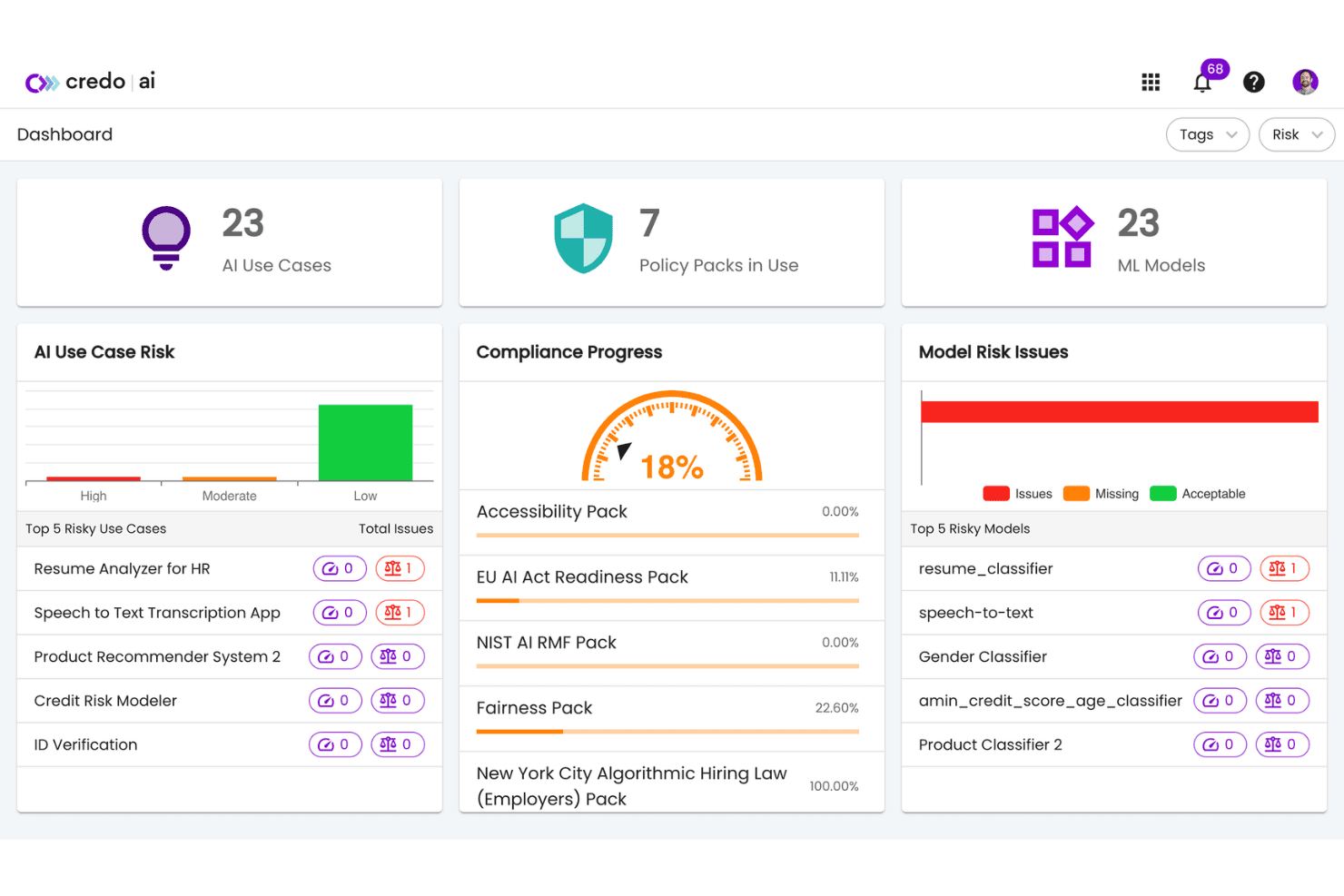
Credo AI offers a centralized governance dashboard displaying AI use case risk levels, compliance progress across policy packs, and model risk issues for CTOs managing AI oversight. Credo AI is a purpose-built AI governance platform that combines an AI model registry, automated risk assessment, policy enforcement, compliance mapping, and runtime monitoring across the full AI lifecycle.
Who Is Credo AI Best For?
Credo AI is a strong fit for enterprise teams in regulated industries like financial services and healthcare that need structured AI risk and compliance oversight.
Why I Picked Credo AI
I picked Credo AI as one of the best because its pre-built policy packs for EU AI Act, NIST AI RMF, and ISO 42001 give compliance teams a direct path from regulation to enforcement, without building frameworks from scratch. I like how the Policy Engine automates evidence collection and generates audit-ready documentation as models move through the lifecycle. The Agent Registry also impresses me, letting my team govern autonomous AI agents with the same policy-driven rigor applied to traditional models.
Credo AI Key Features
- Shadow AI discovery: Continuously scans cloud and code environments to auto-detect unregistered AI and agentic systems.
- Governance knowledge graph: Connects regulations, controls, and AI components for unified policy orchestration and oversight.
- Runtime governance: Ingests traces and applies real-time policy checks as models or agents process data in production.
- Python SDK: Lets teams integrate governance checks and policy enforcement directly into ML pipelines and custom workflows.
Credo AI Integrations
Credo AI offers native integrations with 30+ apps including AWS, Microsoft, Databricks, and IBM, and provides an API and Python SDK for custom enterprise AI applications.
Pros and Cons
Pros:
- Agent registry supports agentic AI governance
- Shadow AI discovery across cloud environments
- Automated policy packs for major regulations
Cons:
- Interface complexity may slow initial onboarding
- Lacks deep technical model explainability
Learn more about Credo AI: Best for lifecycle coverage with audit evidence
- Free demo available
- Pricing upon request
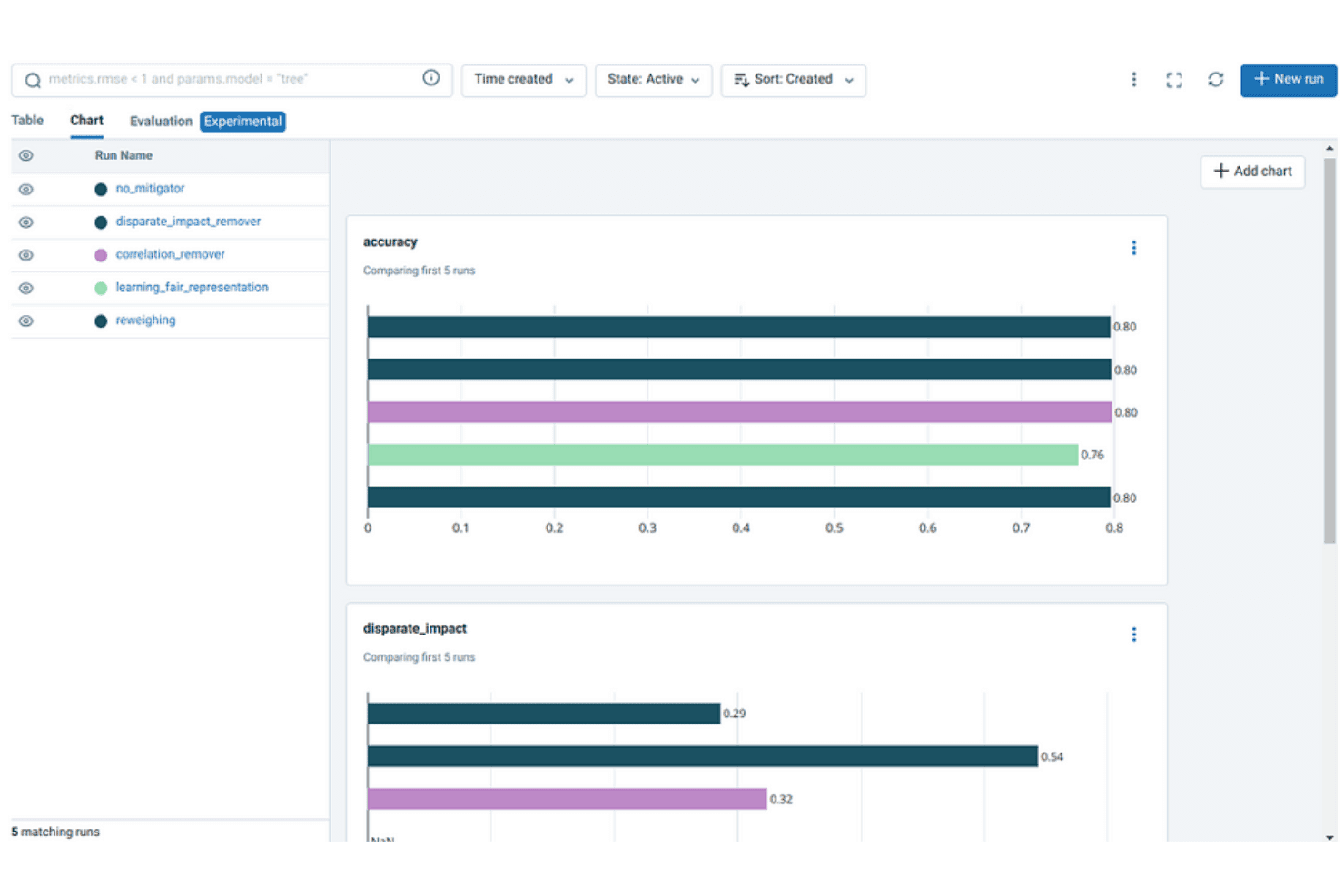
Holistic AI offers a comparative chart view of fairness mitigation runs, tracking accuracy and disparate impact metrics across five algorithms. Holistic AI is an AI governance platform covering the AI lifecycle: discovery and inventory of AI systems, risk assessment, testing and red teaming, governance workflows, and continuous monitoring. It supports compliance with the EU AI Act, NIST and ISO 42001, with audit evidence.
Who Is Holistic AI Best For?
It's a strong fit for large enterprises with broad AI deployments that need to document and prove compliance across multiple regulatory frameworks simultaneously.
Why I Picked Holistic AI
Holistic AI earns its spot on my shortlist because of how it handles simultaneous compliance across the EU AI Act, NIST AI RMF, ISO 42001, and NYC Local Law 144. What I particularly like is the automated control mapping: it maps your AI systems to each framework's controls and flags gaps without manual cross-referencing. I also rely on its continuous evidence collection to generate audit-ready documentation without rebuilding it from scratch before every regulatory review.
Holistic AI Key Features
- Automated model inventory: Scans cloud platforms, code repositories, and SaaS tools to detect and register all AI systems within the organization.
- LLM guardrails: Provides real-time content filtering for prompt injection, hallucinations, PII leakage, and unsafe outputs in generative AI workflows.
- Role-based collaboration: Offers interfaces and workflows tailored to data scientists, compliance leads, and executives for coordinated governance actions.
- Immutable audit trails: Automatically records decision history, approvals, and model changes for regulator-ready documentation and accountability.
Holistic AI Integrations
Holistic AI offers native integrations with AWS, Azure, GitHub, Databricks, ServiceNow, Snowflake, Confluence, Langsmith, CrewAI, and more, plus an API for custom integrations.
Pros and Cons
Pros:
- Real-time LLM guardrails for generative AI
- Automated model discovery across environments
- Extensive regulatory framework coverage
Cons:
- Fewer explainability options than MLOps tools
- Limited code-level model inspection
Learn more about Holistic AI: Best for enterprise model lifecycle management
- Free trial + free demo available
- From $795/month
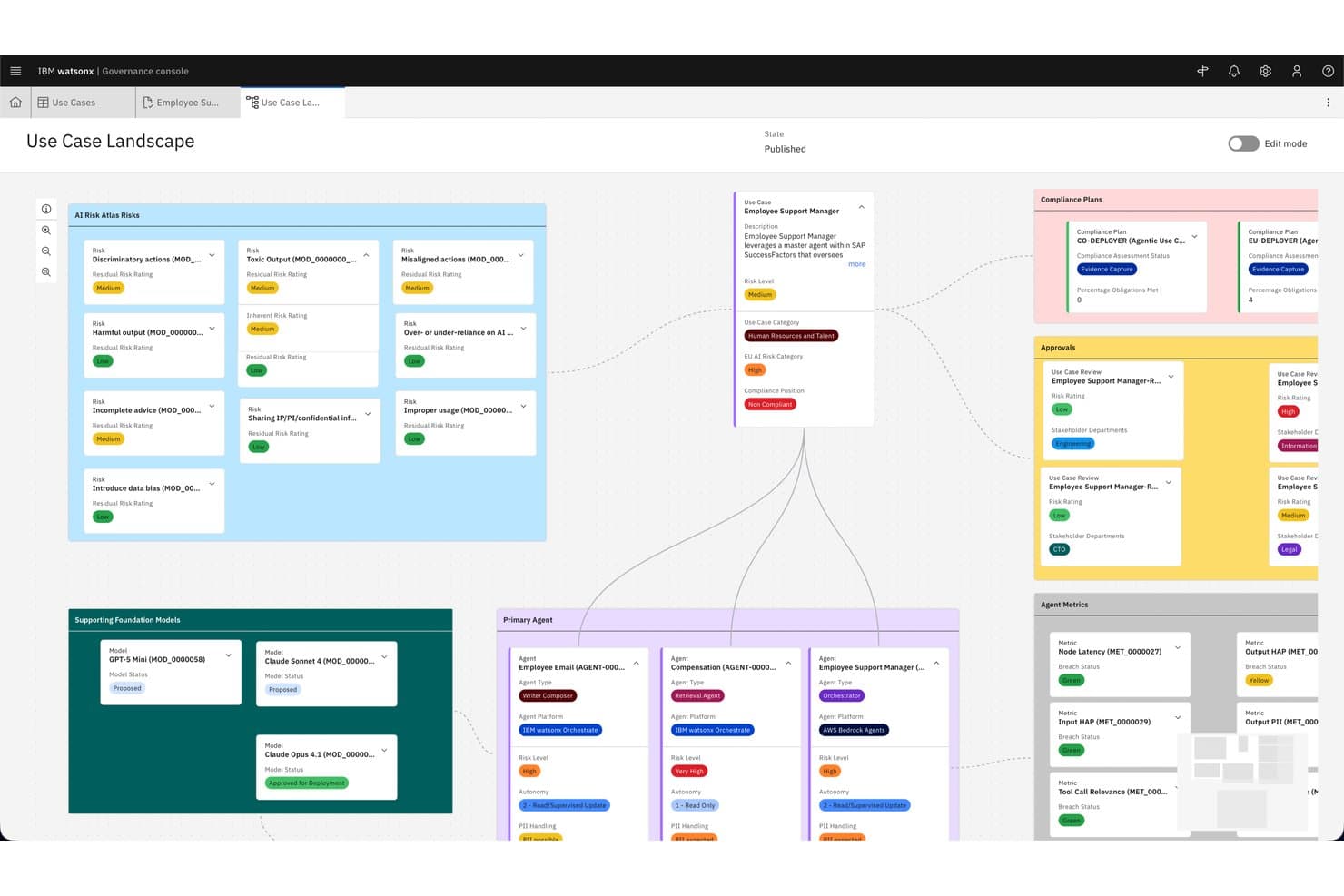
IBM watsonx.governance offers a Use Case Landscape view that maps AI risks, compliance plans, agent metrics, and approval workflows for enterprise AI governance. IBM watsonx.governance is an enterprise AI governance platform that combines model lifecycle management, risk assessment, policy enforcement, compliance mapping, and continuous monitoring across multi-vendor AI environments.
Who Is IBM watsonx.governance Best For?
It's a strong fit for large regulated enterprises in financial services, healthcare, and insurance that need centralized AI oversight across complex, multi-vendor environments.
Why I Picked IBM watsonx.governance
I picked IBM watsonx.governance as one of the best because its Governance Graph maps every AI asset across the entire estate, connecting models, policies, and regulatory requirements in one living view. I also like how automated AI factsheets generate audit-ready documentation at every lifecycle stage, capturing ownership, risk scores, and approvals without manual work. The closed-loop enforcement layer automatically routes breaches and risk signals back to corrective actions for proactive risk mitigation.
IBM watsonx.governance Key Features
- Automated model discovery: Continuously scans connected environments for shadow AI and undocumented models.
- Regulatory framework mapping: Maps and monitors AI systems against regulations like the EU AI Act, NIST AI RMF, and ISO 42001.
- LLM guardrails and red teaming: Filters and tests LLMs for prompt injection, hallucinations, PII leakage, and toxic content.
- Evidence and audit automation: Creates immutable audit trails, model cards, and one-click evidence reports for compliance.
IBM watsonx.governance Integrations
IBM watsonx.governance offers native integrations with Amazon SageMaker and has native integrations across the Microsoft ecosystem, including Microsoft Azure. An API is available for custom integrations.
Pros and Cons
Pros:
- Supports advanced LLM guardrails and red teaming
- Provides automated regulatory mapping and compliance checks
- Maps AI assets across hybrid cloud environments
Cons:
- Reporting customization can be rigid
- Setup complexity for multi-stakeholder deployments
Learn more about IBM watsonx.governance: Best for privacy-first governance workflows
- Free demo available
- Pricing upon request
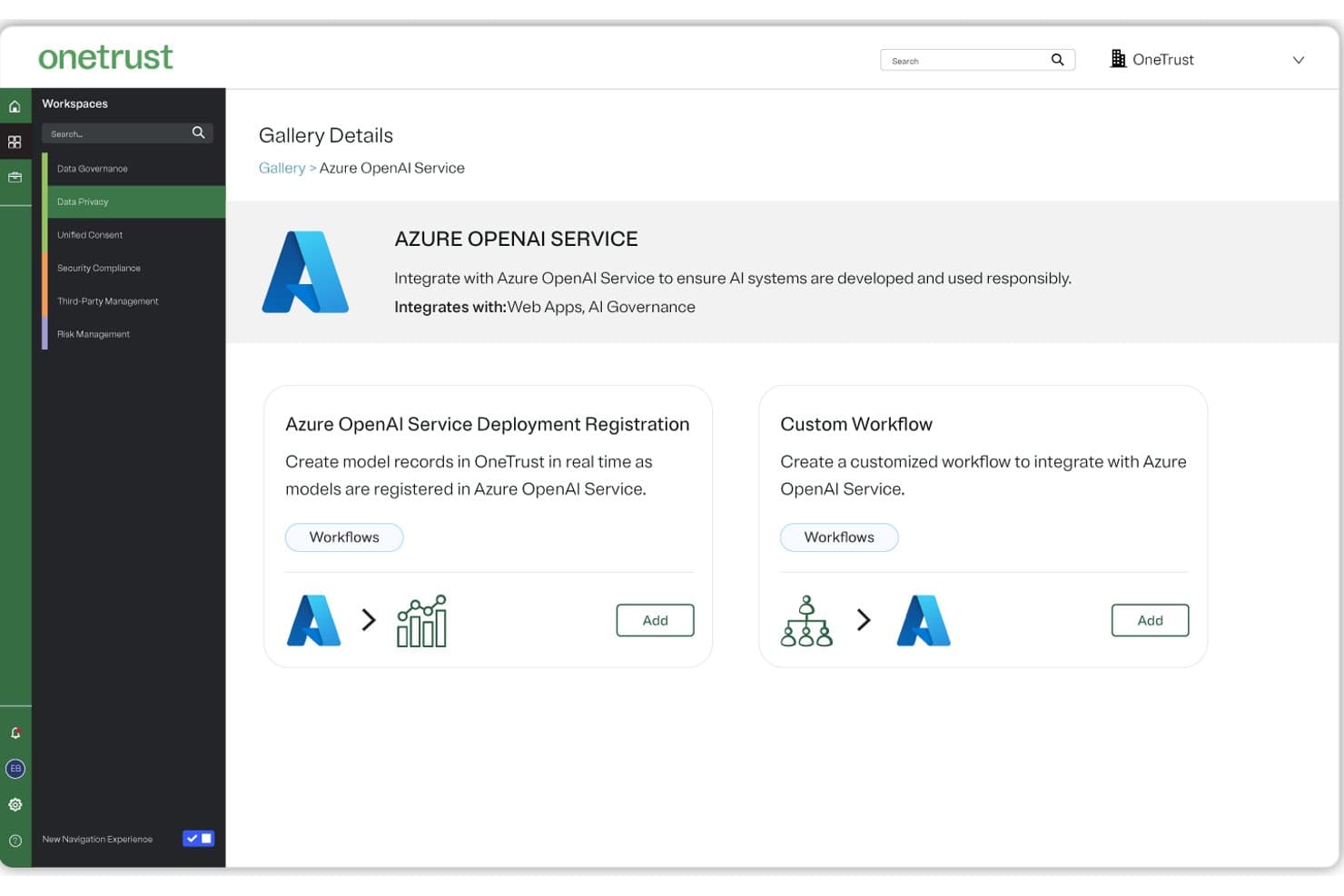
OneTrust AI Governance offers Azure OpenAI Service integration to automatically register AI model deployments and create customized governance workflows. OneTrust AI Governance is an enterprise AI governance platform that extends a privacy and risk management foundation into AI-specific workflows, covering model inventory, risk assessment, compliance mapping, policy enforcement, and runtime guardrails.
Who Is OneTrust AI Governance Best For?
It's a strong fit for large, regulated enterprises that already manage privacy and risk programs and need AI governance layered into that existing infrastructure.
Why I Picked OneTrust AI Governance
I've included OneTrust AI Governance in my top picks because its privacy-first foundation is built in, not bolted on. When a model processes personal data, OneTrust detects PII at runtime, correlates it with strict data privacy obligations, and enforces redaction or blocking before output reaches users. I also like that its compliance mapping covers the EU AI Act, NIST AI RMF, and ISO 42001 simultaneously, surfacing gaps across all three frameworks in a single risk assessment.
OneTrust AI Governance Key Features
- Centralized model inventory: Maintains a complete AI inventory by cataloging all models, datasets, agents, and vendors in a single searchable system.
- Automated regulatory mapping: Aligns AI systems with frameworks like EU AI Act, NIST AI RMF, ISO 42001, and GDPR.
- Configurable approval workflows: Supports intake, review, and sign-off gates for AI lifecycle governance.
- Runtime guardrail enforcement: Applies prompt filtering, data redaction, and action blocking for production AI and agent workloads.
OneTrust AI Governance Integrations
OneTrust AI Governance offers over 100 native integrations, including Databricks, Google Vertex AI, Twilio, RingCentral, Salesforce, Snowflake, ServiceNow, Power BI, and Okta. An API is also available for custom integrations.
Pros and Cons
Pros:
- Compliance coverage for multiple AI regulations
- Automated evidence collection for audits
- Privacy-by-design workflows for model governance
Cons:
- Implementation can be resource-intensive
- Fairness and explainability features less advanced
Learn more about OneTrust AI Governance:
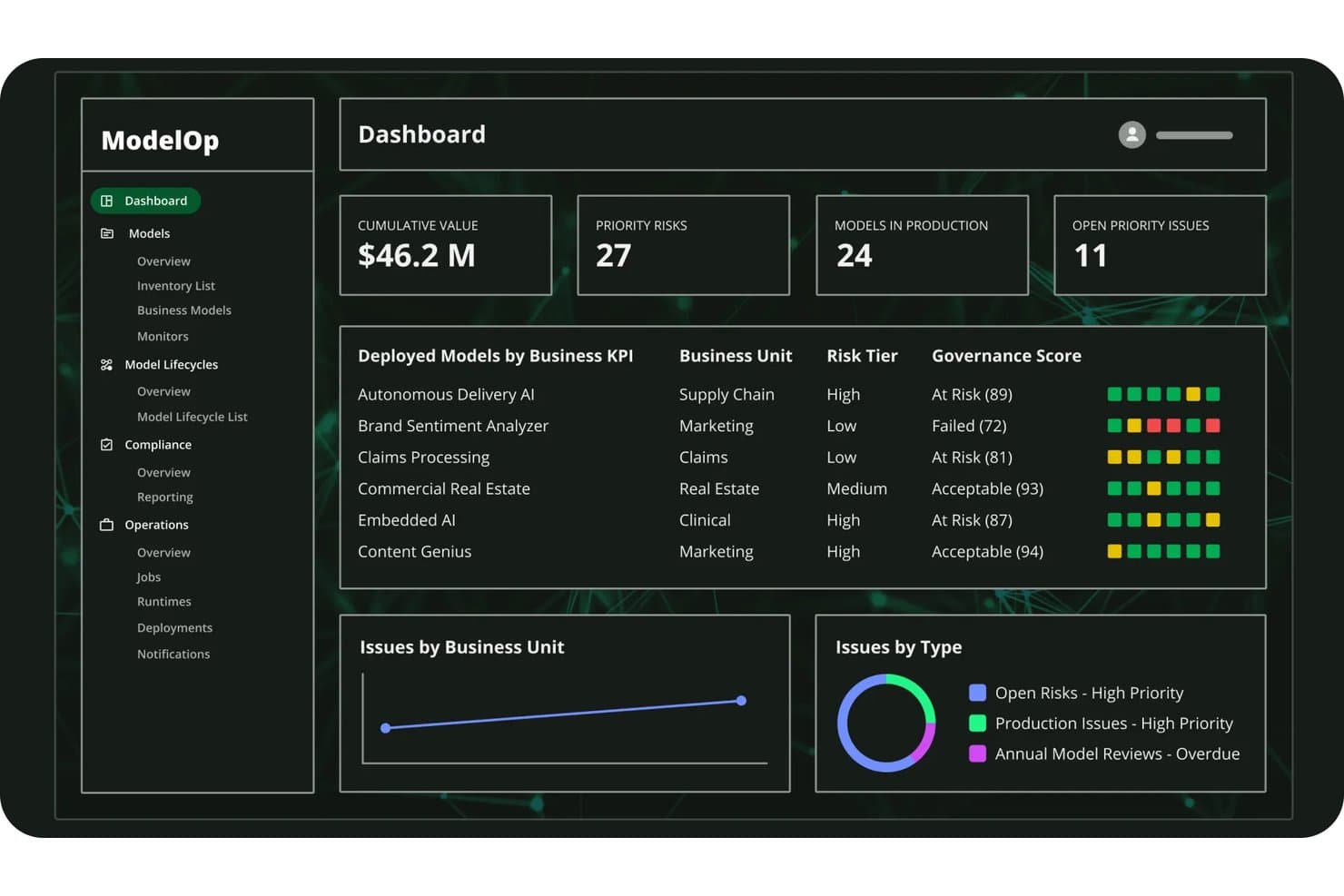
ModelOp offers a centralized AI governance dashboard displaying deployed models, risk tiers, governance scores, and priority issues across business units. ModelOp Center is an enterprise AI governance platform that centralizes model inventory, lifecycle management, policy enforcement, and compliance mapping across ML, GenAI, agentic, and third-party AI systems.
Who Is ModelOp Best For?
ModelOp is designed for large enterprises in regulated industries—financial services, healthcare, insurance, and pharma—managing complex, heterogeneous AI portfolios across multiple teams and systems.
Why I Picked ModelOp
ModelOp earns its spot on my shortlist because its automated discovery genuinely solves shadow AI exposure. I particularly like how it queries MCP and A2A servers to import agent card information and tool definitions automatically, so even newly deployed agents get registered without manual effort. It also surfaces custom GPTs and AI embedded in third-party SaaS tools that most teams don't know are running in their environment.
ModelOp Key Features
- Centralized AI system of record: Catalogs every model, agent, and AI solution with ownership, lineage, and deployment status across your organization.
- Lifecycle workflow automation: Standardizes reviews, approvals, and policy enforcement for AI systems from intake through retirement.
- Multi-framework compliance mapping: Aligns each AI-driven system to requirements in EU AI Act, NIST AI RMF, OCC SR 11-7, ISO 42001, and more.
- Automated audit documentation: Generates model cards, validation reports, and audit trails for regulatory and internal review needs.
ModelOp Integrations
ModelOp offers 50+ native integrations, including Amazon Web Services, Azure, Google Cloud Platform, ServiceNow, Jira, Databricks, Snowflake, Power BI, Tableau, and OpenAI. An API is also available for custom integrations.
Pros and Cons
Pros:
- End-to-end model lifecycle governance workflows
- Regulatory mapping spans multiple global frameworks
- Automated discovery covers shadow and agentic AI
Cons:
- Advanced features require extensive onboarding
- Model monitoring lacks root cause analysis
Learn more about ModelOp:
Alte instrumente de guvernanță AI
Iată câteva instrumente suplimentare de guvernanță AI care nu au ajuns pe lista mea scurtă, dar care merită totuși analizate:
- 11Fiddler AIBest for real-time model performance monitoring
- 12ArthurBest for advanced AI bias and drift detection
- 13Domino Data LabBest for model oversight in regulated industries
- 14AtlanBest for active metadata and context mapping
- 15DatatronBest for centralized rule-based AI monitoring
- 16TrustibleBest for automated regulatory mapping workflows
- 17ModulosBest for automated EU AI Act compliance
- 18FairNowBest for bias detection across model lifecycles
How I Evaluate AI Governance Tools
To make my shortlist, each platform needs to go beyond checkbox compliance and actually help teams track, control, and document AI systems in production. I break my evaluation into two layers: the core functionality every tool must deliver and the differentiating factors that separate one vendor from another.
Core Functionality (Table Stakes for This List)
When I'm selecting tools for my list, I rank each one on a scale from 0 (does not offer the functionality) to 5 (excels in this area) for each core functionality listed below. Then, I calculate the tool's total score into a percentage. Each tool needs to achieve a minimum total score of 65% to be considered for inclusion.
- AI Model Inventory: I look for a centralized registry that tracks model versions, owners, and deployment status so nothing runs in production unaccounted for.
- Risk Assessment: Structured scoring workflows matter here, especially ones that tie risk tiers to specific model use cases like credit decisioning or hiring.
- Policy Enforcement: I evaluate whether the platform can automate approval gates and guardrails rather than just storing written policies as static documents.
- Compliance Mapping: Coverage of major frameworks like the EU AI Act, NIST AI RMF, and ISO 42001 is the baseline I check for in every tool.
- Model Monitoring: Real-time tracking for bias, drift, and fairness is what I look for, particularly for models serving live customer-facing applications.
- Audit Documentation: The platform should generate model cards, impact assessments, and audit trails that are ready to hand to a regulator or internal reviewer.
Once I have a list of tools that meet the criteria, I consider what sets each platform apart.
Differentiating Factors (What Sets Vendors Apart)
Here's how I compare and contrast different vendors:
Standout Features
Automated model discovery is a major differentiator. I check whether a platform can scan cloud environments and repos to surface shadow AI that teams didn't register. LLM guardrails matter more each quarter as generative AI adoption grows; I look for real-time prompt filtering that catches PII leakage and hallucinations before they reach end users. Bias and fairness testing rounds out my evaluation, especially tools that run disparate impact analysis across demographic subgroups and flag drift over time.
Beyond Features
The integration ecosystem is one of the first things I check. A platform that connects to your ML stack—SageMaker, Databricks, Azure ML—and syncs with GRC and ticketing tools like Jira keeps governance embedded in existing workflows. Deployment flexibility also matters; teams in regulated industries often need on-premise or VPC options to meet data residency requirements. I evaluate multi-stakeholder collaboration too, looking for role-based views that give risk officers, data scientists, and executives each the right level of detail.
Cum să alegeți instrumentele de guvernanță AI
Este ușor să vă pierdeți în liste lungi de funcții și structuri complexe de prețuri. Pentru a vă ajuta să rămâneți concentrați în timp ce parcurgeți procesul unic de selecție a software-ului, iată o listă de verificare a factorilor de care trebuie să țineți cont:
| Factor | Aspecte de luat în considerare |
|---|---|
| FactorScalabilitate | Aspecte de luat în considerarePoate instrumentul să gestioneze sute de modele, utilizatori și fluxuri de lucru pe măsură ce crește amploarea utilizării AI în organizația dumneavoastră? Întrebați furnizorii cum sprijină extinderea în diferite unități de afaceri. |
| FactorIntegrări | Aspecte de luat în considerareAveți nevoie de conexiuni native la platforme ML, lacuri de date, IAM sau sisteme de gestionare a tichetelor? Enumerați sistemele principale și testați compatibilitatea cu API-uri sau conectori predefiniți. |
| FactorPosibilități de personalizare | Aspecte de luat în considerareCât de mult puteți adapta punctajele de risc, fluxurile de lucru pentru politici sau mapările de conformitate la nevoile organizației dumneavoastră, nu doar la șabloanele standard? |
| FactorUșurință în utilizare | Aspecte de luat în considerareVor putea părțile interesate tehnice și non-tehnice să utilizeze cu ușurință instrumentul? Evaluați claritatea interfeței prin demonstrații sau versiuni de testare pentru diferite grupuri de utilizatori. |
| FactorImplementare și integrare inițială | Aspecte de luat în considerareCe resurse sunt necesare pentru implementarea și operaționalizarea platformei? Verificați sprijinul oferit de furnizor, timpul până la obținerea primelor rezultate și planificarea gestionării schimbării. |
| FactorCost | Aspecte de luat în considerareSe bazează prețul pe numărul de modele, utilizatori sau pe utilizarea cloudului? Comparați costurile pe termen lung și verificați flexibilitatea pentru extinderea sau reducerea domeniului de aplicare. |
| FactorMăsuri de securitate | Aspecte de luat în considerareCe mecanisme de criptare, controale ale accesului și audit sunt implementate? Asigurați-vă că măsurile de protecție sunt aliniate la cerințele de reglementare și la nivelul de securitate al industriei dumneavoastră. |
| FactorCerințe de conformitate | Aspecte de luat în considerareÎndeplinește instrumentul reglementările actuale și emergente cu care vă confruntați, precum Actul UE privind inteligența artificială sau normele specifice sectorului? Luați în considerare cadrele, generarea de dovezi și frecvența actualizărilor. |
Ce sunt instrumentele de guvernanță AI?
Instrumentele de guvernanță AI sunt platforme care ajută organizațiile să monitorizeze, să controleze și să documenteze dezvoltarea și utilizarea sistemelor AI pe parcursul întregului lor ciclu de viață. Aceste instrumente sprijină conformitatea cu reglementările, gestionează riscurile asociate modelelor și mențin piste de audit pentru responsabilitate. Prin centralizarea supravegherii, acestea oferă echipelor IT, responsabililor de conformitate și directorilor o perspectivă asupra modului în care este implementată inteligența artificială, asigurând operațiuni etice, transparente și sigure.
Funcțiile instrumentelor de guvernanță AI
Atunci când selectați instrumente de guvernanță AI, urmăriți următoarele funcții esențiale:
- Inventar centralizat al modelelor: Cataloghează toate modelele AI/ML într-un singur loc, inclusiv proprietarii acestora, starea implementării și etapa ciclului de viață.
- Evaluarea automată a riscurilor: Ghidează utilizatorii prin fluxuri de lucru structurate pentru evaluarea unor riscuri precum prejudecățile, confidențialitatea și expunerea la riscuri de reglementare pentru fiecare model.
- Fluxuri de lucru pentru aplicarea politicilor: Permite echipelor să definească, să automatizeze și să urmărească aprobările politicilor, măsurile de protecție și regulile de guvernanță de-a lungul întregului flux AI.
- Maparea conformității cu reglementările: Aliniază modelele la anumite legi și cadre de reglementare prin generarea de dovezi și maparea controalelor la reglementările globale existente.
- Monitorizarea modelelor în timp real: Urmărește modelele implementate pentru prejudecăți, deviere, echitate, explicabilitate și degradarea performanței, oferind alerte atunci când apar probleme.
- Automatizarea documentației pentru audit: Produce automat piste de audit, evaluări de impact și fișe ale modelelor pentru nevoile de transparență și raportare în scopuri de reglementare.
- Măsuri de protecție pentru LLM și AI generativă: Monitorizează rezultatele modelelor lingvistice de mari dimensiuni, verifică existența atacurilor de tip injectare de prompturi, a scurgerilor de date cu caracter personal și a rezultatelor dăunătoare sau lipsite de sens.
- Controale ale accesului bazate pe roluri: Restricționează accesul la datele și fluxurile de lucru sensibile pe baza rolurilor utilizatorilor, sprijinind conformitatea și reducând riscurile interne.
- Integrarea cu stiva MLOps: Se conectează la platforme ML, lacuri de date, sisteme de gestionare a tichetelor și furnizori de identitate pentru a unifica guvernanța în cadrul fluxurilor de lucru existente.
Beneficiile instrumentelor de guvernanță AI
Implementarea instrumentelor de guvernanță AI oferă mai multe beneficii pentru echipa și compania dumneavoastră. Iată câteva dintre beneficiile de care vă puteți bucura:
- Sprijin pentru conformitatea cu reglementările: Țineți pasul cu legile și cadrele de reglementare aflate în evoluție prin generarea de dovezi și maparea activităților AI la reglementările globale.
- Reducerea riscurilor asociate modelelor: Identificați și remediați din timp probleme precum prejudecățile, devierea și riscurile privind confidențialitatea, prin monitorizare automată și evaluări ale riscurilor.
- Responsabilitate sporită: Mențineți piste de audit transparente, fișe ale modelelor și înregistrări ale aprobărilor, facilitând urmărirea deciziilor și demonstrarea conformității.
- Supraveghere centralizată: Obțineți o imagine completă a tuturor sistemelor AI și a responsabilității asupra modelelor din organizație prin inventare centralizate și tablouri de bord bazate pe roluri.
- Eficiență operațională: Automatizați aplicarea politicilor, documentația pentru audit și procesele de guvernanță pentru a economisi timpul echipei și a reduce volumul de muncă manuală.
- Colaborare îmbunătățită între echipe: Permiteți cercetătorilor de date, responsabililor de risc, departamentului IT și directorilor să lucreze folosind o singură sursă de adevăr, cu vizualizări personalizate pentru utilizatori și fluxuri de lucru partajate.
- Protecție pentru AI generativă: Monitorizați modelele generative pentru abuzuri ale prompturilor, scurgeri de date cu caracter personal și rezultate dăunătoare, reducând noile riscuri pe măsură ce utilizarea AI se extinde.
Costurile și prețurile instrumentelor de guvernanță AI
Selectarea instrumentelor de guvernanță AI necesită înțelegerea diferitelor modele și planuri de preț disponibile. Costurile variază în funcție de caracteristici, dimensiunea echipei, extensii și multe altele. Tabelul de mai jos rezumă planurile uzuale, prețurile medii ale acestora și caracteristicile incluse de obicei în instrumentele de guvernanță AI:
Tabel comparativ al planurilor pentru instrumentele de guvernanță AI
| Tipul planului | Preț mediu | Caracteristici comune |
|---|---|---|
| Tipul planuluiPlan gratuit | Preț mediu$0 | Caracteristici comuneInventar de bază al modelelor, evaluare limitată a riscurilor și urmărirea manuală a politicilor. |
| Tipul planuluiPlan personal | Preț mediu$15-$40/utilizator/lună | Caracteristici comuneGestionarea centralizată a modelelor, maparea de bază a conformității și opțiuni limitate de integrare. |
| Tipul planuluiPlan pentru companii | Preț mediu$50-$120/utilizator/lună | Caracteristici comuneFluxuri de lucru automatizate pentru evaluarea riscurilor, monitorizarea modelelor în timp real, documentație pentru audit, integrare cu platforme ML și controale bazate pe roluri. |
| Tipul planuluiPlan pentru întreprinderi | Preț mediu$150+/utilizator/lună | Caracteristici comuneAplicarea avansată a politicilor, acoperire completă a reglementărilor, automatizare la scară largă, flexibilitate la implementare și asistență dedicată. |
Întrebări frecvente despre instrumentele de guvernanță a IA
Iată câteva răspunsuri la întrebările frecvente despre instrumentele de guvernanță a IA:
Ce tipuri de organizații au nevoie de instrumente de guvernanță a IA?
Instrumentele de guvernanță a IA sunt utile pentru orice organizație care implementează IA în medii reglementate sau critice pentru activitate, în special pentru cele din domeniul financiar, al sănătății, al asigurărilor și al administrației publice, precum și pentru orice echipă care extinde utilizarea IA în mai multe departamente.
Pot instrumentele de guvernanță a IA să ajute la auditurile de conformitate?
Da, majoritatea platformelor de guvernanță a IA generează automat piste de audit, documentația modelelor și dovezi privind conformitatea pentru a sprijini auditurile interne și solicitările autorităților de reglementare externe.
Cum se integrează instrumentele de guvernanță a IA cu stivele tehnologice existente?
Multe soluții oferă conectori predefiniți pentru platforme ML, instrumente MLOps, lacuri de date și sisteme de gestionare a tichetelor, precum și API-uri pentru integrarea verificărilor de guvernanță în fluxurile CI/CD și în cadrele de orchestrare.
Este posibilă monitorizarea atât a modelelor tradiționale, cât și a IA generative cu ajutorul acestor instrumente?
Da, platformele de top acceptă monitorizarea tuturor tipurilor de modele — inclusiv a modelelor tradiționale de învățare automată și a IA generative — și semnalează riscuri precum părtinirea, devierea și injectarea de prompturi.
Cum gestionează aceste instrumente datele sensibile și cerințele de implementare?
Mulți furnizori oferă implementare SaaS, în cloud privat sau locală pentru a răspunde cerințelor privind rezidența datelor și securitatea și acceptă instalări izolate de rețea pentru industriile cu cerințe stricte de conformitate.