

Software-ul de gestionare a performanței activelor conectează datele OT și IT pentru a urmări, analiza și prezice starea și fiabilitatea activelor critice. Atunci când coordonați operațiuni de amploare, nu vă puteți permite puncte oarbe sau defecțiuni neașteptate — aceste instrumente vă oferă o perspectivă în timp real, bazată pe date, asupra modului în care funcționează utilajele, infrastructura și sistemele dumneavoastră.
În acest ghid, voi prezenta cel mai bun software de gestionare a performanței activelor pentru 2026, explicând modul în care fiecare soluție sprijină fiabilitatea organizațiilor, întreținerea predictivă și integrarea la scară largă. Mă voi concentra pe ceea ce contează cu adevărat pentru CTO și liderii tehnologici care nu își permit perioade de nefuncționare.
Why Trust Our Software Recommendations
6,700+
Reviews
20
Industry experts
16+
Evaluation factors
14
Years
Our team has been testing and reviewing software since 2012. As tech leaders ourselves, we know how difficult—and important—it is to choose the right software.
For this guide, we evaluated tools using hands-on testing and independent research, scoring tools using our selection criteria.
Our reviews reflect our human editorial judgment, not a sales pitch.
Expert reviewers:
- Paulo Gardini MiguelTech Director
 Tim FisherVP of AI
 Gabriel RosasTech Lead & Software Architect
 Christhian GruhnTech Lead & Platform Architect

Tabel comparativ al software-urilor de gestionare a performanței activelor
Acest tabel comparativ sintetizează detaliile privind prețurile pentru selecțiile mele de top de software pentru gestionarea performanței activelor:
Score legend (out of 5)
- Excellent4.5–5
- Good4–4.4
- Average3–3.9
- Below average2–2.9
- Poor1–1.9
Sorted by: Default
| Tool | Starting Price | Website | |||||||
|---|---|---|---|---|---|---|---|---|---|
Best for sensor-to-work-order AI diagnostics | 4.5 out of 5 | 5 | 4 | 5 | 4 | 5 | 4 | Pricing upon request Free demo available | Website |
Best for AI-driven APM at enterprise scale | 4.5 out of 5 | 5 | 4 | 5 | 5 | 3 | 5 | Pricing upon request Free demo available | Website |
Best for infrastructure-heavy RCM and RBI programs | 4.5 out of 5 | 5 | 5 | 5 | 5 | 3 | 4 | Pricing upon request Not available | Website |
Best for rotating equipment in oil and gas | 4.5 out of 5 | 5 | 4 | 5 | 5 | 3 | 5 | Pricing upon request Not available | Website |
Best for industrial-scale OT/IT data convergence | 4.3 out of 5 | 5 | 4 | 5 | 5 | 2 | 5 | Pricing upon request Free demo available | Website |
Best for SAP-native closed-loop EAM execution | 4.8 out of 5 | 5 | 5 | 5 | 5 | 5 | 4 | $295/month Free demo available | Website |
Best for AI-driven predictive maintenance at scale | 4.8 out of 5 | 5 | 5 | 5 | 5 | 5 | 4 | Pricing upon request Free demo available | Website |
Best for asset-intensive industrial AI maintenance | 5.0 out of 5 | 5 | 5 | 5 | 5 | 5 | 5 | Pricing upon request Free demo available | Website |
Best for digital twin-driven predictive analytics | 4.7 out of 5 | 5 | 5 | 5 | 5 | 3 | 5 | Pricing upon request Not available | Website |
Best for industrial-scale predictive analytics | 4.8 out of 5 | 5 | 5 | 5 | 5 | 4 | 5 | Pricing upon request Free demo available | Website |


Recenzii ale celor mai bune software-uri de gestionare a performanței activelor
Mai jos sunt prezentate rezumatele mele detaliate ale celor mai bune software-uri de gestionare a performanței activelor care au ajuns pe lista mea scurtă. Recenziile mele oferă o analiză detaliată a funcțiilor, celor mai bune cazuri de utilizare și capacităților fiecărei platforme, pentru a vă ajuta să o găsiți pe cea mai potrivită pentru dumneavoastră.
 Best for sensor-to-work-order AI diagnostics
- Free demo available
- Pricing upon request
Visit WebsiteCustomer Rating:4.8/5
TRACTIAN tracks asset health scores and cavitation alerts in real time. TRACTIAN is an industrial asset performance management platform that pairs proprietary IoT sensors with a native CMMS and AI diagnostics engine to monitor rotating equipment health, predict failures, and manage work orders end to end.
Who Is TRACTIAN Best For?
TRACTIAN is a strong fit for maintenance and reliability teams in asset-intensive industries like manufacturing, oil & gas, and mining who need sensor-driven predictive maintenance without a lengthy deployment.
Why I Picked TRACTIAN
I picked TRACTIAN as one of the best because its sensor-to-work-order pipeline is genuinely end-to-end in a way most APM platforms aren't. The Smart Trac Ultra sensors detect failure signatures like bearing wear or rotor bar damage, and the AI automatically generates a prioritized, technician-ready work order in TracOS with a root cause explanation and repair SOP attached. I also rate its Electrical Signature Analysis highly, since it catches motor winding and insulation faults months before they show up through vibration monitoring alone.
TRACTIAN Key Features
- Electrical Signature Analysis: Monitors raw electrical waveforms per phase to detect rotor, stator, winding, and insulation faults before they appear in vibration data.
- Composable asset tree: Builds a flexible, hierarchical asset registry with AI-assisted BOM registration, criticality weighting, and linked failure history per asset.
- OEE production monitoring: Tracks availability, performance, and quality in real time, with operator-labeled downtime causes and AI detection of micro-stops without PLC connectivity.
- Native SQL connector: Provides direct, real-time SQL access to CMMS data for live connections to Excel, Tableau, Looker, and custom BI tools without API middleware.
TRACTIAN Integrations
TRACTIAN offers integrations with SAP, Oracle, IBM Maximo, Infor, ServiceNow, Power BI, Microsoft Teams, Slack, Autodesk, and Samsara. It also provides a native SQL connector and REST API for custom connections and live BI access.
Pros and Cons
Pros:
- Electrical Signature Analysis detects faults early
- AI generates work orders with root cause
- Combines sensors, CMMS, and AI diagnostics
Cons:
- Custom enterprise pricing lacks public transparency
- Hardware lock-in restricts third-party sensor use
Learn more about TRACTIAN: Best for AI-driven APM at enterprise scale
- Free demo available
- Pricing upon request

C3 AI centralizes asset alerts, costs, and diagrams in one dashboard. C3 AI Reliability is an AI-native asset performance management platform that combines real-time asset health monitoring, predictive maintenance analytics, prescriptive failure mode identification, and process optimization across large-scale industrial environments.
Who Is C3 AI Best For?
C3 AI Reliability is built for large enterprises in asset-intensive industries—oil and gas, chemicals, cement, and manufacturing—running thousands of assets across multiple sites.
Why I Picked C3 AI
I picked C3 AI Reliability as one of the best because no other tool on this list handles AI-driven predictive maintenance at enterprise scale quite like it does. The platform's CHARM time-series foundation model detects anomalies across thousands of simultaneous asset streams, and its automated failure mode identification doesn't just flag problems—it prescribes specific mitigation steps with AI-generated evidence packages. Shell runs 10,000+ assets through it; Dow runs 500+ production AI models with $45M in documented annual benefit.
C3 AI Key Features
- C3 AI Asset Connect: A centralized digital asset hub that unifies sensor data, engineering drawings, work orders, failure modes, and 3D models into a single system of record using 200+ prebuilt asset templates.
- C3 AI Energy Management: Tracks energy consumption, GHG emissions, water use, and waste at equipment, facility, and enterprise levels with real-time monitoring and benchmarking across sites.
- C3 AI Field Services: Extends the platform to frontline technicians with AI-guided mobile inspection checklists, work order summaries, and an AI assistant chat for field asset restoration.
- Multi-cloud and edge deployment: Runs on AWS, Azure, Google Cloud, private cloud, and edge environments, with support for Kubernetes, NVIDIA, Intel, and ARM hardware for OT-constrained plant networks.
C3 AI Integrations
C3 AI offers prebuilt integrations with SAP, Oracle, IBM Maximo, AVEVA, Honeywell, Bently Nevada, and SKF. It also connects to SCADA, LIMS, and OPC UA data sources across cloud, private-cloud, hybrid, and edge deployments.
Pros and Cons
Pros:
- Supports multi-cloud and edge deployments
- Provides AI-driven failure mode identification
- Handles thousands of assets at enterprise scale
Cons:
- No first-party digital twin simulation available
- Requires substantial data preparation and alignment
Learn more about C3 AI: Best for infrastructure-heavy RCM and RBI programs
- Not available
- Pricing upon request
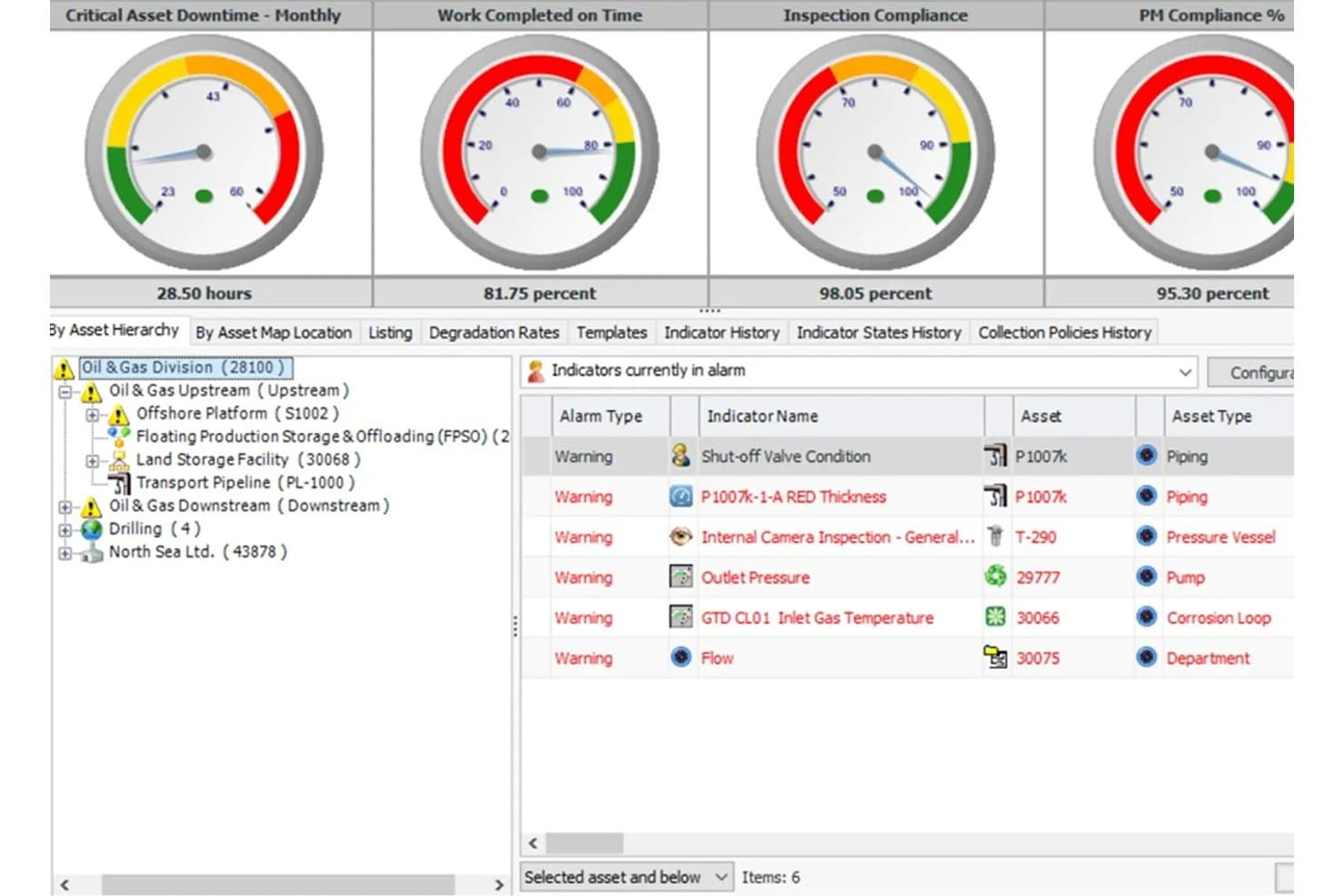
AssetWise centralizes asset health alerts and KPI gauges in one dashboard. AssetWise is Bentley Systems' modular asset performance management suite built on a digital twin platform, combining RCM, RBI, condition monitoring, predictive analytics, and asset lifecycle information management for infrastructure-intensive industries.
Who Is AssetWise Best For?
AssetWise is built for asset-intensive industries like oil & gas, utilities, and rail, where formal RCM and RBI programs are a regulatory and operational necessity.
Why I Picked AssetWise
AssetWise earns its spot on my shortlist because no other platform in this category matches its depth for formal RCM and RBI programs in infrastructure-heavy environments. I'm particularly impressed by its RBI tooling for static equipment like pressure vessels and piping, which runs probabilistic failure assessments against ISA 84 and IEC 61511 standards. On top of that, its iTwin digital twin platform carries engineering models from the capital project phase directly into operations, so your reliability team isn't working from degraded or disconnected asset data.
AssetWise Key Features
- Root cause analysis (RCA) tools: Build fault trees and fishbone diagrams to trace equipment failures back to their fundamental causes.
- Atmospheric storage tank (AST) analysis: Runs probability and consequence assessments on storage tanks to calculate remaining life and schedule surveys.
- APM Inspections mobile app: Lets field technicians capture gauge readings, photos, and barcode scans offline, then sync work requests when reconnected.
- Management of Change (MOC) workflows: Tracks and controls engineering change requests across the asset lifecycle within the centralized ALIM registry.
AssetWise Integrations
AssetWise has certified integrations with SAP, IBM Maximo, and Oracle eAM, plus integrations with Ellipse and Power BI. It connects to Sensemetrics and offers a REST API with TLS 1.2 for custom integrations.
Pros and Cons
Pros:
- Proven performance in infrastructure industries
- Deep RCM and RBI compliance support
- Digital twin integration for engineering continuity
Cons:
- Implementation complexity slows initial deployment
- End-to-end work orders require external EAM
Learn more about AssetWise:

Cordant visualizes asset risk across categories in a unified dashboard. Cordant is Baker Hughes' industrial APM platform built on the Bently Nevada System 1 condition monitoring engine, combining asset health monitoring, reliability strategy development, defect elimination, and mechanical integrity management for heavy industrial equipment.
Who Is Cordant Best For?
Cordant is built for reliability engineers and maintenance teams in oil and gas, LNG, petrochemical, and heavy process industries managing large fleets of rotating equipment.
Why I Picked Cordant
I picked Cordant as one of the best because no other APM platform pairs 60+ years of Bently Nevada condition monitoring heritage with a library of 247+ pre-built failure modes built specifically for rotating equipment like compressors, turbines, and pumps. I love how System 1's continuous autonomous monitoring captures vibration and process data at up to one sample per second, with sub-second alarm capture during startups, giving reliability engineers in oil and gas the signal fidelity they actually need. The hybrid AI and physics-based analytics layer then translates raw readings into prescriptive advisories, so my team isn't just seeing anomalies but getting ranked, actionable guidance on what to fix first.
Cordant Key Features
- Defect elimination workflows: Identifies cause-and-effect relationships across problems, events, and incidents, then tracks corrective actions through to resolution with multiple RCA methodologies.
- Production loss accounting: Sets production targets by plant, product, and period, then automatically quantifies and classifies losses to surface performance gap drivers.
- Asset strategy scenario modeling: Builds financially optimized reliability strategies with performance, cost, and risk scenario comparisons to support maintenance investment decisions.
- Energy and sustainability management: Tracks energy consumption and emissions at the individual asset and plant level to support ESG reporting and identify underperforming equipment.
Cordant Integrations
Cordant integrates with SAP PM, IBM Maximo, OSIsoft PI, Honeywell Uniformance, and OPC UA/DA data sources. It’s also available through Microsoft Azure Marketplace and connects with Bently Nevada System 1 hardware.
Pros and Cons
Pros:
- Unified platform for health, strategy, integrity
- Prescriptive maintenance powered by hybrid analytics
- Deepest rotating equipment monitoring expertise
Cons:
- Requires external CMMS for work order management
- No native mobile field execution capability
Learn more about Cordant: Best for industrial-scale OT/IT data convergence
- Free demo available
- Pricing upon request
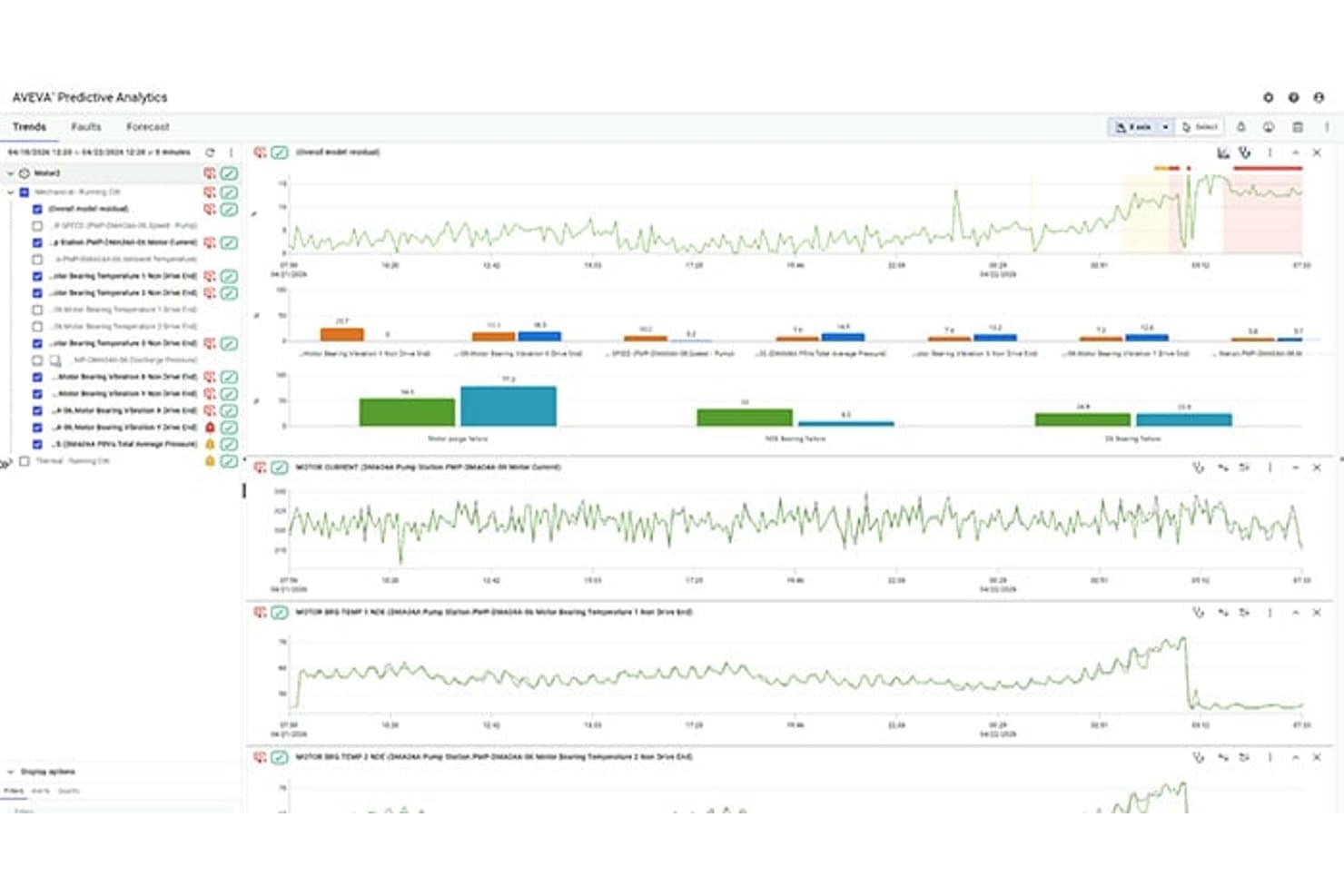
AVEVA APM tracks equipment trends and fault predictions over time. AVEVA APM is an industrial asset performance management platform built around the PI System data infrastructure, combining real-time condition monitoring, AI-driven predictive analytics, OT/IT data integration, and enterprise-scale asset contextualization across edge, on-premises, and cloud environments.
Who Is AVEVA APM Best For?
AVEVA APM is a strong fit for large industrial operators in oil and gas, power, pharma, and mining who need to unify OT and IT data at enterprise scale.
Why I Picked AVEVA APM
I've included AVEVA APM in my top picks because no other platform comes close to its depth of OT/IT data convergence at industrial scale. The PI Server Asset Framework contextualizes raw sensor data from up to 20 million tags into structured asset hierarchies, giving operations and IT teams a shared data layer across sites. Paired with AVEVA Predictive Analytics, that same infrastructure feeds ML-based early warning models, like the ones TotalEnergies used to save €1.5M and avoid 64 days of unplanned downtime in a single year.
AVEVA APM Key Features
- PI Server Asset Framework: Models raw sensor data into structured, multi-level asset hierarchies with metadata templates, criticality attributes, and relational context across enterprise sites.
- Event Frames: Captures and analyzes repeatable operational events—batches, shifts, downtime periods—and links them directly to process data for root-cause analysis and OEE reporting.
- AVEVA Edge Data Store: Collects and buffers industrial data at the edge in remote or harsh environments, maintaining data continuity during network disruptions before syncing to central or cloud archives.
- PI Integrator for Business Analytics: Pushes time-series asset data from PI Server into enterprise BI tools like Power BI and Tableau, as well as cloud data lakes on Azure and AWS.
AVEVA APM Integrations
AVEVA APM integrates with SAP, Microsoft Power BI, Tableau, Azure, AWS, and Databricks through connectors, PI Integrator, APIs, and SDKs. It also connects to industrial sources through OPC UA, MQTT, and Modbus, with CMMS/EAM connections available via APIs and PI notifications.
Pros and Cons
Pros:
- Tiered dashboards show real-time and historical KPIs
- Enables prescriptive analytics with AI models
- Scales to 20 million data tags
Cons:
- Complex setup effort for large environments
- No native work order management module
Learn more about AVEVA APM: Best for SAP-native closed-loop EAM execution
- Free demo available
- From $295/month

SAP Supply Chain tracks asset inspection recommendations with risk and status views. SAP Asset Performance Management is an enterprise-grade APM solution that combines embedded IoT connectivity, AI-driven predictive analytics, RCM and FMEA methodologies, and closed-loop work order execution within the SAP ecosystem.
Who Is SAP Supply Chain Best For?
SAP Asset Performance Management is built for large enterprises in asset-intensive industries—energy, oil & gas, utilities, and manufacturing—that are already running SAP EAM and need a predictive maintenance layer that feeds directly back into their existing work order environment.
Why I Picked SAP Supply Chain
SAP Asset Performance Management earns its spot on my shortlist because it's the only APM tool I've found that closes the loop directly inside SAP EAM, turning a failure prediction into a live work order without any middleware in between. I particularly like how Weibull-based failure curve analytics and RUL estimation feed directly into automated maintenance notifications, so reliability engineers aren't just seeing predictions but acting on them within the same system. The embedded Cumulocity IoT layer adds native OPC UA connectivity, letting you pull sensor streams from PLCs and SCADA systems straight into the APM application.
SAP Supply Chain Key Features
- Risk and criticality assessment: Standardized templates calculate risk and criticality scores across impact categories to classify assets and derive appropriate maintenance strategies.
- AI-assisted visual inspection: Computer vision analyzes images collected from cameras and drones to detect wear indicators and automatically generate maintenance alerts.
- Failure curve analytics: Weibull-based statistical models visualize asset degradation trends and failure probabilities to support maintenance planning decisions.
- Joule AI assistant: A natural language interface lets reliability engineers query asset data and surface maintenance insights without navigating complex dashboards.
SAP Supply Chain Integrations
SAP Asset Performance Management offers native integrations with SAP S/4HANA Cloud, SAP ERP, and embedded Cumulocity IoT. It connects to industrial systems through OPC UA, data historians, data lakes, and SCADA or DCS environments.
Pros and Cons
Pros:
- Built-in RCM and FMEA methodologies
- Native AI-driven visual and sensor analytics
- Direct work order execution inside SAP EAM
Cons:
- Implementation can take several months
- Requires existing SAP EAM environment
Learn more about SAP Supply Chain: Best for AI-driven predictive maintenance at scale
- Free demo available
- Pricing upon request

IBM Maximo Application Suite tracks asset health, risk, and failure metrics in real time. IBM Maximo Application Suite is an enterprise asset performance management platform that combines EAM, IoT condition monitoring, AI-driven predictive maintenance, mobile field execution, and RCM strategy management in a single suite.
Who Is IBM Maximo Application Suite Best For?
IBM Maximo Application Suite is built for large enterprises in asset-intensive industries—utilities, oil and gas, transportation, and nuclear—that need AI-driven predictive maintenance and IoT condition monitoring across thousands of assets and multiple sites.
Why I Picked IBM Maximo Application Suite
IBM Maximo Application Suite earns its spot on my shortlist because of how far its AI-driven predictive maintenance goes beyond basic alerting. Maximo Predict runs five distinct ML models simultaneously, including one that forecasts the specific date an asset is likely to fail, so maintenance teams can schedule interventions before breakdown rather than reacting to it. I'm also impressed by Condition Insight, which maps that failure forecast directly to FMEA-based prescribed actions and surfaces the recommendation in plain language, no data science background required.
IBM Maximo Application Suite Key Features
- Maximo Monitor IoT ingestion: Pulls near-real-time data from SCADA systems, data historians, BMS, and MES sources via an Edge Data Collector, with AI anomaly detection built in.
- RCM Strategy Builder: An AI agent that helps you build FMEA frameworks and maintenance strategy workflows, backed by a library of 800 asset types and 58,000 failure modes.
- Maximo Assist AR troubleshooting: Gives field technicians AI-powered guidance and augmented reality collaboration with remote experts, with support for 22 languages.
- Multi-org asset registry: Maintains a hierarchical, multi-site asset registry with industry-specific data models for verticals like Nuclear, Oil & Gas, Aviation, and Utilities.
IBM Maximo Application Suite Integrations
IBM Maximo Application Suite offers documented integrations with SAP S/4HANA, Oracle Applications, AVEVA PI, Ignition SCADA, ESRI ArcGIS, IBM Envizi, and IBM TRIRIGA. Open APIs and IBM App Connect support custom connectivity across OT, ERP, GIS, and ESG systems.
Pros and Cons
Pros:
- Deep library for regulated industry failure modes
- Prescriptive maintenance using five ML models
- Real-time anomaly detection with AI explanation
Cons:
- User interface remains cluttered despite redesign
- System setup and rollout are highly complex
Learn more about IBM Maximo Application Suite: Best for asset-intensive industrial AI maintenance
- Free demo available
- Pricing upon request

IFS Cloud EAM tracks supplier invoice spend and analysis over time. IFS Cloud EAM is an enterprise asset management platform that combines real-time asset health monitoring, AI-driven predictive maintenance, work order management, and IoT integration for asset-intensive industrial environments.
Who Is IFS Cloud EAM Best For?
IFS Cloud EAM is a strong fit for asset-intensive industries like energy, mining, aerospace, and manufacturing that need enterprise-grade AI-driven maintenance at scale.
Why I Picked IFS Cloud EAM
IFS Cloud EAM earns its spot on my shortlist because no other platform embeds Industrial AI this deeply into asset-intensive maintenance workflows. I particularly like the Copilot-assisted FMECA, which walks reliability engineers through failure mode analysis and auto-generates maintenance strategies from historical asset data. Pair that with condition-based maintenance triggers and explainable AI recommendations, and you get a system built specifically for environments where an unplanned failure means a downed wind farm or a grounded aircraft fleet.
IFS Cloud EAM Key Features
- Asset investment planning: Copperleaf-powered capital planning tools let you rank assets by risk, model investment scenarios, and prioritize maintenance spend across your portfolio.
- Integrated 3D visualization: Navigate interactive 3D models of physical assets to validate conditions and trigger work orders directly from the visual interface.
- Sustainability management module: Track, collect, and report ESG data against a CSRD-aligned KPI catalog, with tools for goal-setting and disclosure reporting.
- Mobile field execution: Field technicians can update asset status, log work, and capture images from a mobile interface that syncs in real time with the core platform.
IFS Cloud EAM Integrations
IFS Cloud EAM has native integrations across IFS Cloud, including IFS ERP, IFS Field Service Management, IFS Supply Chain Management, and Copperleaf. It also connects with Crosser, OPC-UA, and SCADA systems, with APIs for custom integrations.
Pros and Cons
Pros:
- 3D asset visualization for work order validation
- Asset-based pricing aligns with operational needs
- Predictive maintenance uses embedded industrial AI
Cons:
- Advanced analytics require additional licensed modules
- Implementation projects are often lengthy and complex
Learn more about IFS Cloud EAM: Best for digital twin-driven predictive analytics
- Not available
- Pricing upon request

ABB Genix APM tracks asset health metrics like availability and MTBF. ABB Genix APM is an industrial asset performance management platform that combines predictive analytics, digital twin modeling, AI-driven diagnostics, and performance KPI reporting across rotating, electrical, and static equipment.
Who Is ABB Genix APM Best For?
ABB Genix APM is a strong fit for large industrial operators in oil & gas, power generation, utilities, and mining who need AI-driven predictive analytics across complex, multi-site asset portfolios.
Why I Picked ABB Genix APM
ABB Genix APM earns its spot on my shortlist because of how far its digital twin capability goes beyond basic condition monitoring. The Predict 360 module builds genuine digital twins by combining physics-based and AI/ML models, so I can simulate failure scenarios for a compressor or heat exchanger before anything breaks in the real world. Layered on top, the Genix APM Copilot uses LLMs to answer natural-language questions like "what failure mode caused this pressure drop" and automatically generates work requests in connected CMMS systems.
ABB Genix APM Key Features
- Assess 360 asset integrity tracking: Monitors asset risk categories, failure mechanisms, and lifecycle status across 120+ pre-built asset models with OPEX/CAPEX financial analytics built in.
- Opportunity Loss Manager: Quantifies production losses in measurable terms, giving operations teams a direct view of performance gaps tied to specific assets.
- System Anomaly Detection: Identifies abnormal asset behavior across OT data sources using configurable thresholds and NAMUR NE107 health scoring for early warning.
- Flexible deployment architecture: Supports on-premise, ABB-managed cloud, and customer-managed cloud configurations, including air-gapped environments for OT security compliance.
ABB Genix APM Integrations
ABB Genix APM integrates with ABB System 800xA, Symphony Plus, OPC UA, Modbus TCP, OSIsoft PI, and AVEVA PI. It also connects with Azure, IoT devices, and external CMMS/EAM systems through its industrial data architecture.
Pros and Cons
Pros:
- Copilot uses LLMs for root-cause analysis
- Over 120 pre-built industrial asset models
- Digital twin simulation for failure prediction
Cons:
- Most work orders depend on CMMS integration
- Lack of pricing transparency before sales contact
Learn more about ABB Genix APM: Best for industrial-scale predictive analytics
- Free demo available
- Pricing upon request
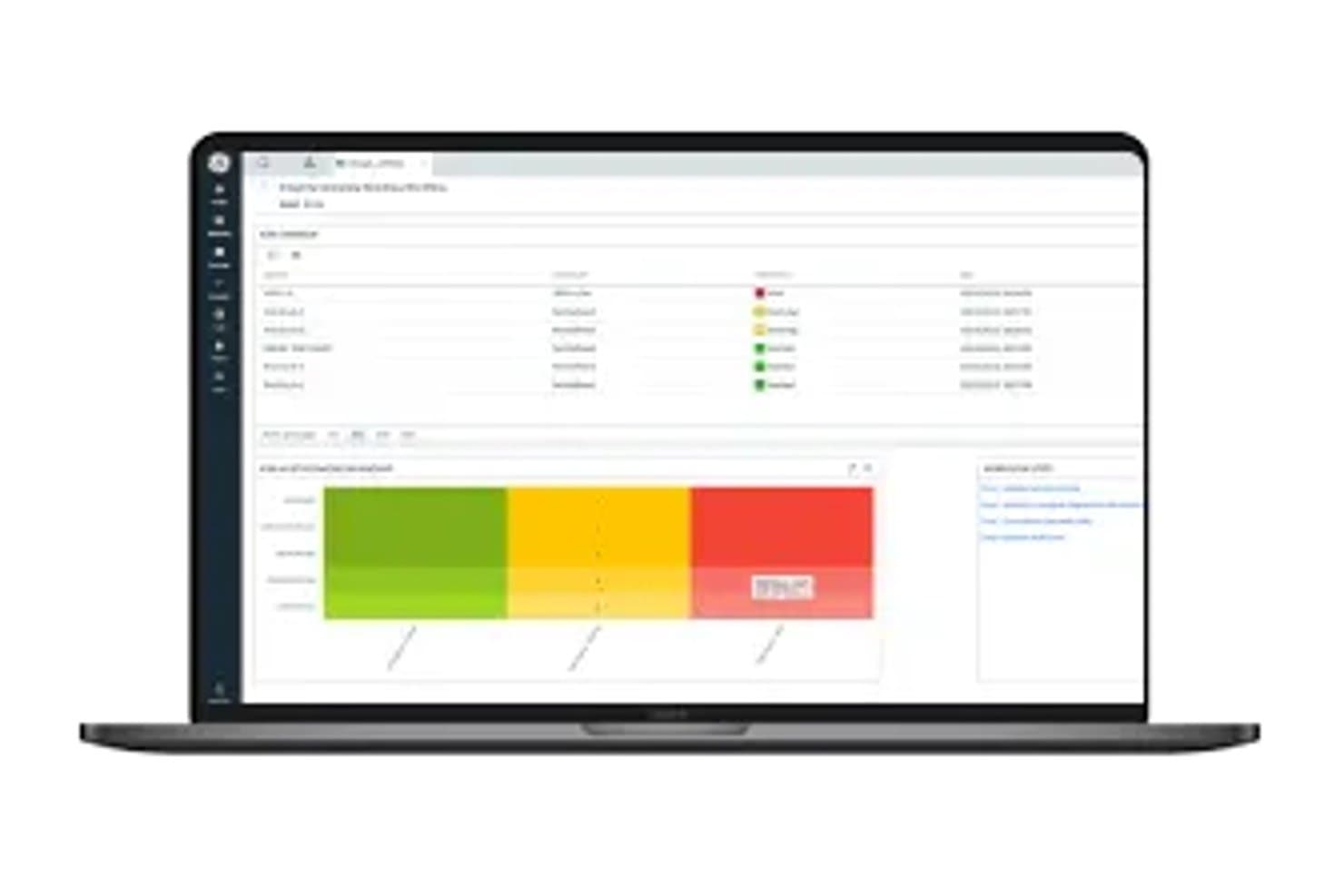
GE Vernova visualizes asset risk levels using a color-coded risk matrix. GE Vernova APM is an industrial asset performance management platform that combines AI-powered anomaly detection, predictive analytics, mechanical integrity management, and reliability engineering tools across a modular, cloud-native architecture.
Who Is GE Vernova Best For?
GE Vernova APM is a strong fit for large industrial enterprises in oil & gas, power generation, and heavy manufacturing that run multi-site operations and need mature AI-driven failure prediction at scale.
Why I Picked GE Vernova
GE Vernova APM earns its spot on my shortlist because SmartSignal's similarity-based ML models have been trained over 20+ years of industrial failure data, giving it failure detection lead times measured in weeks or months rather than hours. I'm particularly impressed by the digital twin blueprints, which map tag configurations to known failure modes across rotating equipment and turbines without custom scripting. The Monte Carlo simulations in the APM Reliability module add another layer, letting reliability engineers model maintenance strategy tradeoffs before committing to a schedule.
GE Vernova Key Features
- Autonomous Inspection: Uses computer vision and AI to automate visual inspection tasks like gauge reading and corrosion detection directly from image captures.
- APM Integrity module: Manages mechanical integrity and risk-based inspection workflows, including mobile documentation via the Integrity Mobile app.
- CERius emissions tracking: Monitors Scope 1, 2, and 3 emissions data and ties asset-level performance to ESG reporting requirements.
- Bi-directional EAM integration: Syncs with SAP, IBM Maximo, and Oracle to automatically trigger and schedule work orders when analytics detect an issue.
GE Vernova Integrations
GE Vernova APM offers native integrations with SAP, IBM Maximo, Oracle, and Proficy Historian, plus connections to OSIsoft PI/AVEVA PI. It supports custom connectivity through REST APIs, OPC UA, MQTT, Kafka, and APM Connect.
Pros and Cons
Pros:
- Supports large-scale, multi-site deployments
- Digital twin blueprints require no custom scripting
- Delivers weeks-to-months advance failure prediction
Cons:
- Some users report integration challenges with legacy systems
- Implementation often requires significant technical resources
Learn more about GE Vernova:
Alte software-uri de gestionare a performanței activelor
Iată câteva opțiuni suplimentare de software pentru gestionarea performanței activelor care nu au ajuns pe lista mea scurtă, dar care merită totuși analizate:
- 11Attune APMBest for pre-built asset twin model libraries
- 12Cognite Data FusionBest for IT/OT data convergence at industrial scale
- 13FiixBest for CMMS-rooted APM with Rockwell OT sync
- 14eMaintBest for CMMS-rooted condition-based maintenance
- 15MaintainXBest for mobile-first maintenance across multiple sites
- 16AspenTechBest for process-industry failure prediction
- 17Oracle Fusion Cloud MaintenanceBest for Oracle ERP-native asset lifecycle management
- 18Siemens AdvantaBest for edge-to-cloud APM in Siemens OT environments
How I Evaluate Asset Performance Management Software
I split my evaluation into baseline capabilities every serious APM platform must cover and the differentiators that separate tools built for real industrial complexity from those that just check boxes.
Core Functionality (Table Stakes For This List)
When I'm selecting tools for my list, I rank each one on a scale from 0 (does not offer the functionality) to 5 (excels in this area) for each core functionality listed below. I then calculate the tool's total score into a percentage, using 65% as a benchmark to help assess its overall fit for the list.
- Asset health monitoring: I evaluate how each tool ingests real-time sensor and IoT data to track operating parameters like vibration, temperature, and pressure across connected assets.
- Predictive maintenance analytics: ML-driven failure prediction and remaining useful life estimates are what I look for, not just threshold-based alerts or static scheduling rules.
- Centralized asset registry: I check whether the platform maintains a structured, hierarchical asset database with criticality rankings, lifecycle status, and support for taxonomies like ISO 14224.
- Work order management: The link between detected asset conditions and automated work order generation matters here, including mobile execution and parts integration in the field.
- Performance and reliability reporting: Dashboards covering KPIs like OEE, MTBF, MTTR, and availability across multiple sites tell me how well a platform supports data-driven reliability decisions.
- IoT and enterprise integration: I look for native connectors to SCADA, historians, ERP, and EAM/CMMS systems, plus open APIs and edge support for bi-directional data sync.
Once I have a list of tools that meet the criteria, I consider what sets each platform apart.
Differentiating Factors (What Sets Vendors Apart)
Here's how I compare and contrast different vendors:
Standout Features
I look for digital twin simulation that lets reliability teams model failure scenarios and test maintenance strategies on virtual asset replicas before committing resources in production. Edge computing support matters just as much—platforms like GE Vernova and ABB Genix APM process anomaly detection at the asset level, which is essential for remote sites with limited bandwidth or strict OT network segmentation. I also evaluate prescriptive RUL analytics, where the platform doesn't just flag a pending failure but tells a technician what to replace, when, and which parts to stage. Finally, I check for mobile field execution with offline capability and AR overlays, since work orders are useless if frontline crews can't act on them at the asset.
Beyond Features
I evaluate each vendor's deployment model against real plant network constraints—cloud-only platforms won't fly in air-gapped OT zones, so I check for hybrid and on-premise options aligned with Purdue Model segmentation. Industry-specific reference deployments matter just as much; a vendor with pre-built failure mode libraries for rotating equipment in oil and gas, like Cordant, saves months compared to building taxonomies from scratch. I also model total cost of ownership across licensing structures, since per-asset and per-tag pricing can diverge dramatically as sensor counts scale across sites.
Cum să alegeți un software de gestionare a performanței activelor
Atunci când comparați software-uri de gestionare a performanței activelor, alegerea potrivită depinde de cât de bine se aliniază platforma cu complexitatea activelor dumneavoastră, nevoile de conectivitate și obiectivele de fiabilitate:
| Dacă prioritatea dumneavoastră este… | Căutați… |
|---|---|
| Dacă prioritatea dumneavoastră este…Integrarea rapidă cu datele OT/IT existente | Căutați…Conectori nativi pentru SCADA, istoricul de date și ERP |
| Dacă prioritatea dumneavoastră este…Predicția exactă a defecțiunilor în stadii incipiente | Căutați…Învățare automată integrată pentru durata de viață utilă rămasă (RUL) |
| Dacă prioritatea dumneavoastră este…Analize de fiabilitate specifice industriei | Căutați…Biblioteci de șabloane sau taxonomii pentru tipurile dumneavoastră de active |
| Dacă prioritatea dumneavoastră este…Executarea lucrărilor în zone cu lățime de bandă limitată | Căutați…Posibilitatea de a gestiona ordinele de lucru pe dispozitive mobile/în modul offline |
| Dacă prioritatea dumneavoastră este…Operațiuni securizate în rețele izolate | Căutați…Opțiuni de implementare locală sau hibridă |
Cum să evaluați lista scurtă
- Testați afirmațiile privind integrarea nativă: Solicitați o demonstrație live de 1 oră care să prezinte importul de date din sistemul OT/IT real sau eșantion utilizat de dumneavoastră.
- Verificați performanța învățării automate: Solicitați un studiu de caz documentat care să compare exactitatea RUL cu înregistrările reale de întreținere.
- Verificați acoperirea activelor din industrie: Solicitați o listă completă a modelelor de active predefinite sau a șabloanelor de taxonomie pentru clasele dumneavoastră de active.
- Demonstrați compatibilitatea mobilă offline: Efectuați o probă în care generați și finalizați un ordin de lucru cu rețeaua dezactivată pe un dispozitiv mobil.
- Evaluați flexibilitatea implementării în raport cu ușurința actualizărilor: Decideți dacă aveți nevoie de o implementare locală/hibridă pentru locații securizate sau de soluția cloud pentru actualizări mai rapide din partea furnizorului.
Ce este software-ul de gestionare a performanței activelor?
Software-ul de gestionare a performanței activelor este o platformă care combină datele IT și OT pentru a monitoriza, analiza și prezice starea, fiabilitatea și nevoile de întreținere ale activelor fizice. Aceste instrumente vă ajută să reduceți perioadele de nefuncționare, să optimizați programele de întreținere și să prelungiți durata de viață a activelor, transformând datele provenite de la senzori și din operațiuni în informații utile. Această abordare sprijină echipele axate pe fiabilitate, întreținere și operațiuni digitale în medii complexe.
Funcții
Atunci când selectați un software de gestionare a performanței activelor, urmăriți următoarele funcții esențiale:
- Monitorizarea stării activelor: Urmărește în timp real datele provenite de la senzori și echipamente, precum temperatura, vibrațiile și presiunea, astfel încât să puteți identifica din timp problemele și să înțelegeți rapid starea echipamentelor.
- Analiza mentenanței predictive: Utilizează date istorice și în timp real pentru a identifica tendințe și a prognoza momentul în care echipamentele vor avea probabil nevoie de mentenanță, ajutându-vă să evitați defecțiunile și să reduceți reparațiile reactive.
- Registrul centralizat al activelor: Oferă o bază de date structurată cu toate activele companiei, inclusiv starea lor actuală, specificațiile, istoricul mentenanței și nivelul de criticitate, facilitând gestionarea inventarelor extinse.
- Gestionarea ordinelor de lucru: Conectează datele despre stare la crearea automată sau manuală a ordinelor de lucru, atribuie sarcini echipelor și urmărește progresul până la finalizare, asigurându-se că mentenanța este efectuată la momentul potrivit.
- Raportarea performanței și fiabilității: Creează tablouri de bord și rapoarte care prezintă indicatori-cheie, precum timpul mediu între defecțiuni (MTBF) și timpul mediu de reparare (MTTR), permițându-vă să măsurați și să îmbunătățiți programele de fiabilitate.
- Integrarea IoT și a sistemelor: Se conectează la SCADA, istorice de date, ERP și alte sisteme de afaceri pentru a unifica datele operaționale și de întreprindere, astfel încât planificarea mentenanței să beneficieze de un context complet.
- Acces mobil pe teren: Le permite tehnicienilor să consulte istoricul activelor, să primească ordine de lucru și să actualizeze stările de pe dispozitivele lor mobile, chiar și pe teren sau în zone cu conectivitate redusă.
- Gestionarea ciclului de viață: Urmărește activele de la punerea în funcțiune până la dezafectare, permițându-vă să planificați eficient înlocuirile, modernizările și proiectele de investiții.
- Conformitate și pistă de audit: Păstrează înregistrări digitale pentru mentenanță, inspecții și etalonare, sprijinind standardele din industrie și simplificând auditurile.
- Controale pentru rolurile și permisiunile utilizatorilor: Oferă un control detaliat asupra persoanelor care pot vizualiza, edita sau programa sarcini și asupra celor care pot consulta date sensibile despre active, protejând informațiile și fluxurile de lucru critice.
Funcții AI comune
Pe lângă funcțiile standard ale software-ului de gestionare a performanței activelor prezentate mai sus, multe dintre aceste soluții integrează AI cu funcții precum:
- Detectarea automată a anomaliilor: Modelele AI analizează datele senzorilor în timp real pentru a identifica tipare neobișnuite sau abateri de la condițiile normale de funcționare, semnalând problemele pe care alertele tradiționale bazate pe praguri le-ar putea omite. Acest lucru vă ajută să detectați problemele subtile înainte ca acestea să se agraveze.
- Predicția modurilor de defecțiune: AI prezice moduri specifice de defecțiune învățând din defecțiunile istorice și din înregistrările de mentenanță, permițându-vă să anticipați nu doar când s-ar putea defecta un activ, ci și cum și de ce este probabil să se întâmple acest lucru.
- Recomandări prescriptive pentru mentenanță: AI depășește etapa de predicție a defecțiunilor, sugerând acțiunea de mentenanță optimă, momentul potrivit și piesele necesare, ajutând echipa să prioritizeze ordinele de lucru și să reducă intervențiile inutile.
- Evaluarea dinamică a riscurilor: AI evaluează continuu riscul activelor, luând în considerare datele în timp real, performanța istorică și condițiile de mediu, oferindu-vă un profil de risc actualizat pentru fiecare activ și sprijinind luarea unor decizii mai bune.
- Analiza automată a cauzei principale: AI analizează volume mari de date operaționale pentru a identifica cauzele fundamentale ale problemelor recurente, ajutându-vă să abordați problemele sistemice în loc să tratați doar simptomele.
Beneficii
Implementarea software-ului de gestionare a performanței activelor oferă mai multe beneficii echipei și companiei dumneavoastră. Iată câteva dintre avantajele pe care le puteți anticipa:
- Reducerea perioadelor de nefuncționare neplanificate: Monitorizarea în timp real a stării activelor și analiza mentenanței predictive vă permit să identificați din timp riscurile, astfel încât să programați mentenanța înainte de apariția defecțiunilor.
- Prelungirea duratei de viață a activelor: Registrele centralizate ale activelor și instrumentele de gestionare a ciclului de viață vă ajută să planificați înlocuirile, modernizările și mentenanța pe baza istoricului și stării exacte a activelor.
- Optimizarea programelor de mentenanță: Învățarea automată și recomandările prescriptive vă permit să prioritizați lucrările potrivite pentru activele potrivite, reducând intervențiile inutile și costurile de mentenanță.
- Creșterea fiabilității și eficienței: Tablourile de bord privind performanța și rapoartele de fiabilitate vă oferă informații utile despre indicatori precum MTBF și MTTR, ajutându-vă să identificați domeniile care necesită îmbunătățiri.
- Îmbunătățirea conformității și a pregătirii pentru audit: Urmărirea automată a ordinelor de lucru și pistele de audit digitale vă mențin pregătiți pentru verificările de reglementare, documentând activitățile de mentenanță și inspecțiile.
- Integrarea mai bună cu sistemele existente: Integrările IoT și cu sistemele de întreprindere conectează sistemele SCADA, ERP și istorice de date, astfel încât toate datele operaționale și de mentenanță să rămână sincronizate.
- Echipe mobile de teren mai eficiente: Accesul mobil și offline la ordinele de lucru menține productivitatea tehnicienilor pe teren—chiar și atunci când conectivitatea este limitată—asigurându-se că sarcinile urgente nu sunt amânate.
Costuri și prețuri
Selectarea software-ului de gestionare a performanței activelor necesită înțelegerea diferitelor modele și planuri de tarifare disponibile. Costurile variază în funcție de funcții, dimensiunea echipei, suplimente și alți factori. Tabelul de mai jos rezumă planurile comune, prețurile medii ale acestora și funcțiile incluse de obicei în soluțiile software de gestionare a performanței activelor:
Tabel comparativ al planurilor pentru software-ul de gestionare a performanței activelor
| Tip de plan | Preț mediu | Funcții uzuale |
|---|---|---|
| Tip de planPlan gratuit | Preț mediu$0 | Funcții uzualeRegistru de bază al activelor, monitorizare limitată a stării activelor, gestionarea de bază a ordinelor de lucru și raportare de bază. |
| Tip de planPlan personal | Preț mediu$50–$200/lună | Funcții uzualeMonitorizarea activelor pentru echipe mici, crearea ordinelor de lucru, analize predictive limitate și acces mobil pentru câțiva utilizatori. |
| Tip de planPlan pentru companii | Preț mediu$500–$2,000/lună | Funcții uzualeRegistru de active pentru mai multe locații, integrare IoT, raportare avansată, acces mobil pe teren și automatizarea fluxurilor de lucru pentru echipe de dimensiuni medii. |
| Tip de planPlan pentru întreprinderi | Preț mediu$2,000–$10,000+/lună | Funcții uzualeRegistru nelimitat al activelor, analize predictive pentru întreținere, informații bazate pe inteligență artificială, integrare API, tablouri de bord personalizate și asistență completă. |
Întrebări frecvente despre software-ul pentru gestionarea performanței activelor
Iată câteva răspunsuri la întrebările frecvente despre software-ul pentru gestionarea performanței activelor:
Cum pot ști dacă software-ul pentru gestionarea performanței activelor este compatibil cu echipamentele sau industria mea?
Va trebui să verificați dacă există șabloane sau taxonomii predefinite pentru active, care corespund echipamentelor și standardelor din industria dumneavoastră. Solicitați furnizorilor o listă a tipurilor de active acceptate și verificați dacă oferă implementări de referință pentru industria dumneavoastră, cum ar fi industria petrolului și gazelor sau utilitățile. Soluția potrivită ar trebui să includă biblioteci ale modurilor de defectare sau modele de analiză adaptate claselor dumneavoastră de active.
Poate software-ul pentru gestionarea performanței activelor să funcționeze în medii izolate de rețea sau cu securitate ridicată?
Da, dar va trebui să confirmați că software-ul acceptă opțiuni de implementare locală sau hibridă. Platformele disponibile exclusiv în cloud nu pot funcționa în rețele OT deconectate. Căutați soluții concepute pentru segmentarea conform Modelului Purdue și care nu necesită acces permanent la internet pentru operațiunile zilnice.
Ce tipuri de integrări ar trebui să prioritizez atunci când evaluez software-ul pentru gestionarea performanței activelor?
Concentrați-vă pe integrările cu sistemele SCADA, bazele de date istorice, EAM/CMMS și ERP existente. Conectorii nativi și API-urile deschise vă permit să centralizați datele operaționale și cele ale întreprinderii. De asemenea, va trebui să confirmați că instrumentul acceptă sincronizarea datelor în timp real și încărcarea în loturi pentru mediile moștenite sau cu lățime de bandă limitată.
Cum evaluez capabilitățile de întreținere predictivă ale unei platforme?
Solicitați o demonstrație care să prezinte preluarea în timp real a datelor dumneavoastră și cereți studii de caz cu acuratețea documentată a predicției RUL (durata de viață utilă rămasă). Căutați analize bazate pe ML care depășesc pragurile statice și confirmați că platforma oferă recomandări practice și prescriptive, nu doar alerte.
Care sunt unele costuri ascunse de care ar trebui să țin cont în cazul software-ului pentru gestionarea performanței activelor?
Fiți atenți la modelele de tarifare per activ sau per etichetă, deoarece costurile pot crește rapid atunci când extindeți acoperirea senzorilor. Luați în considerare și taxele de implementare, personalizare și integrare, precum și orice costuri suplimentare pentru funcții precum accesul mobil, raportarea sau integrările cu terți. Nu uitați să includeți în calcul asistența și instruirea continue.