

Reseña de Apiary: Ventajas, Desventajas, Características y Precios

Revisamos herramientas de forma independiente y las comisiones ayudan a financiar nuestras pruebas. Consulta nuestra política de transparencia, nuestra metodología o sugiere una herramienta.
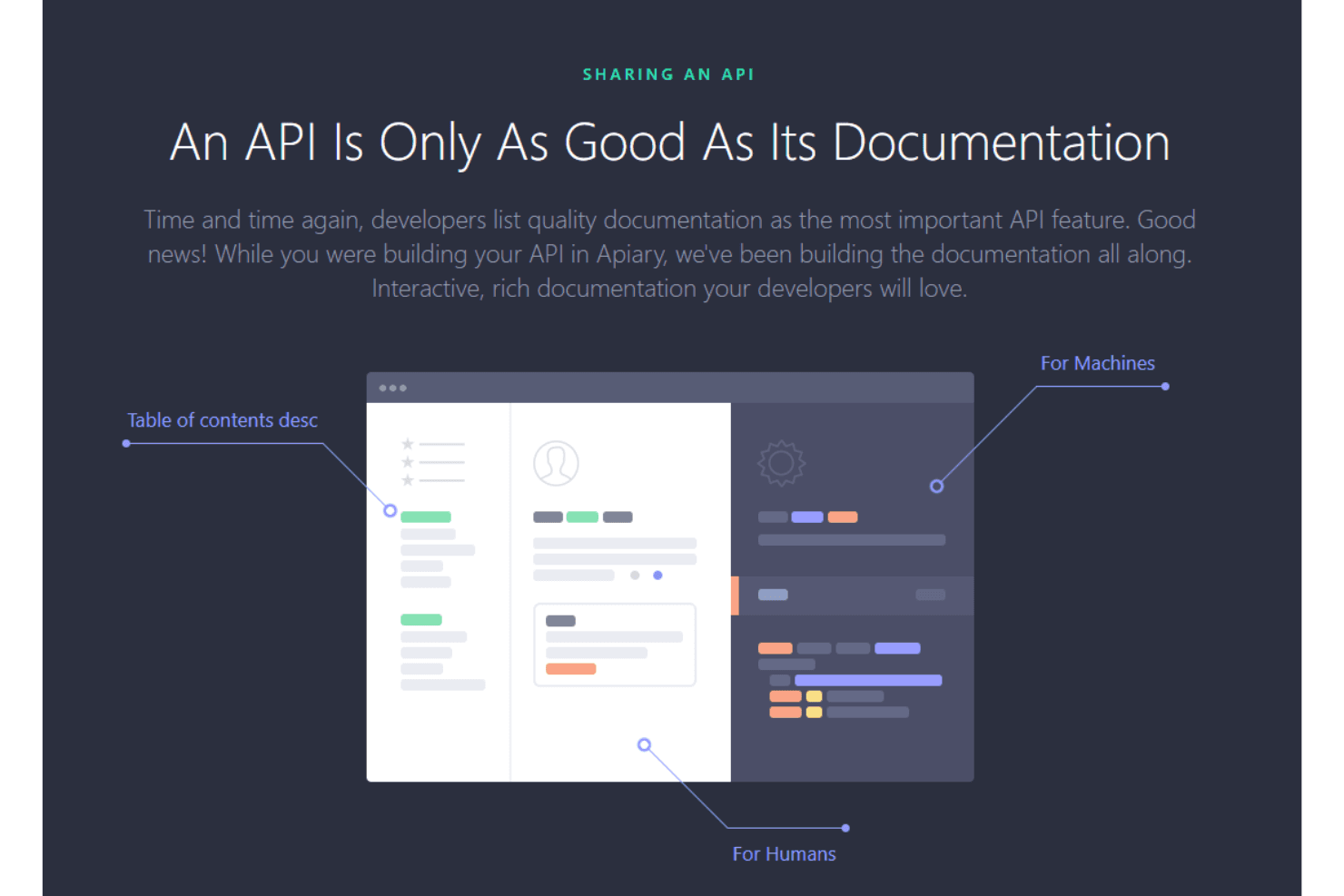
Apiary is an application development software built around API design, documentation, and mock server testing. It's a good fit for development teams that need to define and document APIs before writing production code, particularly when collaboration between backend developers and API consumers matters. I'd consider it over something like SwaggerHub if your team wants API documentation, interactive testing, and mock servers in one place—without configuring those pieces as separate tools or integrations.
Apiary Evaluation Summary
4.3/5
- Pricing available on request
- as a free trial but doesn’t mention the number of days
Por qué confiar en nuestras recomendaciones de software
6,700+
Reviews
20
Industry experts
16+
Evaluation factors
14
Years
Nuestro equipo lleva probando y evaluando software desde 2012. Como líderes tecnológicos, sabemos lo difícil —y lo importante— que es elegir el software adecuado.
Para esta guía, evaluamos las herramientas mediante pruebas prácticas e investigación independiente, puntuando las herramientas según nuestros criterios de selección.
Nuestras reseñas reflejan nuestro criterio editorial humano, no un discurso de ventas.
Revisores expertos:
- Paulo Gardini MiguelDirector técnico
 Tim FisherVP de IA
 Gabriel RosasTech Lead y arquitecto de software
 Christhian GruhnTech Lead y arquitecto de plataforma

Apiary Overview
In my opinion, Apiary.io stands out as a solid choice for teams focused on API creation. Its interface is intuitive, making it easier for developers to draft and test APIs. Compared to other platforms, Apiary offers a competitive edge with its collaborative features, allowing multiple team members to work seamlessly. However, its onboarding process could be more streamlined, and the customer support, while adequate, sometimes lacks immediacy. Apiary is best suited for small to medium-sized teams that prioritize collaboration and API design. If your team needs a tool that integrates well with other development tools and offers good value for money, Apiary is worth considering.
Pros
- You can easily document and test APIs, making your work more efficient.
- Its user-friendly interface helps you quickly understand and navigate the software.
- You can leverage its developer-friendly framework for robust and adaptable API management.
Cons
- You might find the learning curve steep if you're new to API management.
- It may lack some advanced features compared to other API management solutions.
- You could encounter limitations in customization options, affecting flexibility.
Is Apiary Right For Your Needs?
Who Would be a Good Fit for Apiary?
Apiary.io is ideal for development teams focusing on API design and documentation. If your work involves frequent API iterations and collaboration, Apiary's features like API Blueprint, mock servers, and collaborative documentation can be useful. It helps streamline your workflow by allowing you to design, prototype, and test APIs efficiently.
- Software DevelopersApiary provides tools for designing, prototyping, and testing APIs, ensuring your development process is efficient.
- Tech StartupsStartups benefit from prototyping and iterating on new APIs quickly, which Apiary supports with its comprehensive toolset.
- API-Driven ProjectsFor projects relying heavily on APIs, Apiary's documentation and testing features help maintain consistency and reliability.
- Collaborative TeamsTeams that need to work together on API design will appreciate Apiary's collaborative documentation and version control.
- Educational InstitutionsApiary offers a platform for students to learn about API design and testing, making it a valuable educational tool.
- Consulting FirmsFirms providing API solutions can use Apiary to quickly design and showcase API capabilities to clients.
Who Would be a Bad Fit for Apiary?
Apiary.io might not be suitable for teams that need advanced customization or complex integrations. If your work requires highly tailored workflows or deep integration with other systems, you might find Apiary's features limiting. For instance, if your team needs to create detailed resource management plans or requires in-depth analytics, you might struggle with Apiary's capabilities. Apiary is better suited for straightforward API development and documentation rather than complex, multi-layered application development.
- Large EnterprisesApiary might not handle the scale and complexity of large enterprises that require extensive customization and integration capabilities. In this case, consider API development tools offered by AWS, Microsoft, and IBM.
- Custom Software DevelopmentFor teams focused on creating custom software solutions, Apiary's limited customization options can be a hindrance.
- Data-Intensive ApplicationsIf your project demands intensive data processing or analytics, Apiary's functionalities may not suffice.
- Resource ManagementApiary lacks detailed resource management features, making it unsuitable for teams needing comprehensive planning tools.
- Advanced ReportingTeams requiring advanced reporting might find Apiary insufficient, as it doesn't cater to in-depth analytics needs.
- Complex Workflow IntegrationIf your work involves integrating multiple complex workflows, Apiary's integration capabilities might fall short.
Nuestra metodología de revisión
Cómo probamos y puntuamos las herramientas
Hemos invertido años construyendo, refinando y mejorando nuestro sistema de pruebas y puntuación de software. La rúbrica está diseñada para captar los matices de la selección de software y lo que hace a una herramienta efectiva, enfocándose en aspectos críticos del proceso de toma de decisiones.
A continuación, puedes ver exactamente cómo nuestro sistema de prueba y puntuación funciona a través de siete criterios. Esto nos permite ofrecer una evaluación imparcial del software basada en funcionalidad central, características destacadas, facilidad de uso, incorporación, soporte al cliente, integraciones, reseñas de clientes y relación calidad-precio.
Funcionalidad principal (25% de la puntuación final)
El punto de partida de nuestra evaluación siempre es la funcionalidad central de la herramienta. ¿Tiene las características y funciones básicas que un usuario esperaría encontrar? ¿Alguna de esas funciones principales está limitada a planes de precios superiores? Esperamos que una herramienta esté a la altura de las capacidades básicas de sus competidores.
Características destacadas (25% de la puntuación final)
Luego, evaluamos las características poco comunes y sobresalientes que van más allá de la funcionalidad principal que normalmente se encuentra en herramientas de su tipo. Una puntuación alta refleja características especializadas o únicas que hacen el producto más rápido, eficiente o que ofrecen valor adicional al usuario.
También evaluamos qué tan fácil es integrar con otras herramientas que normalmente forman parte del ecosistema tecnológico para expandir la funcionalidad y utilidad del software. Las herramientas que ofrecen abundantes integraciones nativas, conexiones de terceros y acceso API para crear integraciones personalizadas obtienen la mejor puntuación.
Facilidad de uso (10% de la puntuación final)
Consideramos cuán rápido y sencillo es ejecutar las tareas definidas por la funcionalidad principal usando la herramienta. El software con mejor puntuación está bien diseñado, es intuitivo, ofrece aplicaciones móviles, proporciona plantillas y hace que tareas relativamente complejas parezcan sencillas.
Incorporación (10% de la puntuación final)
Sabemos lo importante que es la adopción rápida por parte del equipo para una nueva plataforma, por lo que evaluamos cuán fácil es aprender y usar una herramienta con entrenamiento mínimo. Evaluamos cuán rápido un miembro del equipo puede configurarla y comenzar a utilizarla sin experiencia previa. Las soluciones con mayor puntuación requieren poco o ningún soporte.
Soporte al cliente (10% de la puntuación final)
Revisamos qué tan rápido y sencillo es resolver dudas y encontrar ayuda por teléfono, chat en vivo o base de conocimientos. Las herramientas y compañías que proporcionan soporte en tiempo real obtienen la mejor puntuación, mientras que los chatbots obtienen la peor.
Reseñas de clientes (10% de la puntuación final)
Además de nuestras pruebas y evaluaciones, consideramos la puntuación neta de promotores por parte de clientes actuales y anteriores. Revisamos la probabilidad de que elijan la herramienta de nuevo para la funcionalidad principal. Una puntuación alta refleja una alta puntuación neta de promotores actuales o pasados.
Relación calidad-precio (10% de la puntuación final)
Por último, considerando todos los demás criterios, revisamos el precio promedio de los planes de nivel básico comparado con las funciones principales y consideramos el valor de los demás criterios de evaluación. El software que ofrezca más, por menos, obtendrá una puntuación mayor.
Core Features
API Blueprint Editor
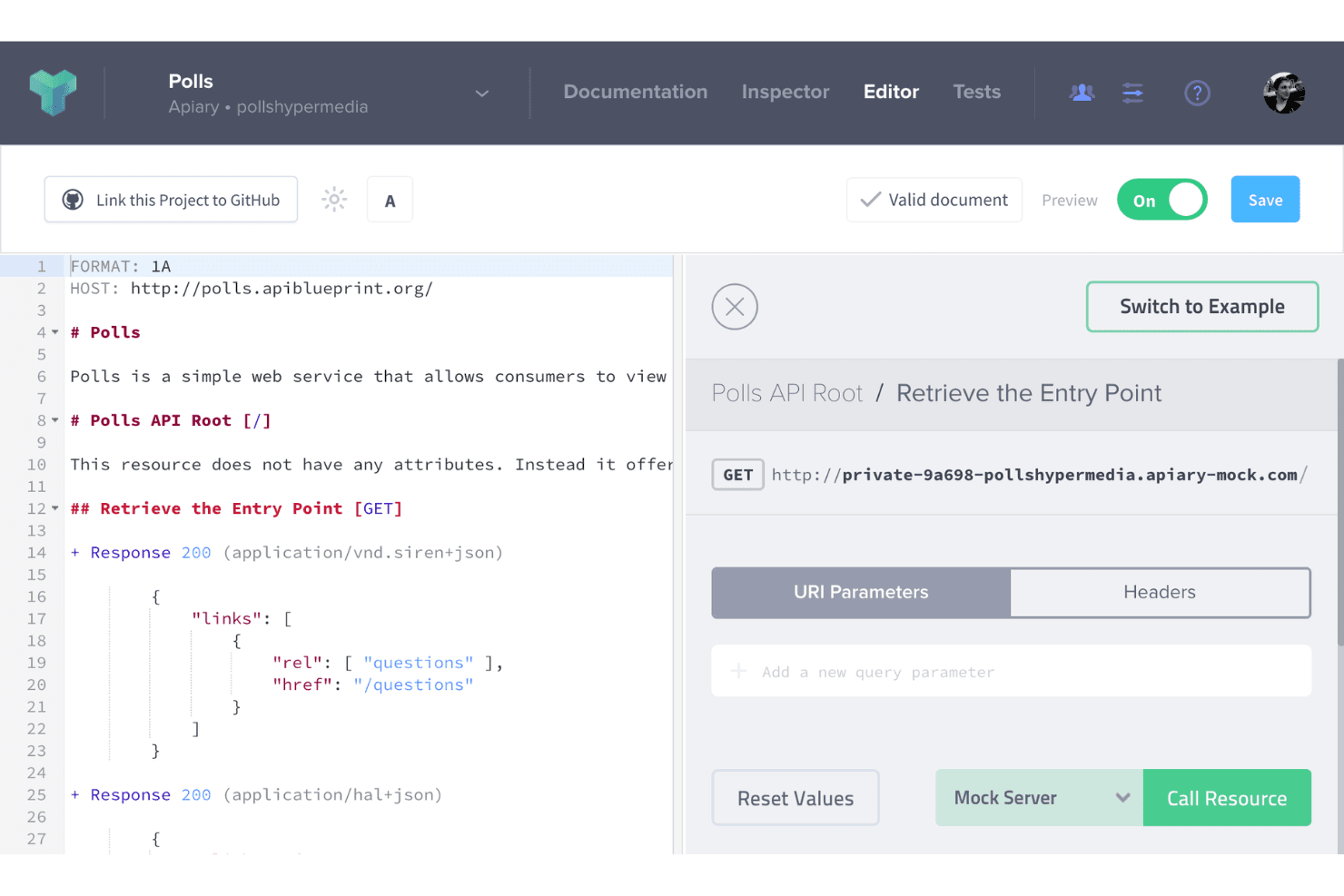
You can use Apiary's intuitive API Blueprint Editor to design your APIs with ease. The editor supports OpenAPI, which requires specific syntax. It lets you write API documentation in markdown, ensuring that you and your team can focus on creating clear and concise documentation effortlessly.
Mock Servers
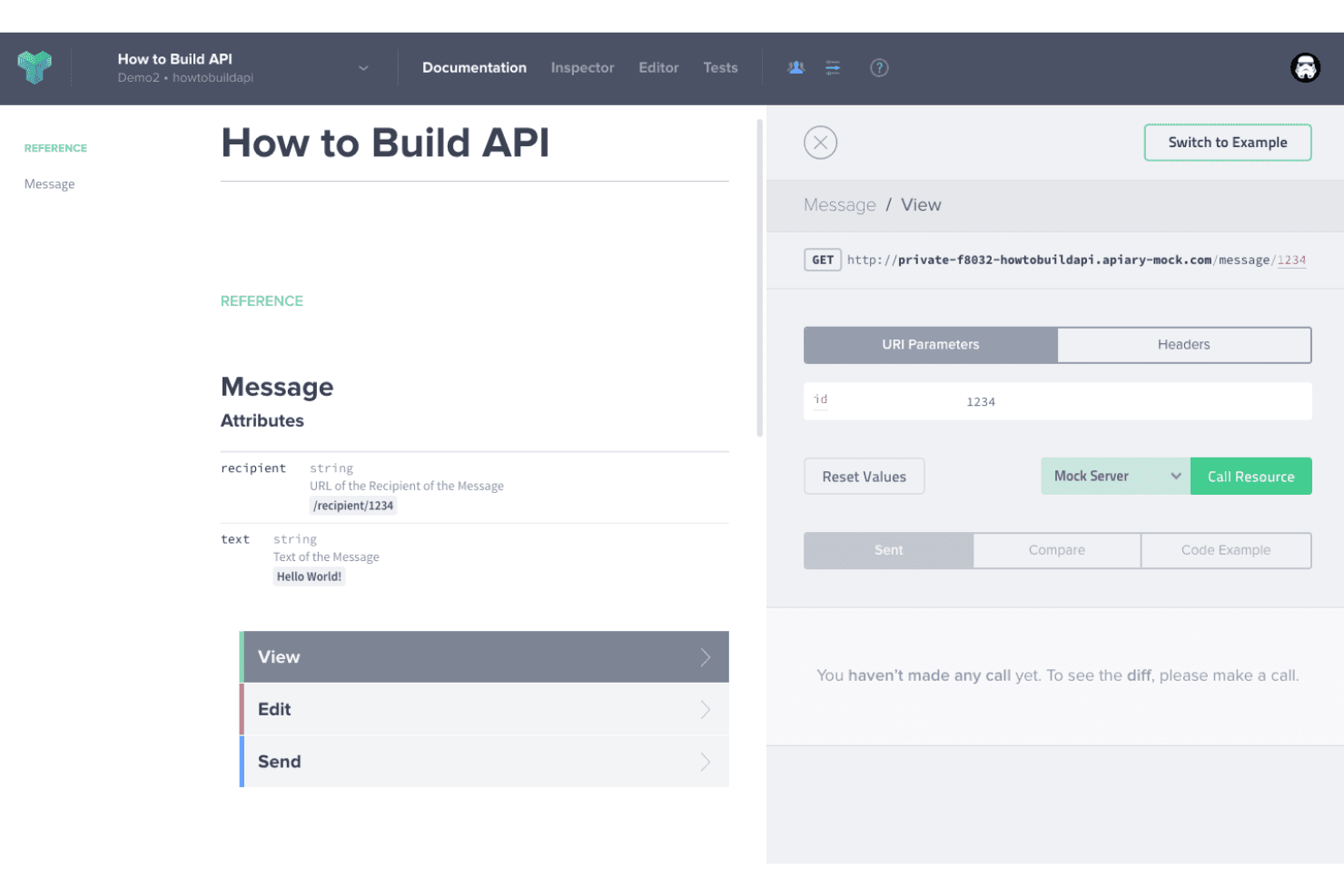
With Apiary's mock servers, you can test your API designs without worrying about backend development. This feature allows you to simulate API responses, giving you and your team a real-time understanding of how your API will behave.
API Documentation
Apiary automatically generates documentation from your API designs. This ensures that you have up-to-date, user-friendly docs that helps you and your team understand API endpoints and their functionalities.
API Inspector
The API Inspector feature allows you to track requests and responses in real time. This is invaluable for debugging and ensures that your API performs as expected.
Collaboration Tools
Apiary provides collaboration tools that enable your team to work together on API development. Whether you're commenting on API designs or discussing changes, these tools help you streamline the development process.
Version Control
You can manage different versions of your API with Apiary's version control feature. This ensures that you can track changes and revert to previous versions if needed, maintaining the integrity of your API development.
Ease of Use
Apiary's interface is intuitive, making it accessible for both beginners and experienced developers. You can quickly design and test APIs, thanks to its user-friendly design and straightforward documentation. However, the learning curve might be slightly steeper if you're unfamiliar with API concepts. Compared to other tools, Apiary’s real-time collaboration, automation capabilities, and immediate feedback features enhance your workflow. However,some users find the advanced customization options require a bit more time to master.
Integrations
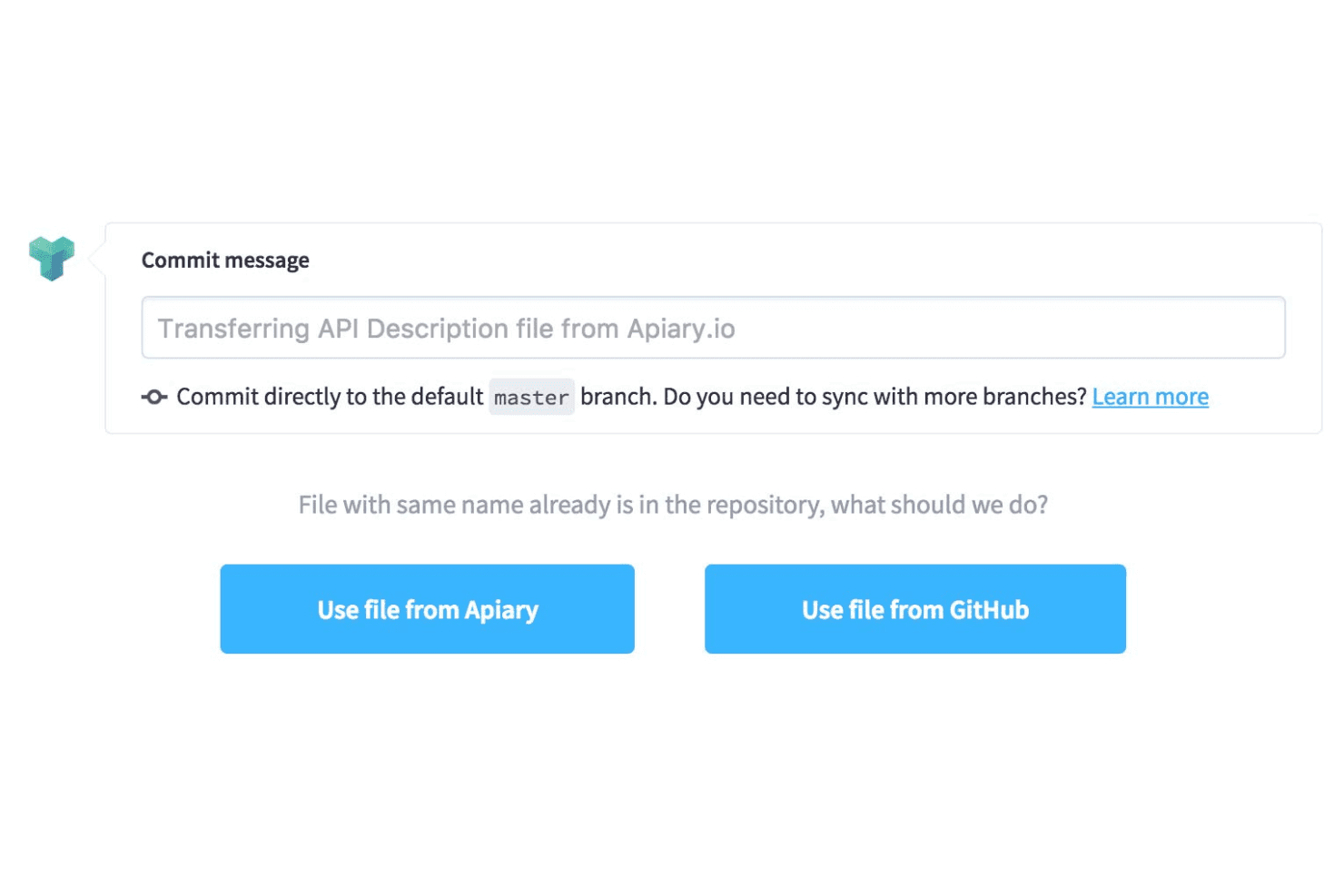
Apiary.io integrates with GitHub, API Blueprint, Swagger, and provides functionality for API testing and mock server design. Apiary also has an Integration API that allows third-party applications and partners to integrate with its services and tools.
Apiary Specs
- API: Yes
- Bug Tracking: No
- CI/CD Integration: No
- Cloud Deployment: Yes
- Code Review: No
- Code Transformation: No
- Collaboration Support: Yes
- Data Export: No
- Data Import: No
- Developer Tools: Yes
- External Integrations: Yes
- Git Integration: Yes
- History/Version Control: Yes
- IDE Plugins: No
- Local Deployment: No
- Multi-User: Yes
- Notifications: No
- Project Management: No
- Release Management: No
- Static Analysis: No
- Task Scheduling/Tracking: No
- Testing: Yes


