

Reseña de Roboflow 2026: Características clave, ventajas, desventajas y precios
¿Qué sigue? Impulsa el crecimiento de tu SaaS y tus habilidades de liderazgo. Suscríbete a nuestro boletín para recibir las últimas ideas de CTOs y líderes tecnológicos en ascenso. ¡Te ayudaremos a escalar de forma inteligente y a liderar con mayor fortaleza, con guías, recursos y estrategias de los mejores expertos!

Revisamos herramientas de forma independiente y las comisiones ayudan a financiar nuestras pruebas. Consulta nuestra política de transparencia, nuestra metodología o sugiere una herramienta.
Struggling to manage complex image datasets and deploy AI models efficiently? Roboflow is a computer vision platform that simplifies visual intelligence for video, images, and real-time streams.
In this review, you’ll find an in-depth look at Roboflow’s features, pros and cons, best and worst use cases, pricing, and how it stacks up against other options.
Roboflow Evaluation Summary

4.8/5
- From $99/month
- Free plan + free trial + free demo available
Por qué confiar en nuestras recomendaciones de software
6,700+
Reviews
20
Industry experts
16+
Evaluation factors
14
Years
Nuestro equipo lleva probando y evaluando software desde 2012. Como líderes tecnológicos, sabemos lo difícil —y lo importante— que es elegir el software adecuado.
Para esta guía, evaluamos las herramientas mediante pruebas prácticas e investigación independiente, puntuando las herramientas según nuestros criterios de selección.
Nuestras reseñas reflejan nuestro criterio editorial humano, no un discurso de ventas.
Revisores expertos:
- Paulo Gardini MiguelDirector técnico
 Tim FisherVP de IA
 Gabriel RosasTech Lead y arquitecto de software
 Christhian GruhnTech Lead y arquitecto de plataforma

Roboflow Overview
Roboflow gives teams a clear way to label, train, and deploy computer vision models on a single platform, making it easier to develop vision applications. It focuses on usability and fast setup, so teams can move from dataset to deployment without heavy machine learning infrastructure. Overall, it’s well-suited for developers who want an accessible end-to-end vision workflow and rapid prototyping.
Pros
- AI-assisted annotation speeds up labeling large datasets.
- Supports deployment to edge devices, cloud, or on-premises.
- Offers open source tools and public datasets for experimentation.
Cons
- Costs can scale quickly with high-volume training and inference.
- Limited low-level customization compared to fully custom ML pipelines.
- Performance and latency vary by deployment method.
Is Roboflow Right For Your Needs?
Who Would be a Good Fit for Roboflow?
Roboflow is ideal for teams that need to build, annotate, and deploy computer vision models quickly without heavy infrastructure or deep ML expertise. Its platform supports rapid prototyping, collaborative annotation, and flexible deployment options across various industries.
- ManufacturingDeploy vision AI to automate quality inspections, detect defects, track inventory, and improve efficiency across modern manufacturing operations.
- Industrial ManufacturingUse vision AI to monitor equipment performance, prevent downtime, automate inspections, and optimize complex industrial production environments at scale.
- Healthcare & MedicineApply vision AI to analyze medical imagery, monitor patients, automate workflows, and improve diagnostic accuracy and healthcare outcomes.
- AutomotiveEnhance automotive manufacturing with vision AI that detects defects, monitors assembly lines, optimizes processes, and prevents costly production downtime.
- Aerospace & DefenseUse vision AI to inspect components, verify assembly accuracy, monitor safety compliance, and ensure quality across aerospace manufacturing operations.
- Consumer GoodsProtect product quality and brand trust using vision AI to inspect packaging, verify labels, detect defects, and optimize production.
Who Would be a Bad Fit for Roboflow?
Roboflow may not suit organizations with highly specialized or non-vision-centric needs, strict data privacy mandates, or those requiring deep integration with complex enterprise systems.
- Non-Technical Business Plug-and-Play UsersDepartments that need instant image tagging without dataset preparation, annotation workflows, or model iteration may prefer pre-trained APIs (e.g., turnkey vision services) rather than managing datasets and training pipelines.
- Audio & Voice Technology ProvidersTeams working primarily with voice or audio data require specialized tools beyond Roboflow’s computer vision capabilities.
- Low-Budget Hobbyists Scaling Private ProjectsIndividual builders or small teams with limited budgets who need large-scale private datasets, frequent retraining, or high-volume inference may encounter cost and usage constraints compared to lightweight open-source alternatives.
- Cloud Infrastructure & Network OperationsOrganizations managing cloud services or network infrastructure need platforms tailored to those domains rather than image-based AI.
- Business Intelligence & Analytics PlatformsBI tools focused on data analytics and reporting do not align with Roboflow’s focus on image annotation and model deployment.
- Backend-Only SaaS ProvidersBackend SaaS platforms without a visual data component will not benefit from Roboflow’s computer vision features.
Nuestra metodología de revisión
Cómo probamos y puntuamos las herramientas
Hemos invertido años construyendo, refinando y mejorando nuestro sistema de pruebas y puntuación de software. La rúbrica está diseñada para captar los matices de la selección de software y lo que hace a una herramienta efectiva, enfocándose en aspectos críticos del proceso de toma de decisiones.
A continuación, puedes ver exactamente cómo nuestro sistema de prueba y puntuación funciona a través de siete criterios. Esto nos permite ofrecer una evaluación imparcial del software basada en funcionalidad central, características destacadas, facilidad de uso, incorporación, soporte al cliente, integraciones, reseñas de clientes y relación calidad-precio.
Funcionalidad principal (25% de la puntuación final)
El punto de partida de nuestra evaluación siempre es la funcionalidad central de la herramienta. ¿Tiene las características y funciones básicas que un usuario esperaría encontrar? ¿Alguna de esas funciones principales está limitada a planes de precios superiores? Esperamos que una herramienta esté a la altura de las capacidades básicas de sus competidores.
Características destacadas (25% de la puntuación final)
Luego, evaluamos las características poco comunes y sobresalientes que van más allá de la funcionalidad principal que normalmente se encuentra en herramientas de su tipo. Una puntuación alta refleja características especializadas o únicas que hacen el producto más rápido, eficiente o que ofrecen valor adicional al usuario.
También evaluamos qué tan fácil es integrar con otras herramientas que normalmente forman parte del ecosistema tecnológico para expandir la funcionalidad y utilidad del software. Las herramientas que ofrecen abundantes integraciones nativas, conexiones de terceros y acceso API para crear integraciones personalizadas obtienen la mejor puntuación.
Facilidad de uso (10% de la puntuación final)
Consideramos cuán rápido y sencillo es ejecutar las tareas definidas por la funcionalidad principal usando la herramienta. El software con mejor puntuación está bien diseñado, es intuitivo, ofrece aplicaciones móviles, proporciona plantillas y hace que tareas relativamente complejas parezcan sencillas.
Incorporación (10% de la puntuación final)
Sabemos lo importante que es la adopción rápida por parte del equipo para una nueva plataforma, por lo que evaluamos cuán fácil es aprender y usar una herramienta con entrenamiento mínimo. Evaluamos cuán rápido un miembro del equipo puede configurarla y comenzar a utilizarla sin experiencia previa. Las soluciones con mayor puntuación requieren poco o ningún soporte.
Soporte al cliente (10% de la puntuación final)
Revisamos qué tan rápido y sencillo es resolver dudas y encontrar ayuda por teléfono, chat en vivo o base de conocimientos. Las herramientas y compañías que proporcionan soporte en tiempo real obtienen la mejor puntuación, mientras que los chatbots obtienen la peor.
Reseñas de clientes (10% de la puntuación final)
Además de nuestras pruebas y evaluaciones, consideramos la puntuación neta de promotores por parte de clientes actuales y anteriores. Revisamos la probabilidad de que elijan la herramienta de nuevo para la funcionalidad principal. Una puntuación alta refleja una alta puntuación neta de promotores actuales o pasados.
Relación calidad-precio (10% de la puntuación final)
Por último, considerando todos los demás criterios, revisamos el precio promedio de los planes de nivel básico comparado con las funciones principales y consideramos el valor de los demás criterios de evaluación. El software que ofrezca más, por menos, obtendrá una puntuación mayor.
Core Features
Vision AI Deployment
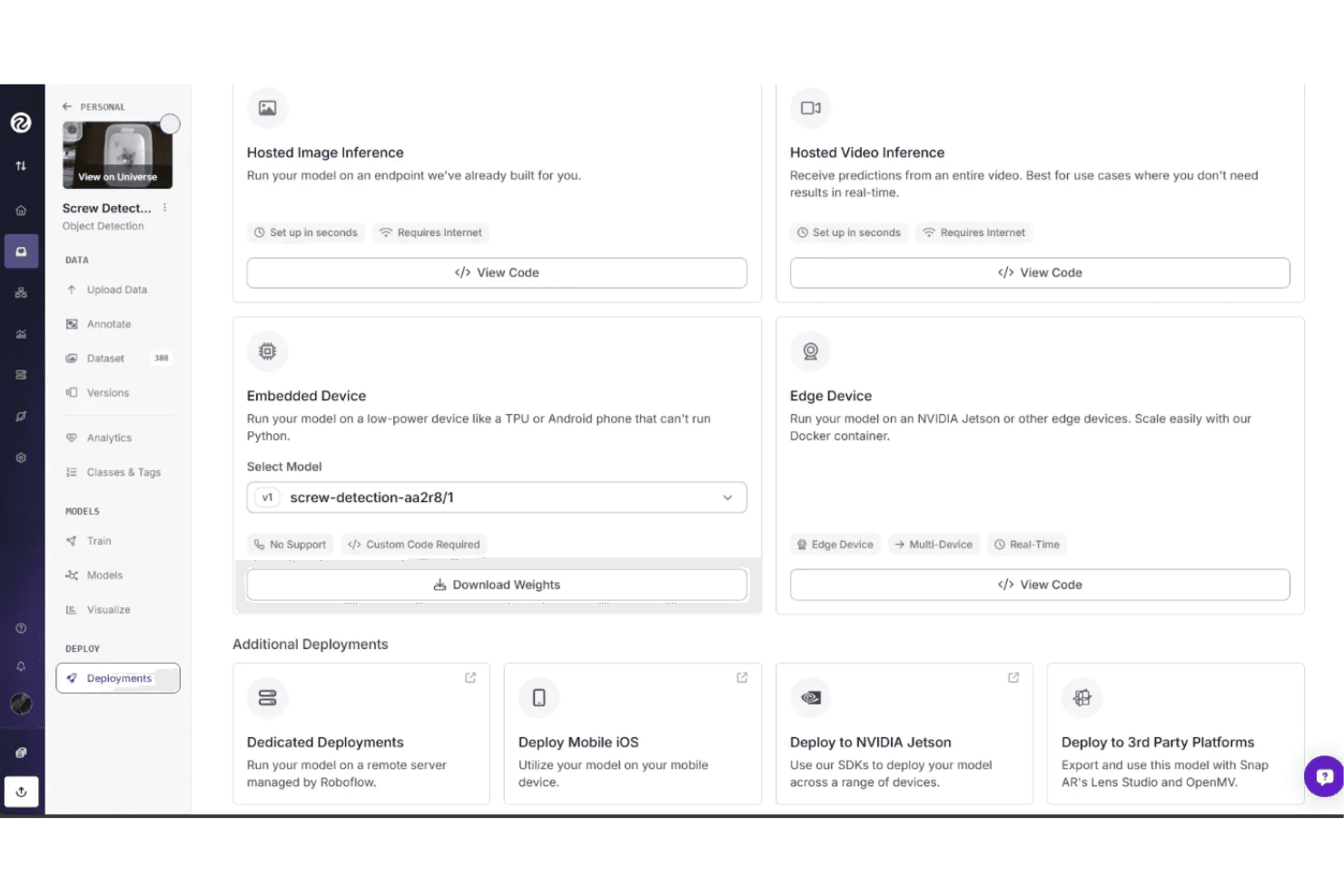
Deploy trained models seamlessly to cloud, edge devices, or on-premises environments with robust APIs and SDKs for easy integration.
Integrated Workflow Builder
Design and automate end-to-end computer vision workflows within the platform, streamlining data preparation, model training, and deployment.
Model Training
Train custom computer vision models with automated hyperparameter tuning, supporting object detection, classification, and segmentation tasks.
AI-Assisted Annotation
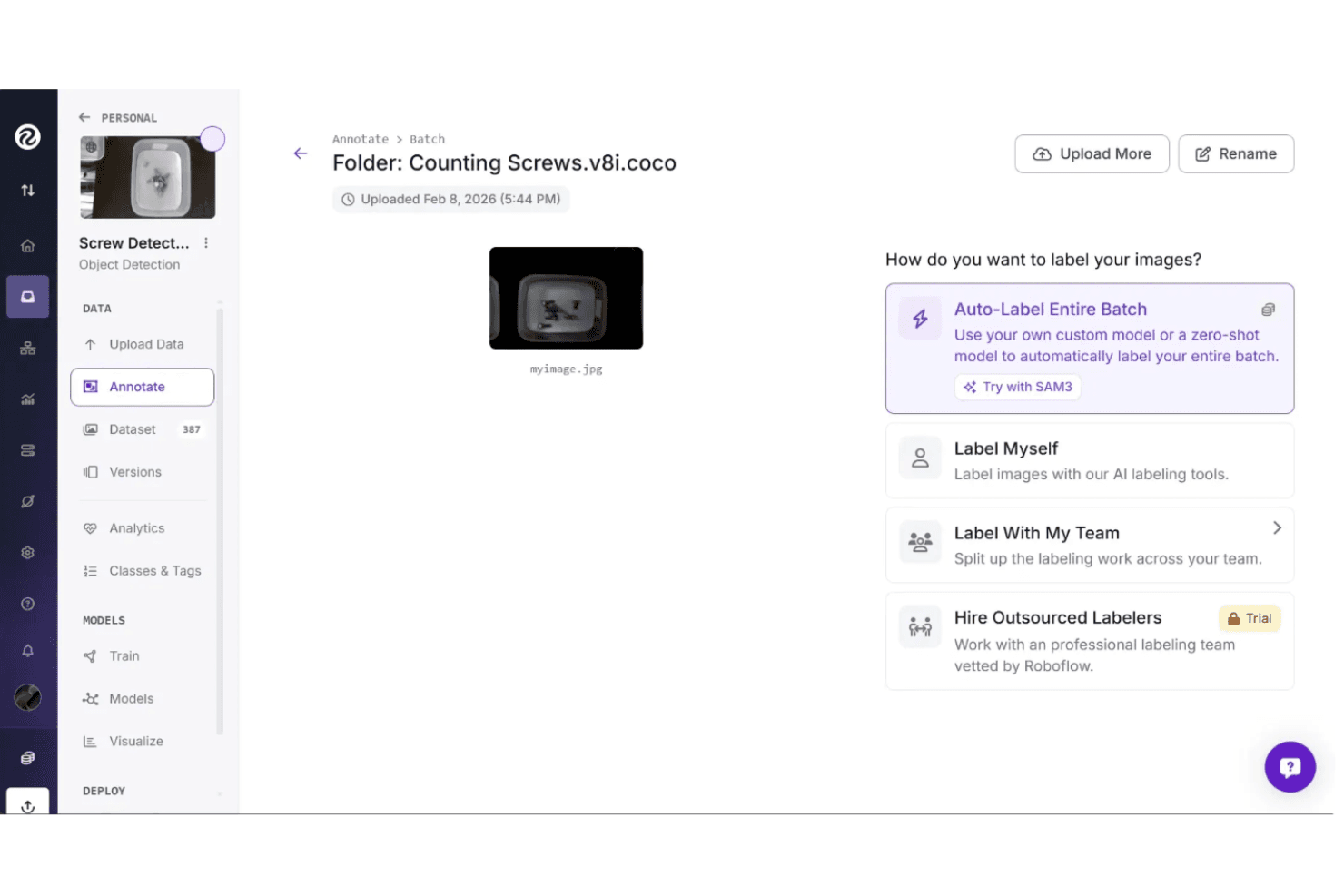
Label images efficiently using browser-based tools enhanced with AI assistance, accelerating annotation for large datasets.
Dataset Management
Upload, organize, and version image datasets in a centralized workspace, enabling collaboration and change tracking.
Managed Compute
Access managed compute to deploy workflows via serverless, batch, or dedicated infrastructure.
Standout Features
Roboflow Detection Transformer (RF-DETR)
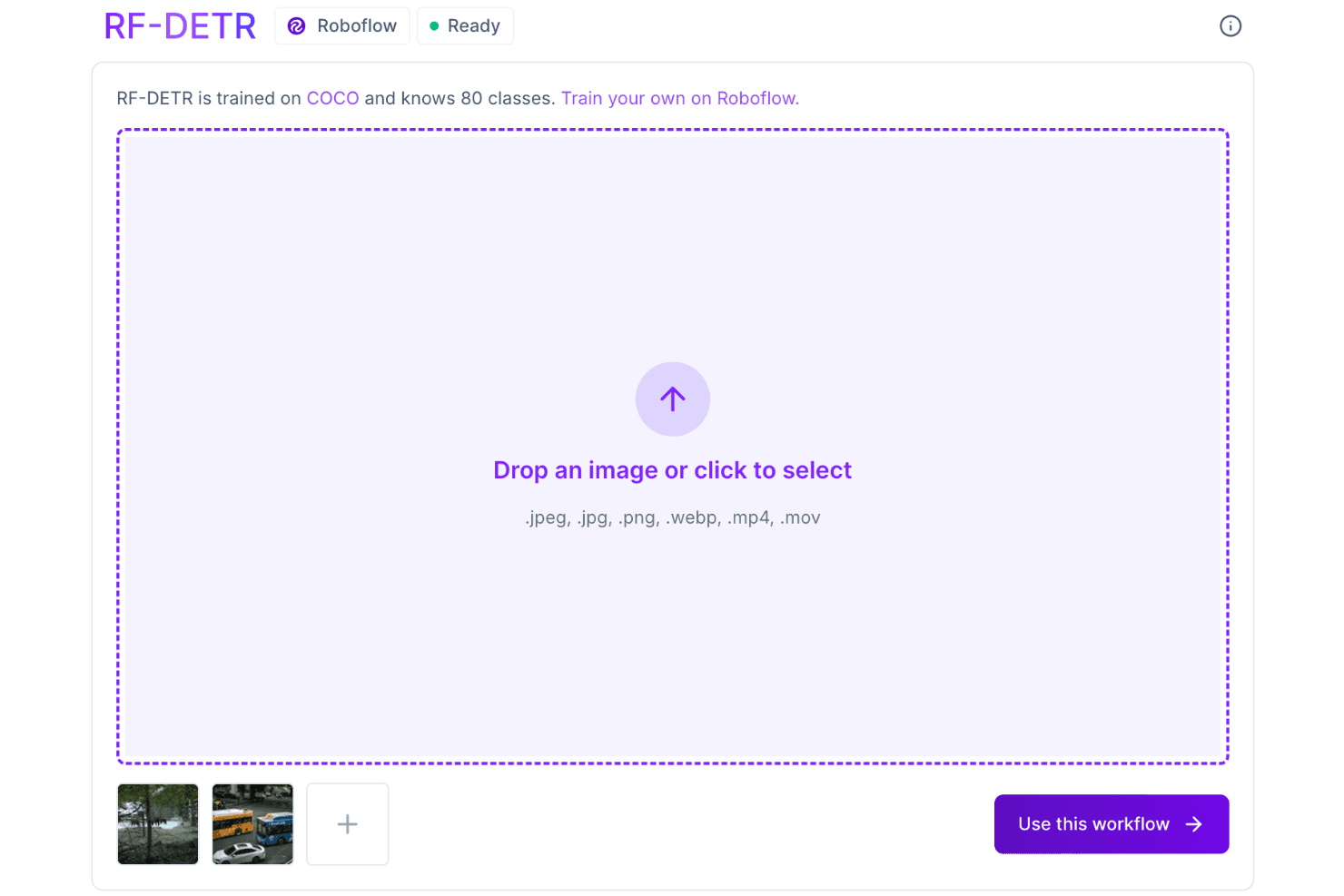
RF-DETR is a transformer-based object detection model developed by Roboflow, designed to deliver faster and more accurate image detection while integrating smoothly with Roboflow’s tools for easy training and deployment.
Serverless Video Streaming API
Use AI for live video to analyze real-time streams, detect and track objects, and support applications like security, automation, and interactive media without managing infrastructure.
Ease of Use
Roboflow is generally regarded as more user-friendly than traditional computer vision workflows. Its structured process—from dataset upload and annotation to training and deployment—helps simplify model development. The platform includes drag-and-drop workflow building, built-in annotation tools, and documentation that can reduce onboarding friction for teams. While advanced users may look for more granular customization, many teams use Roboflow for rapid prototyping and deploying computer vision applications.
Onboarding
Roboflow’s onboarding process is fast and straightforward, with most users able to upload data and start annotating within minutes. The platform offers step-by-step tutorials, extensive documentation, and an active community forum that helps new users quickly resolve issues. Clear in-app prompts guide users through each stage. This focus on accessible resources and hands-on guidance shortens the learning curve and accelerates time-to-value.
Additionally, an onboarding call is available for enterprise plans to provide personalized assistance and ensure a smooth start.

Customer Support
Roboflow earns positive feedback for its responsive, knowledgeable support team, with users often noting a quick turnaround on technical questions and issues. All users can contact support through in-app chat, email, and tickets, while Enterprise plans include priority and dedicated support. Users can also seek help through the community forum and Ask AI, which pulls answers from documentation and past discussions.

Integrations
Roboflow supports dataset imports from tools like LabelBox and CVAT, integrates with major cloud platforms including Google Cloud, AWS, and Azure, and allows model export to frameworks such as YOLO, TensorFlow, and PyTorch.
Roboflow also offers a robust API and supports connections with third-party integration tools for custom workflows.

Value for Money
Roboflow pricing provides accessible computer vision tools for teams from open-source enthusiasts to enterprise users, with a free tier for exploration and flexible paid plans that scale with project complexity and privacy needs. Users benefit from transparent features tailored to dataset size, collaboration, and deployment options, with most finding the investment worthwhile, though some note higher costs at scale.
- Free (Public): Includes data labeling with AI features, model training, workflow builder, cloud-hosted deployment, edge device sandbox, and open source data and models on Roboflow Universe. It supports 2 users with community support and includes free credits and pay-per-use credits.
- Core: Includes all Free features plus private data and models, training analytics, model evaluation, preprocessing and augmentations, concurrent model training, and the ability to download model weights. It supports 3 users with community support and includes free credits and pay-per-use credits.
- Enterprise: Includes all Core features plus commercial inference model license for edge deployment, priority access to faster cloud GPUs, role-based access control with annotation review, workflow versioning, model monitoring, and filtered model evaluation by tag. It offers custom user seats, enterprise support, and pricing.
- Available Add-Ons: Additional user seats, manufacturing inference, enterprise networking (including MQTT/OPC/PLC triggers and industrial camera frame-grabbers), deployment manager, operational insights, data labeling services, enterprise access control and data governance, custom contracting and billing, and professional services.

Roboflow Specs
- A/B Testing: No
- Analytics: Yes
- API: Yes
- Big Data: Yes
- Cloud Deployment: Yes
- Dashboard: Yes
- Data Export: Yes
- Data Import: Yes
- Data Mining: Yes
- Data Visualization: Yes
- External Integrations: Yes
- Local Deployment: Yes
- Multi-User: Yes
- Optimized Search Processing: No
- SAP Integration: No
- Sentiment Analysis: No
Roboflow FAQs
Roboflow Company Overview & History
Roboflow is a computer visionand machine learning software company headquartered in Des Moines, Iowa. The platform is used by over one million developers and thousands of organizations across industries such as manufacturing, logistics, and technology. Roboflow is known for its developer-focused tools, open source contributions, and active community. The company operates independently and has built a reputation for continuous product development and partnerships within the computer vision ecosystem.
Roboflow Major Milestones
- 2019: Founded by Joseph Nelson and Brad Dwyer in Des Moines, Iowa.
- 2020: Roboflow platform became publicly available, expanding access to computer vision tools for developers.
- 2021: Raised Series A funding and experienced significant user growth.
- 2022: Reported serving over one million developers and thousands of organizations.
- 2023: Achieved SOC 2 Type II certification and expanded enterprise security capabilities.
- 2024: Continued expanding partnerships, including participation in the AWS Partner Network.
¿Qué sigue?
Impulsa el crecimiento de tu SaaS y tus habilidades de liderazgo. Suscríbete a nuestro boletín para recibir las últimas perspectivas de CTOs y líderes tecnológicos en ascenso. ¡Te ayudaremos a escalar de manera más inteligente y a liderar con más fuerza utilizando guías, recursos y estrategias de los mejores expertos!